Frozen in Time: Discovery of a WWII Sniper’s Nest Unveils a Haunting Glimpse into the Past
Frozen in Time: Discovery of a WWII Sniper’s Nest
For more than eight decades, a secluded sniper’s nest from World War II lay hidden, sealed off from time and untouched by human presence. When historians and archaeologists uncovered it, they found not only a remarkable preservation of materials but also a poignant story frozen in place — a solitary soldier’s world of vigilance, precision, and endurance. This discovery has quickly become one of the most significant military finds of recent years, offering rare insight into the psychological and tactical dimensions of wartime snipers.
The Hidden World of the WWII Sniper
Snipers have long occupied a unique position in warfare. Their role combined immense skill and mental fortitude, often demanding isolation for long stretches of time under extreme circumstances. During World War II, both Allied and Axis armies trained marksmen to infiltrate enemy positions, using stealth and camouflage to devastating effect.
These nests were concealed within bombed-out buildings, forest foxholes, or camouflaged natural ridges — places selected not just for cover but for strategic visibility. A sniper would lie silently for hours or even days, observing the battlefield through a rifle scope, waiting for a fleeting opportunity to fire. To uncover such a location today, almost perfectly preserved, is to open a window into that tense and dangerous stillness.
A Wartime Time Capsule: What Was Found Inside
Archaeologists described the site as a “time capsule” of military life. Inside the nest were numerous personal and professional artifacts:
-
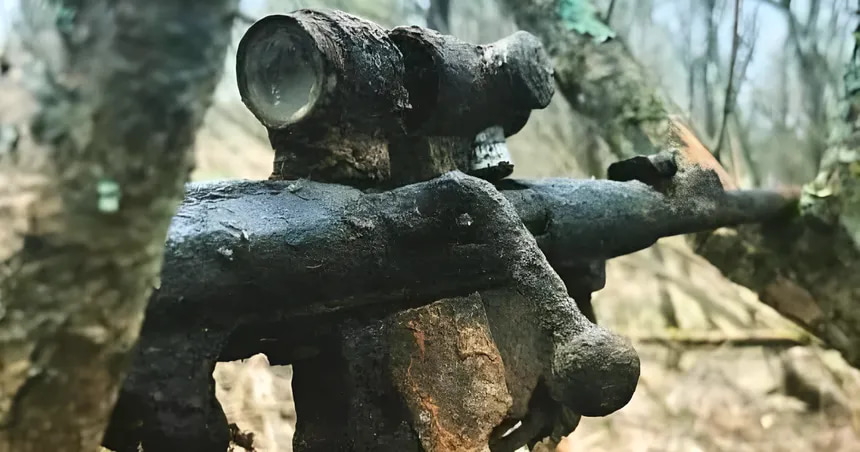
Spent shell casings lined neatly next to a rusted rifle stand
-
Ration tins, some still sealed, alongside faded remnants of paper packaging
-
A worn service cap resting where the sniper might have left it
-
Cigarette butts, matches, and a small hand mirror used for signaling or shaving
Remarkably, these items remained undisturbed since 1944 — the dust and decay forming a natural seal that preserved the scene intact. Every object tells part of a story: the ritual of maintenance, the monotony of waiting, and the invisible psychological tension that defined a sniper’s existence.
Precision and Patience: The Mind of a WWII Sniper
This discovery offers more than relics; it provides an intimate look into the mindset of a soldier trained for solitude and precision. Unlike infantrymen who fought in squads, snipers operated alone or in pairs, far ahead of their lines. Their survival depended on patience, emotional control, and a deep understanding of both terrain and human behavior.
Military historians emphasize that the mental strain of this role was enormous. Snipers had to remain motionless even as exhaustion, hunger, and weather tore at their focus. Every shot carried moral and psychological weight — a single bullet could shift the course of a skirmish or save comrades pinned under enemy fire. The preserved nest vividly illustrates the balance between deadly efficiency and vulnerable humanity.
The Strategic Significance of Sniper Nests
During World War II, snipers served not only as lethal marksmen but as psychological weapons. A skilled sniper could immobilize enemy troops by forcing them to stay under cover, disrupting advances and supply movements. Their presence alone created an atmosphere of fear and uncertainty.
Archaeological features of the newly discovered nest reveal the tactical intelligence behind its setup. The placement of the observation line, the direction of fire, and even the elevation suggest the sniper had prepared the nest with careful calculation. It was built for maximum concealment — a position from which one soldier could oversee an entire stretch of battlefield without detection.
Life Inside the Nest: The Soldier’s Story
While the exact identity of the sniper remains unknown, clues hint at a highly disciplined soldier. Uniform remnants and personal effects suggest a veteran with specialized training, possibly part of an elite reconnaissance or infantry division. The preserved rations indicate careful rationing, supporting the idea that he expected long isolation periods.
There is also a profound human story here. The items — simple, personal, and intimate — convey loneliness amid duty. The presence of a small religious medallion, found tucked inside a ration tin, implies faith served as silent company in the long hours of waiting. Such details blur the line between heroism and endurance, transforming this military relic into a deeply human testament.
From Battlefield Relic to Historical Treasure
Military archaeologists treat sites like this with the same reverence as ancient ruins. Each object is catalogued, photographed, and analyzed before being carefully preserved. The undisturbed condition of the nest has allowed researchers to reconstruct its exact use — from the trajectory of the rifle to the role of supporting items such as binoculars and maps.
Conservation experts are now employing non-invasive methods like 3D laser scanning to document the interior before removal. This ensures that even the smallest arrangement of items — the spent cartridges or the way a ration tin was opened — is recorded as evidence of wartime practice.
Illuminating the Forgotten Heroes
This find also shines light on a group of soldiers who often remain sidelined in popular retellings of World War II. While epic tank battles and sweeping offensives usually dominate textbooks, snipers played a critical yet quiet role in turning tactical outcomes.
Their influence extended beyond the battlefield. Military doctrines that emerged after the war drew heavily from sniper strategies, emphasizing precision, stealth, and reconnaissance — principles that continue to shape modern warfare.
The emotional resonance of this discovery helps reframe how history remembers such figures: not merely as sharpshooters, but as disciplined soldiers whose endurance symbolized both sacrifice and skill.
Why This Discovery Matters Today
In an age where technology dominates modern warfare, the sniper’s nest serves as a timeless reminder of the human element behind military conflict. It embodies patience, fear, and resolve — emotions as relevant to twenty-first-century soldiers as they were in 1944.
By uncovering this site, historians have not just added to the record of World War II; they have revived a lost moment frozen at the height of battle. It underscores the importance of field archaeology in military research, where even small details — a bullet casing, a tattered uniform, a scribbled note — can reshape our understanding of history.
A Silent Witness to History
Resting untouched for 81 years, the WWII sniper’s nest remains a silent witness to courage and endurance under unimaginable pressure. It stands as both a historical artifact and a tribute to the soldiers who operated in shadows, shaping the course of battles through precision and patience.
As the excavation continues, this discovery promises to reveal more about the unseen side of warfare — not the loud clashes of armies, but the stillness of one man, hidden and vigilant, waiting for the moment when history would rest on the pull of a single trigger.
ALSO READ: Mazarrón 2: The Phoenician Shipwreck That’s Rewriting Mediterranean Maritime History