The Earliest “Vehicle”? 22,000-Year-Old Drag Marks at White Sands Reveal Ancient Travois Use
Redefining Prehistoric Transport
In a discovery that shakes up our assumptions about early human ingenuity, archaeologists working at White Sands National Park in New Mexico have uncovered ancient drag marks adjacent to human footprints, dating to roughly 22,000 years ago.
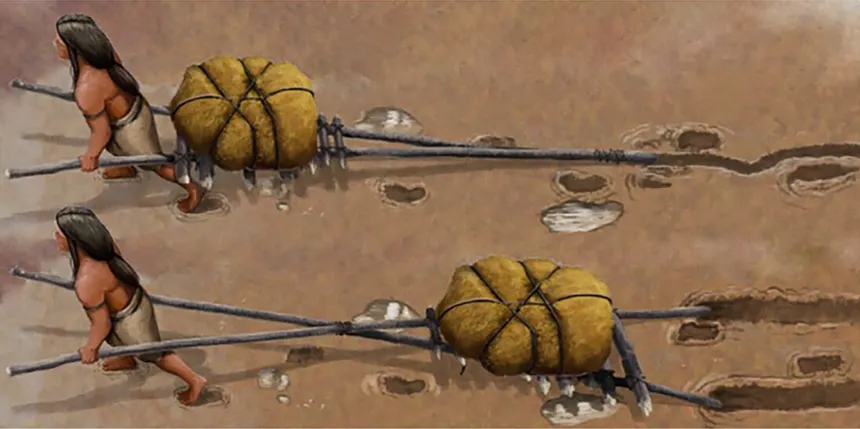
These linear grooves appear to have been made by a travois—a simple wooden sled or drag device pulled across the ground. This find offers what may be the oldest evidence of non-wheel transport technology in the Americas.
By combining footprint trails with these drag marks, this research not only rewrites potential timelines of human migration, but also reveals the resourcefulness of our ancestors in transporting heavy loads long before the invention of the wheel.
The Setting: White Sands and the Footprint Record
White Sands National Park lies in the Tularosa Basin of southern New Mexico, encompassing vast gypsum dunes and the remnants of ancient lakebeds.
Beneath the current desert sands lie hardened, fine-grained sediments once belonging to Paleolake Otero, which preserved a rich archive of footprints left on wet, muddy surfaces tens of thousands of years ago.
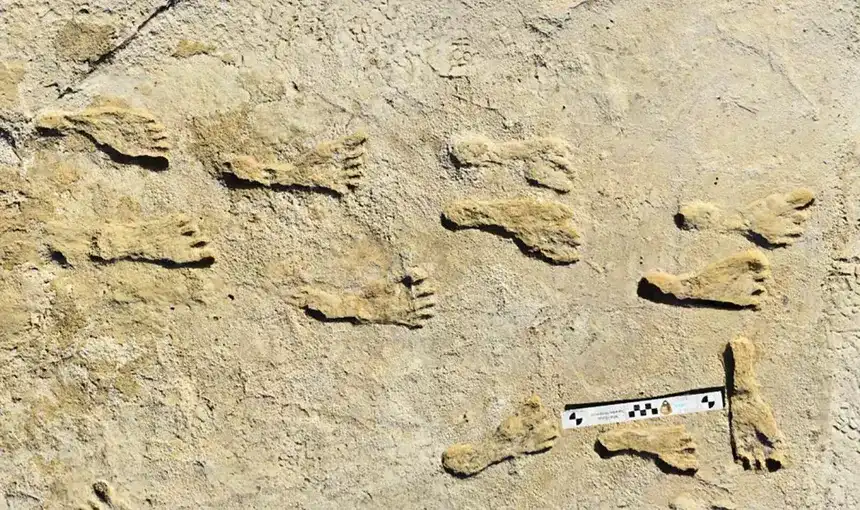
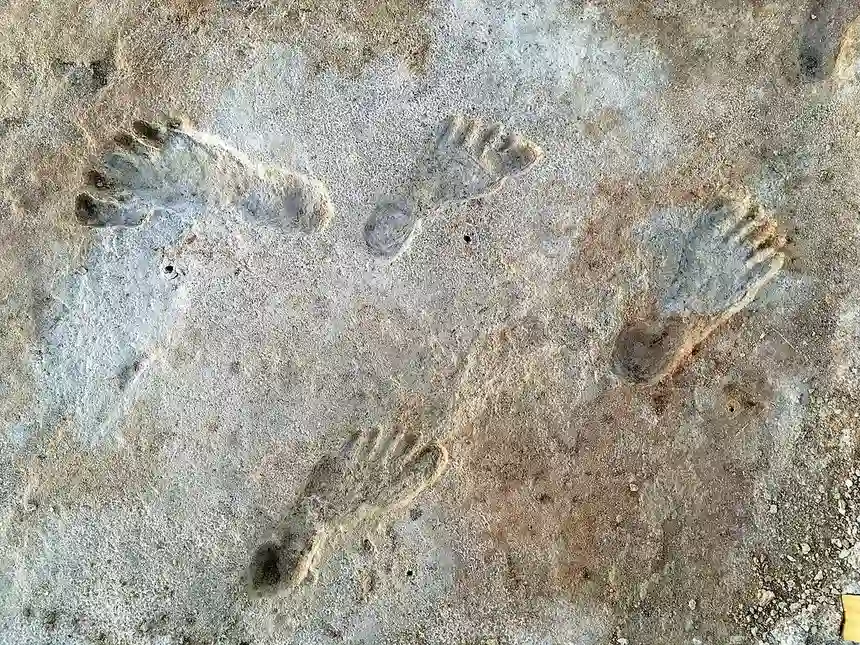
Previously, these fossilized footprints — some of which date between 21,000 and 23,000 years ago — had already challenged the traditional timeline of human arrival in the Americas.
Now, the discovery of linear drag features in direct association with human footprints pushes that story further, hinting at early transport technology capabilities beyond mere foot travel.
Discovering the Drag Marks: Patterns, Types, and Interpretation
Researchers identified three morphological types of drag traces in the sediments:
-
Type I: Narrow, deep grooves (depth > width), sometimes bifurcating, extending from 2 up to ~50 meters.
-
Type II: Broad, shallow runnels (width > depth), often in straight lines, occasionally truncating human footprints at their side.
-
Type III: Two parallel, equidistant grooves (spaced ~250–350 mm apart), tracing gently curving paths up to 30+ meters.
These drag lines frequently intersect, truncate, or run alongside human footprints, indicating they were made contemporaneously by humans moving through the same wet sediments.
To test interpretations, researchers built replicas of simple travois (wooden pole setups) and dragged them over mudflats in Dorset (UK) and along the U.S. coast. The resulting tracks matched the features seen at White Sands.
On balance, the most plausible explanation is that these drag marks were made by wooden poles or crossed poles being dragged by humans carrying loads — in effect, a travois.
Why Other Explanations Don’t Fit
Researchers carefully considered alternative origins:
-
Animal dragging: Megafauna tracks (e.g. mammoths, ground sloths) are abundant in White Sands, but their dragging behavior does not align with the precise, paired grooves or the consistent association with human footprints.
-
Floating debris or driftwood: Flotsam washed by water might leave linear marks, but the drag traces are above lacustrine sediments, not within them, making this less feasible.
-
Boat keels: Marks from watercraft are unlikely in this inland playa context and do not produce the matched pairs of parallel lines in the same pattern.
-
Firewood dragging: A single trunk or branch might leave one groove, but it doesn’t account well for the dual parallel grooves or the consistent alignment with footprints.
None of these alternatives can simultaneously explain the morphology, orientation, footprint associations, and length of the drag traces as convincingly as a human-pulled travois hypothesis.
Implications: Rethinking Prehistoric Mobility and Innovation
If this interpretation holds, it has profound implications:
-
Oldest evidence of transport technology: These traces may represent the earliest known use of a “vehicle” of any kind—predating the wheel (c. 5,000 BC) by tens of thousands of years.
-
Enhanced mobility: The ability to haul loads (game, tools, shelters, or children) would have expanded the reach, efficiency, and logistical capacity of early hunter-gatherers.
-
Early innovation in the Americas: This suggests that sophisticated ideas of load bearing and transport arose independently in early North America, not imported from Old World models.
-
Human presence timeline: The footprint dating (21,000–23,000 years) already challenged older arrival models; the drag marks support the notion of complex behaviors at those early dates.
Additionally, some drag marks extend up to 50 meters in length, showing sustained movement of loads over ground.
The pattern of footprints—some of them those of children—walking beside or between drag lines suggests that entire family groups may have migrated together, with children accompanying those pulling the load.
Challenges, Debates, and Future Research
While the travois interpretation is compelling, there are caveats and debates to be aware of:
-
Dating uncertainties: The exact age of both footprints and drag marks is still under scrutiny, as radiocarbon dating of seed layers and optically stimulated luminescence (OSL) of surrounding sediments each carry challenges.
-
Preservation biases: Wooden poles or travois would not preserve; only the indirect traces remain. This means our record is partial.
-
Regional uniqueness: It’s uncertain whether this practice was local to White Sands or widespread across early North American populations.
-
Interpretive caution: Some skeptics caution against overinterpreting the traces; morphological similarity to experiments is strong, but inferring full behavior demands further corroboration.
Nonetheless, ongoing excavations, improved dating techniques, and comparative studies in similar sedimentary contexts elsewhere may further validate or refine this extraordinary claim.
Conclusion: A New Chapter in Human Innovation
The discovery of 22,000-year-old drag marks associated with human footprints at White Sands invites us to reconsider how inventive early humans were. It suggests that long before wheels or beasts of burden, our ancestors were conceiving ways to reduce their physical burden—pulling loads with simple wooden frames across the landscape.
These traces, subtle yet powerful, echo across the millennia as one of the earliest witnesses to human problem-solving and mobility. They remind us that even in the deepest past, humans experimented, adapted, and moved with purpose across the land.
ALSO READ: The Impeccable Stonework of Sacsayhuamán — The Puzzle of the Inca Masters