The Voynich Manuscript: The Unsolved Mystery of a 15th-Century Codex
The Voynich Manuscript is one of the most perplexing artifacts in human history. Created sometime during the early 15th century, this vellum codex has defied every attempt at decipherment. The indecipherable text, fantastical illustrations, and mysterious origins make it a masterpiece of historical intrigue. Preserved today at Yale University’s Beinecke Rare Book and Manuscript Library, it continues to mystify linguists, historians, and cryptographers even in the age of artificial intelligence.
The Origins and Discovery of the Voynich Manuscript
Scholars trace the manuscript’s origin to Northern Italy between 1404 and 1438, based on carbon dating of the vellum pages. Its early history remains shrouded in mystery, as no one knows who wrote it, for what purpose, or in what language. The manuscript resurfaced in 1912 when Polish book dealer Wilfrid Voynich purchased it from the Jesuits of the Villa Mondragone near Rome. He devoted much of his life to uncovering its secrets but died without success.
Wilfrid Voynich’s name has since become forever linked with the codex, which was later donated to Yale University. Today, researchers from around the world continue to analyze it using the latest imaging and AI tools, but the text remains unreadable.
What’s Inside the Voynich Manuscript?
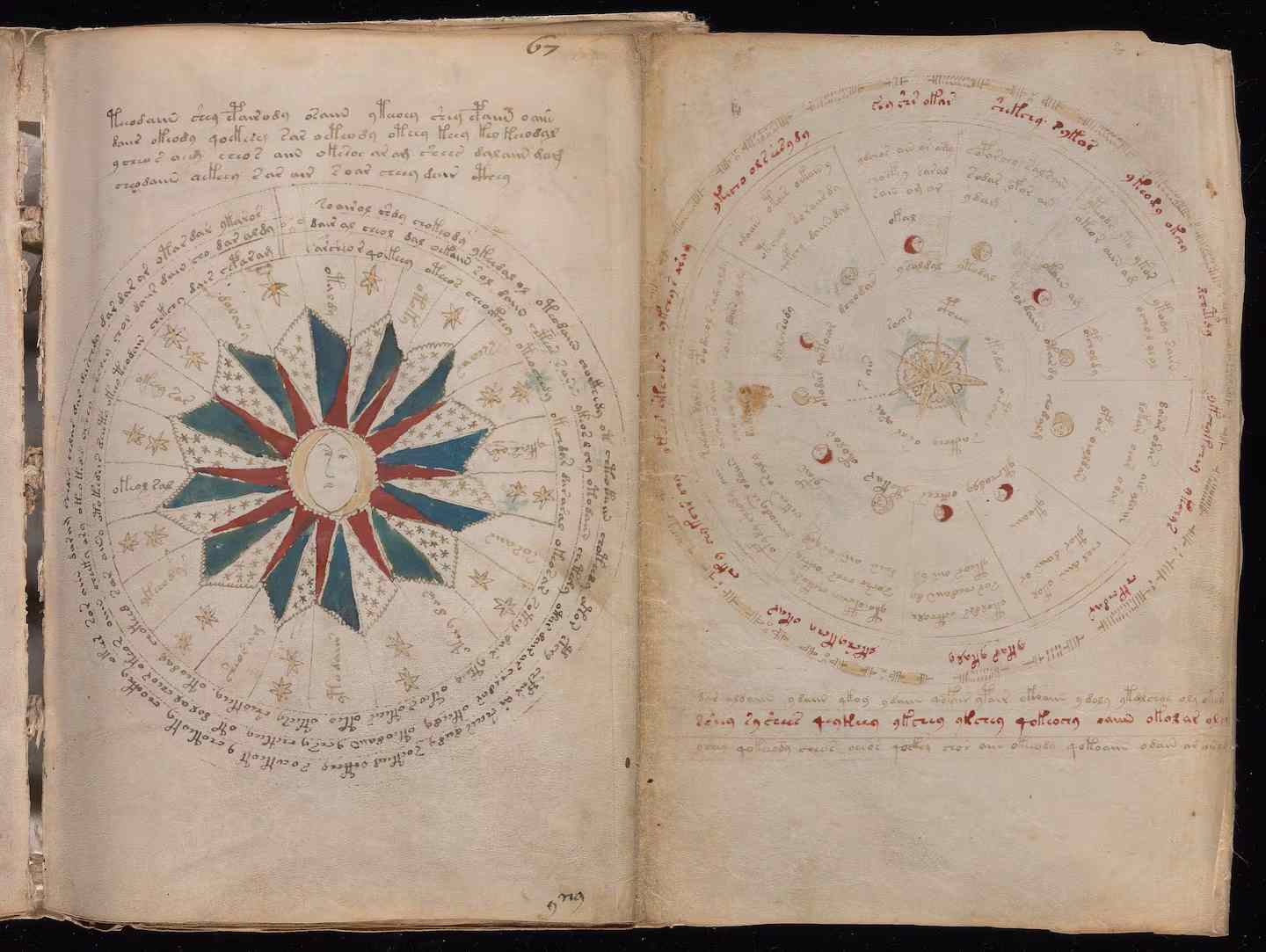
The book contains approximately 240 pages of vellum, intricately illustrated with unknown plants, astronomical charts, and naked female figures immersed in strange green fluids. The content is divided into several sections, each focusing on distinct themes that suggest unique purposes or studies. These sections include:
-
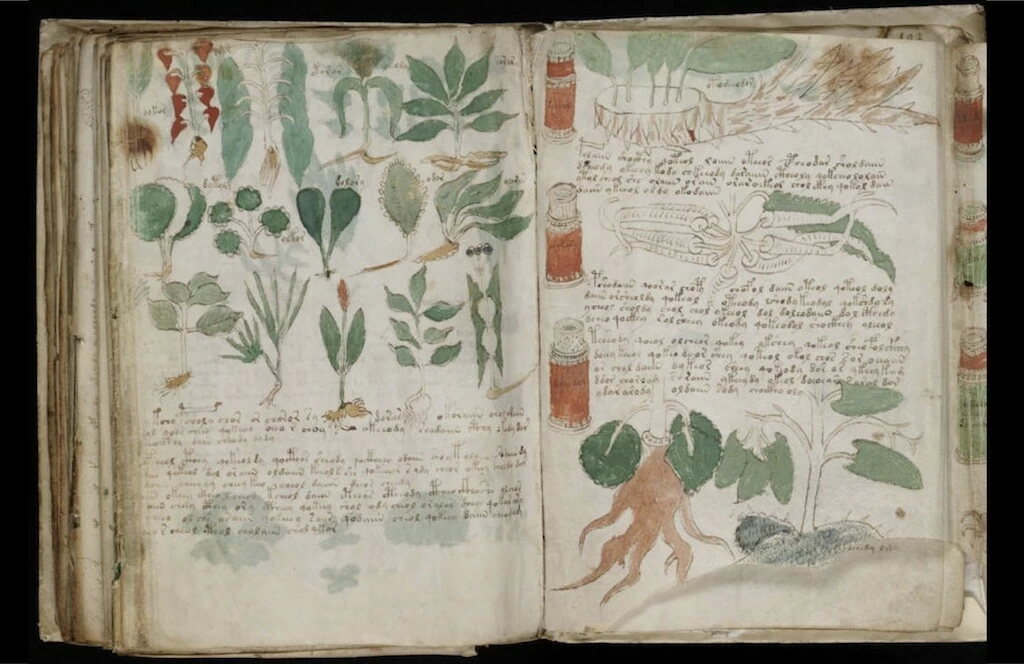
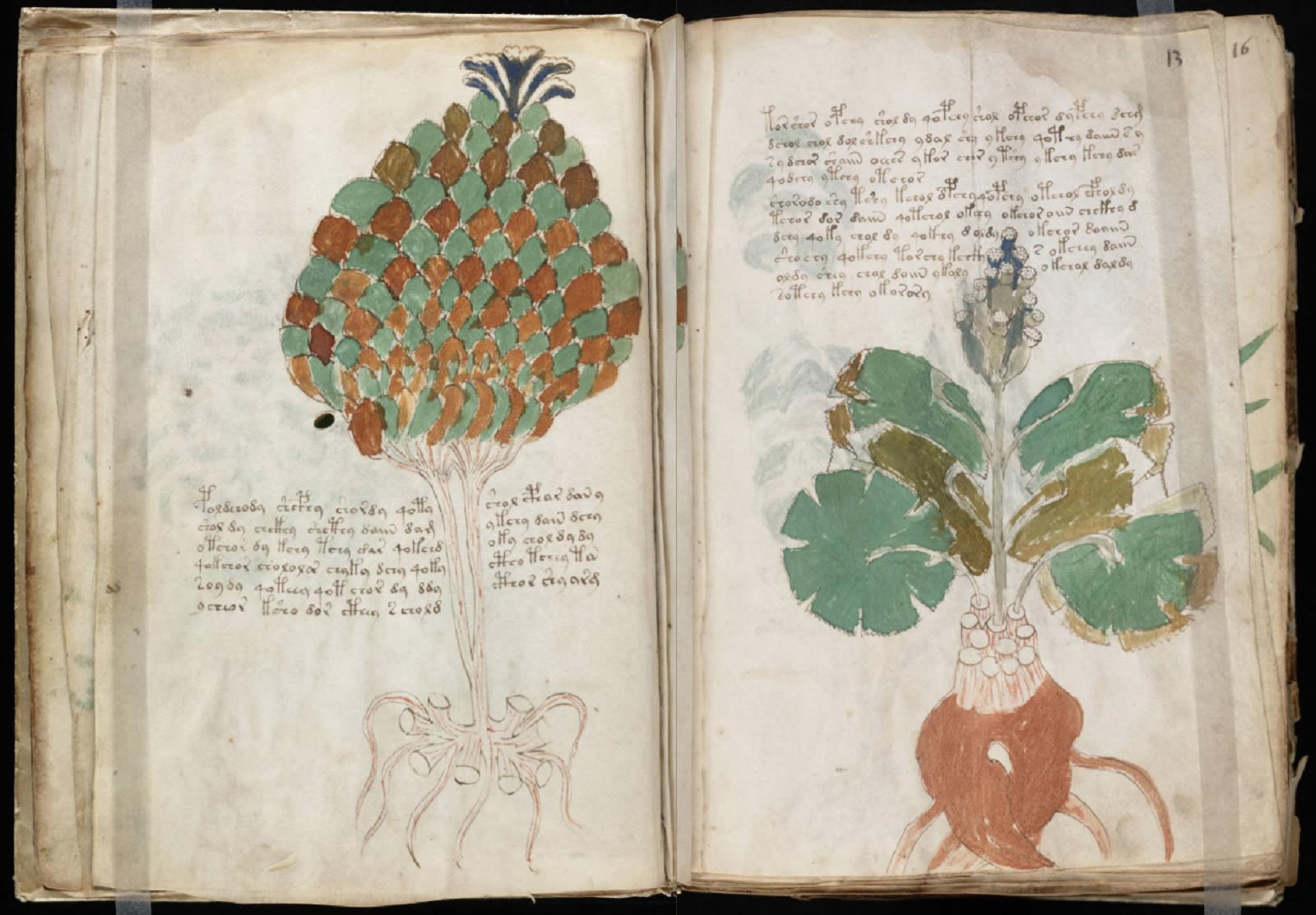
Botanical section: Filled with illustrations of unrecognizable plants, possibly imaginary or symbolic species.
-
Astronomical section: Depicts zodiac-like symbols, celestial diagrams, and cosmological patterns.
-
Biological section: Shows naked women bathing in pools connected by pipes, possibly representing anatomy, alchemy, or fertility.
-
Pharmaceutical section: Contains drawings of herbs and vessels, hinting at medieval medicine or herbalism.
-
Recipes section: A series of short paragraphs accompanied by stars, likely a list of instructions or spells.
The script itself appears to be written in a unique language or code, dubbed “Voynichese,” consisting of about 25 distinct characters written with consistency throughout the manuscript.
The Enigmatic Script: A Language No One Can Read
The script of the Voynich Manuscript is what makes it legendary. Statistical analysis shows that the text follows predictable linguistic patterns, as though it were a real language. Yet, it does not match any known alphabet, language family, or cipher system.
Throughout the 20th and 21st centuries, experts and amateur codebreakers have attempted to translate it. The most notable efforts came from cryptographers at the National Security Agency (NSA) during the Cold War era. Even with advanced cryptanalytic techniques, the manuscript resisted all interpretation.
Some researchers argue that the text may be a sophisticated hoax—an elaborate fabrication designed to deceive Renaissance scholars and patrons. Others believe it conceals medical or alchemical knowledge encrypted to protect its secrets from the uninitiated.
Theories About the Author and Purpose
Over the decades, numerous theories have emerged about who wrote the Voynich Manuscript and why. Among the more famous hypotheses are:
-
A coded alchemical text: Possibly created by an alchemist documenting secret knowledge of transformation and healing.
-
A lost scientific treatise: Written by a medieval scholar in a now-extinct language or cipher.
-
A hoax for profit: Produced to impress or deceive noble patrons seeking rare and mystical works.
-
An early constructed language: Some linguists propose it could represent an artificial language like Esperanto, but centuries earlier.
-
A mental or neurological creation: Others suggest it might be the product of an isolated mind, producing complex yet meaningless patterns.
No theory fully explains all aspects of the manuscript, and each discovery seems to raise more questions than it answers.
Modern Decoding Efforts and Artificial Intelligence
In recent years, digital imaging and AI analysis have breathed new life into Voynich research. Teams of computer scientists, cryptologists, and linguists have used machine learning models to identify textual patterns and possible linguistic roots.
Some studies claim to detect faint traces of Latin, Old Turkish, or Hebrew, while others argue the structure resembles constructed or hybrid languages. Still, no consensus has emerged. Each AI-based breakthrough has so far failed under scrutiny, reinforcing the manuscript’s reputation as an unsolved riddle.
Digitization by Yale University has made high-resolution scans publicly available, allowing global collaboration and fresh perspectives. This digital accessibility is crucial, as new generations of researchers apply interdisciplinary methods—from medieval botany to computational linguistics—to tackle the enduring puzzle.
The Illustrations: Science, Symbolism, or Fantasy?
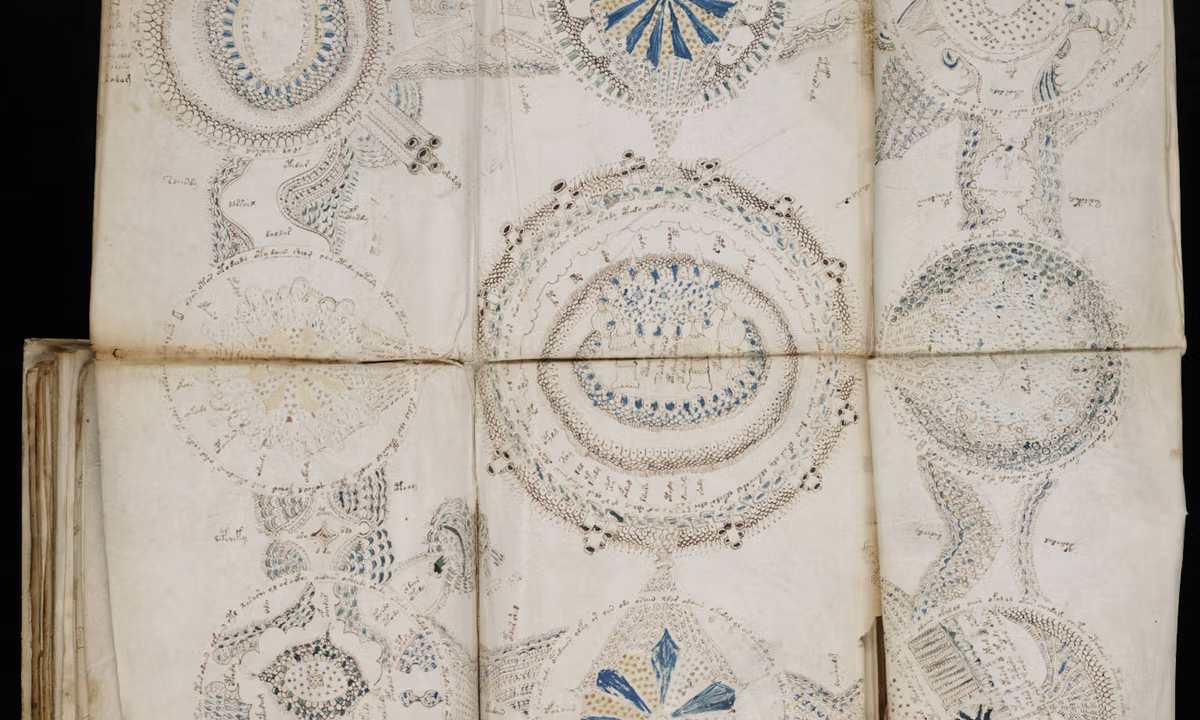
The drawings within the Voynich Manuscript are as mysterious as the text. Some depictions resemble known herbal illustrations from medieval medical texts, while others show plants that do not exist in nature. Similarly, the astronomical charts include renditions of stars and zodiac signs, but arranged in unfamiliar patterns.
The imagery might represent coded symbolism rather than direct observation. The female figures interacting with strange contraptions or bathing in interconnected basins invite speculation about fertility rituals, biological cycles, or spiritual rebirth.
Historians often compare its style to other illuminated manuscripts of the late medieval period but admit that nothing directly parallels its content or style.
A Mirror of Human Curiosity
The ongoing fascination with the Voynich Manuscript says much about the human desire to understand the unknown. It serves as a bridge between medieval mystery and modern science. The codex stands as a testament to creativity, intellect, and the limits of interpretation—reminding us that some aspects of history may forever remain unsolved.
For historians, linguists, and cryptographers, it represents the ultimate challenge: an undeciphered message that may contain lost knowledge or, perhaps, nothing at all. Whatever its origin, the manuscript has transcended time, becoming a symbol of enduring mystery that continues to inspire curiosity in every generation.
Conclusion: The Legacy of an Enigmatic Masterpiece
Over six centuries after its creation, the Voynich Manuscript continues to defy explanation. Whether it hides an ancient scientific code or stands as an unparalleled historical puzzle, its enigma endures. Each failed attempt to read it only adds to its allure.
Digitally preserved at Yale, the manuscript remains accessible to scholars and enthusiasts alike. As technology advances, perhaps one day its secrets will be revealed. Until then, it remains one of humanity’s most captivating riddles—a mirror reflecting our eternal quest to decode the past.
ALSO READ: The Tărtăria Tablets: Europe’s Mysterious Ancient Script