Vancleavea campi: The Enigmatic Late Triassic Reptile
The Late Triassic period, roughly 237 to 201 million years ago, was a time of incredible evolutionary experimentation. Reptiles flourished across the globe, occupying terrestrial, aerial, and aquatic niches. Among this diverse menagerie was a truly puzzling creature—Vancleavea campi, a semi-aquatic reptile whose unusual anatomy continues to intrigue paleontologists.
First discovered in the American Southwest, Vancleavea was not a dinosaur, crocodile, or lizard, but an enigmatic member of the archosauriform lineage, distantly related to modern crocodilians and birds. Its heavily armored body, unique skull features, and specialized adaptations set it apart from any other reptile known from the Triassic.
In this article, we will explore the discovery, anatomy, evolutionary significance, and enduring mystery of Vancleavea campi, one of the most fascinating reptiles of the Triassic world.
Discovery of Vancleavea campi
First Finds
The first fossils attributed to Vancleavea were discovered in the Late Triassic Chinle Formation of the southwestern United States, particularly in New Mexico and Arizona. The genus was formally described in 1995 by paleontologists Long and Murry, who recognized its distinctiveness from other known reptiles.
Ghost Ranch Specimen
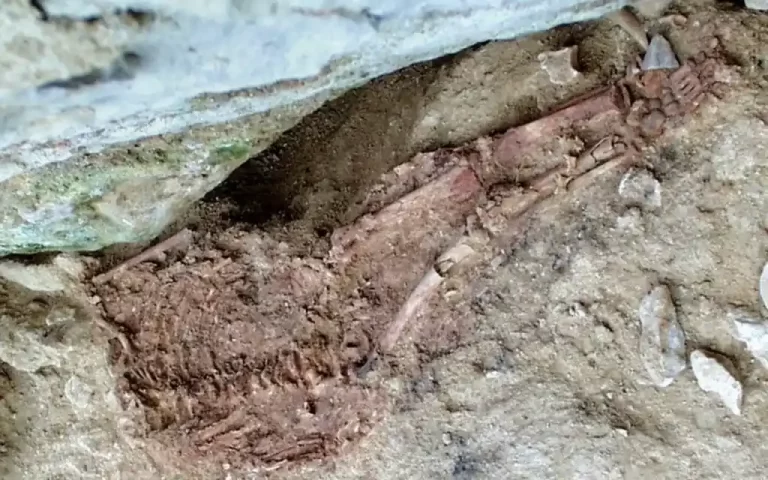
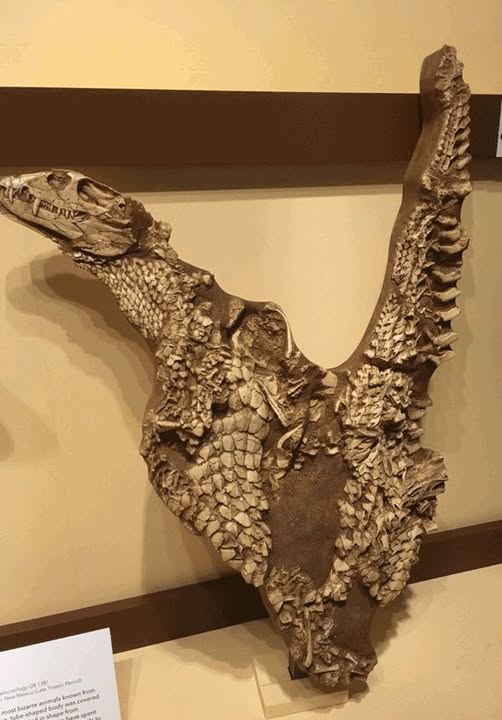
The most complete and informative specimen of Vancleavea campi was later unearthed at Ghost Ranch, New Mexico, a site already famous for its rich deposits of Triassic fossils, including early dinosaurs like Coelophysis. The Ghost Ranch specimen revealed much of the skeletal anatomy, helping researchers reconstruct the animal’s appearance and lifestyle.
Anatomy of Vancleavea campi
General Body Plan
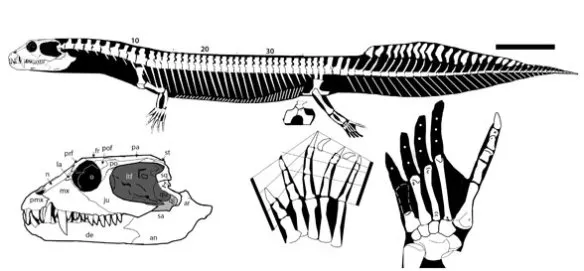
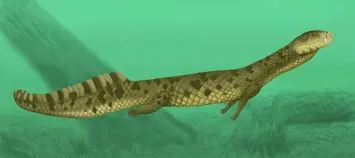
Vancleavea was a semi-aquatic reptile, measuring about 1.2 meters (4 feet) in length. Its body was elongated, with relatively short limbs, suggesting that it was adapted more for swimming than for running on land.
Armor and Osteoderms
One of the most striking features of Vancleavea was its heavy armor. Its body was covered in osteoderms—bony plates embedded in the skin. These included:
-
Dorsal osteoderms forming a protective shield along the back.
-
Lateral plates arranged along the sides of the body.
-
Tail osteoderms that likely assisted in swimming.
This unique arrangement gave Vancleavea a heavily fortified appearance, protecting it from predators while also stabilizing its body in aquatic environments.
Skull and Head Features
Vancleavea’s skull is unlike that of any other Triassic reptile. Distinctive traits include:
-
A robust jugal bone (cheek bone), a feature rarely emphasized in other reptiles.
-
Elongated jaws with sharp teeth suited for catching fish and small aquatic prey.
-
Reduced skull fenestration (openings), contributing to its odd appearance compared to typical archosauriforms.
Limbs and Tail
-
Limbs: Relatively short, suggesting limited efficiency for terrestrial locomotion.
-
Tail: Laterally compressed and equipped with specialized osteoderms, functioning as a powerful swimming organ similar to that of modern crocodiles.
Lifestyle and Ecology
Habitat
Vancleavea lived in the river systems, lakes, and floodplains of Late Triassic North America, particularly within the Chinle Formation. This environment was a lush ecosystem supporting early dinosaurs, crocodile-like phytosaurs, amphibians, and numerous fish species.
Diet
With its sharp teeth and aquatic adaptations, Vancleavea was likely a carnivore or piscivore, feeding primarily on fish, amphibians, and small vertebrates. Its streamlined body and tail made it an efficient predator in water.
Role in the Ecosystem
Vancleavea occupied a niche similar to that of modern crocodilians, though it was not a crocodile. As a mid-level aquatic predator, it balanced the ecosystem by controlling fish and amphibian populations while itself being vulnerable to larger predators like phytosaurs and early theropods.
Evolutionary Significance
An Enigmatic Archosauriform
Vancleavea belongs to Archosauriformes, the larger group that includes crocodiles, dinosaurs, and birds. However, its exact position within this lineage remains debated. It does not fit neatly into any known family, making it a paleontological puzzle.
Unique Adaptations
Its heavily armored body, distinctive skull, and aquatic adaptations highlight the evolutionary experimentation of the Triassic. While many archosauriforms were moving toward land dominance or aerial adaptation, Vancleavea chose a different path—thriving in aquatic habitats.
Importance to Science
Studying Vancleavea helps paleontologists:
-
Understand the diversity of Triassic reptiles.
-
Explore the evolutionary origins of semi-aquatic lifestyles.
-
Reconstruct ecological dynamics before the rise of dinosaurs to dominance.
Fossil Distribution
The remains of Vancleavea have been found primarily in the Chinle Formation, a geologic formation stretching across Arizona, New Mexico, Utah, and Colorado. Key sites include:
-
New Mexico (Ghost Ranch): Most complete specimens.
-
Arizona: Fragmentary remains.
-
Other localities across the American Southwest.
These discoveries highlight the widespread distribution of Vancleavea across western North America during the Late Triassic (Norian stage, ~210–205 million years ago).
Vancleavea at Ghost Ranch: A Paleontological Treasure
The Ghost Ranch specimen remains the most significant discovery of Vancleavea campi. It preserves nearly the entire skeleton, including the skull and armor, allowing paleontologists to accurately reconstruct its anatomy.
Ghost Ranch has produced numerous other iconic fossils, but the Vancleavea specimen stands out for its uniqueness. It reinforces the idea that the Late Triassic was a time of extraordinary reptilian experimentation, with many unusual lineages thriving before the dominance of dinosaurs.
Modern Interpretations and Research
Since its formal description, Vancleavea has been the subject of extensive research and debate. Paleontologists continue to study its anatomy and evolutionary placement using advanced imaging techniques and comparative analysis.
Some questions remain unresolved:
-
Where exactly does Vancleavea fit in the archosauriform family tree?
-
Was it more closely related to early crocodile ancestors or an independent offshoot?
-
What does its unique armor and anatomy reveal about convergent evolution in aquatic reptiles?
These questions keep Vancleavea at the forefront of Triassic paleontology.
Vancleavea in Museums and Exhibits
Casts and reconstructions of Vancleavea campi fossils are displayed in several museums, including exhibitions in the United States and internationally. At the New York (USA) exhibits, visitors can view a detailed fossil cast showcasing the distinctive osteoderms, providing an incredible glimpse into this armored reptile’s unusual design.
Educational programs often highlight Vancleavea as an example of evolutionary experimentation and diversity during the Triassic, helping the public appreciate life before the age of dinosaurs.
Conclusion
The story of Vancleavea campi is one of mystery, adaptation, and survival. This Late Triassic semi-aquatic reptile, with its armored body and unique skull, defies simple classification. Neither dinosaur nor crocodile, it represents a fascinating evolutionary branch that thrived in ancient North America’s rivers and lakes.
Discovered in places like Ghost Ranch in New Mexico, Vancleavea reminds us that prehistoric ecosystems were far more diverse and complex than often imagined. Its enigmatic anatomy challenges paleontologists to think beyond conventional categories, illustrating the endless possibilities of evolution.
Today, whether seen in a museum exhibit or studied in scientific literature, Vancleavea campi continues to inspire curiosity and wonder. It stands as a powerful reminder of Earth’s deep past and the extraordinary forms life has taken along the journey of evolution.
ALSO READ: Throne of the Gods: The Mystical Majesty of Mount Nemrut