The Tomb of Grotte Scalina: Etruscan Mystery with Macedonian Ties
A Forgotten Tomb with Royal Echoes
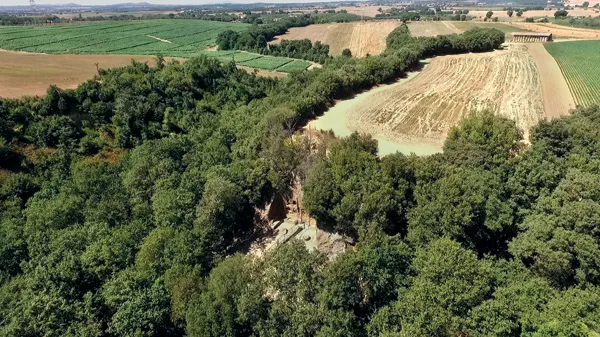
In the quiet countryside of Lazio, Italy, an ancient Etruscan tomb lies carved into the bedrock—a seemingly solitary monument, but one steeped in powerful legacy, mystery, and historical intrigue. Known as the Tomb of Grotte Scalina, this monumental grave stands just 1.55 km north of Musarna, an Etruscan settlement established in the 4th century BC.
Though buried in obscurity for nearly a century, the tomb is now at the heart of a growing body of research linking it to the Macedonian court of Alexander the Great and, surprisingly, to medieval pilgrimages that crossed the Italian landscape over a thousand years later. Is this imposing structure simply the resting place of a local elite—or could it have one final secret left to unveil?
Tarquinia and the Dodecapolis: Guardians of Etruscan Independence
To understand Grotte Scalina, we must begin with Tarquinia, one of the 12 Etruscan city-states that formed the Dodecapolis—the league of Iron Age Etruria. Situated about 100 km north of Rome, Tarquinia was a cultural, political, and military powerhouse, particularly during the 6th to 4th centuries BC.
Its influence extended far beyond its seaside perch. Tarquinia controlled vast agrarian estates that stretched as far east as the River Tiber, and it led military resistance against growing Roman expansion. The city’s elites were not only powerful landowners but also cultural patrons, building fortified satellite towns like Musarna to maintain territorial control.
Musarna: A Military and Agricultural Stronghold
Located about 40 km from Tarquinia, near the modern town of Viterbo, Musarna was founded around 320 BC, during the height of Roman aggression in Etruria. Unlike many scattered farmsteads, Musarna was a planned settlement, laid out with a grid-like structure of public buildings, private homes, and a fortified perimeter.
What makes Musarna especially intriguing is its sophisticated defensive system. Archaeological excavations revealed a formidable moat, followed by a robust city wall supported by an earthen embankment—designs that mirrored Greek siege technology. It’s evidence of a city prepared for war but sustained by agriculture, where citizen-soldiers balanced farming with martial duty.
A Tomb Apart: Monument of Grotte Scalina
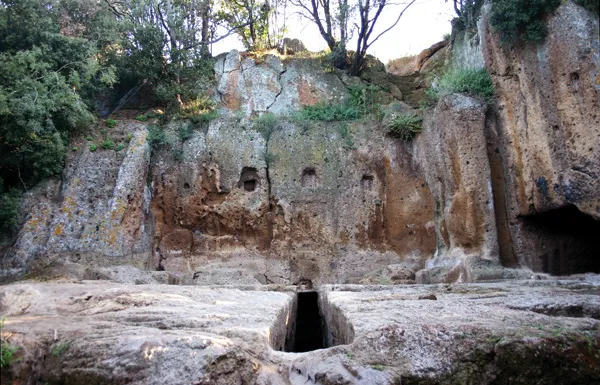
Just a short distance north of Musarna, nestled in the countryside, stands the Tomb of Grotte Scalina—a monumental rock-cut tomb with no known parallel in the region. It was first sketched in the early 1900s by Viterbo-born archaeologist Luigi Rossi Danielli. His drawing depicted:
-
A single-storey rock façade
-
A false central door
-
A pilaster (column-like projection) to the right
-
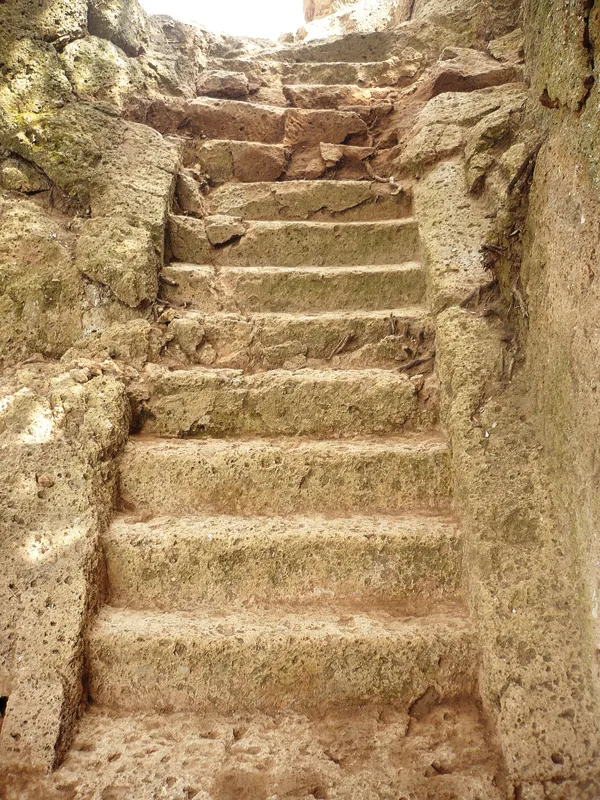
A massive stone stairway on the left
Below this imposing façade was a small burial chamber, modest in size but symbolically rich in design.
Oddly, despite the tomb’s monumental scale and unique structure, its location was lost for nearly a century in a region dense with tombs, tomb raiders, and archaeological activity. It was rediscovered only in 1998, and proper excavation began in 2009 under the auspices of the Centre national de la recherche scientifique (CNRS) and the Soprintendenza Archeologica per l’Etruria Meridionale.
Architectural Enigma: Macedonian Influence?
What sets the Tomb of Grotte Scalina apart is not just its isolation but its architectural style, which resembles funerary monuments from Macedonia during the time of Alexander the Great. Scholars believe this tomb may reflect:
-
Elite Hellenistic taste imported from Greek or Macedonian traditions
-
A desire by the Etruscan nobility to align themselves with the powerful and cosmopolitan Macedonian world
-
Shared military and artistic influences between the Etruscans and Hellenistic cities during the 4th–3rd century BC
The tomb’s false door and formal symmetry are symbolic features often found in Greek and Macedonian tombs. An attempt to mark the transition between life and death with architectural permanence.
This stylistic fusion adds a layer of political intrigue: was the tomb’s occupant someone who had direct connections to the Macedonian court? Or was it simply a way to display wealth, power, and cultural sophistication in the face of Rome’s advancing dominance?
Pilgrims in the Dark Ages: A Medieval Mystery
Even more fascinating is the tomb’s post-Etruscan life. Archaeological evidence suggests that the Tomb of Grotte Scalina became a site of medieval pilgrimage. Likely during the 7th–10th centuries AD. This period saw many ancient structures repurposed by Christian travelers, monks, or mystics. Who believed these ruins held spiritual power or divine protection.
Perhaps it was the tomb’s monumental stairway or its mysterious facade that inspired awe. Some scholars suggest it may have been used as a shelter. A hermit’s retreat, or even as a religious shrine, possibly dedicated to a local saint or martyr.
This unusual continuity of reverence—from an elite Etruscan family to anonymous medieval travelers. Raises a compelling question: what ancient energy or symbolism did this tomb preserve across centuries?
Unanswered Questions and Future Research
Despite increasing scholarly attention, the Tomb of Grotte Scalina remains largely unexplored. Many questions remain:
-
Who was buried here? Was the tomb constructed for a Tarquinian noble with Macedonian ties?
-
What do the tomb’s architectural elements truly signify?
-
Could further excavation uncover inscriptions, grave goods, or additional chambers?
-
And finally, why did the tomb attract pilgrims a thousand years later?
The ongoing collaboration between French and Italian archaeologists promises new insights, and perhaps, one last secret yet to be revealed.
Conclusion: An Enduring Enigma in Stone
The Tomb of Grotte Scalina is not just an ancient grave. It’s a time capsule of cultural, political, and spiritual history. Bridging Iron Age Etruria, Hellenistic influence, and medieval devotion. Set amid olive groves and rolling hills near Musarna. It stands as a lonely monument to forgotten lives, ancient rivalries, and the enduring mystery of human legacy.
For now, its doors remain closed, but the story is far from over. As excavation continues, the tomb may yet whisper new truths from the stone chambers of the past.
ASLO READ: Dramatic Predator-and-Prey Fresco Restored at the House of the Ceii, Pompeii