The Little Boy and the Red Tricycle: A Hiroshima Story That Changed Humanity
On August 6, 1945, Hiroshima awakened under a clear blue sky. In one small neighborhood, three-year-old Shinichi Tetsutani rode his bright red tricycle, a precious gift lovingly restored by his uncle. He was just ten days away from his fourth birthday. Moments later, the first atomic bomb used in war—Little Boy—was dropped less than two kilometers away, forever changing the course of history and turning a child’s playtime into one of the most haunting memories of humanity.
The Boy Who Loved His Red Tricycle
Shinichi, affectionately called “Shin-chan,” was a typical child—curious, playful, and full of laughter. His favorite possession was his red tricycle, which he often rode around the yard with his friend Kimi. Like many Japanese families during the final months of World War II, Shinichi’s family lived modestly. His father had once struggled to find a tricycle, as Japan’s wartime metal shortages had consumed even household goods. Shinichi’s uncle, serving in the navy, eventually found an old tricycle and repaired it for him—a simple act of love that would later become a profound symbol.
8:15 A.M.—The Flash That Ended Innocence
At exactly 8:15 a.m., the atomic bomb detonated over Hiroshima. A massive flash swallowed the morning sky, followed by a roaring shockwave of heat and fire that destroyed buildings, vaporized metal, and silenced thousands of lives in seconds. Shinichi was trapped under the debris of his family home, badly burned but still clutching the handlebars of his tricycle. His friend Kimi was lost in the rubble, and his two older sisters, Michiko and Yoko, were pinned under a burning beam.
When his parents found Shinichi, he was alive but gravely injured. His small voice barely whispered, asking for water, yet his father remembered seeing people die after drinking contaminated water. Torn by heartbreak, his father refused him water, holding him in his arms as he took his final breath that night.
The Backyard Burial: Love in the Shadow of Tragedy
Hiroshima in the aftermath of the bombing was a hellscape: scorched earth, burning homes, and cries of the wounded. Amid the devastation, Shinichi’s father made the painful choice to bury his son in the family garden, alongside Kimi and the red tricycle. He could not bear the thought of cremating such a small body amid the chaos. He wrapped the boy in a blanket, placed his beloved toy beside him, and whispered goodbye.
For forty years, the tricycle lay buried with the child who once rode it under summer skies. The garden slowly healed, but the memory never faded.
Rediscovery: A Father’s Memory Unearthed
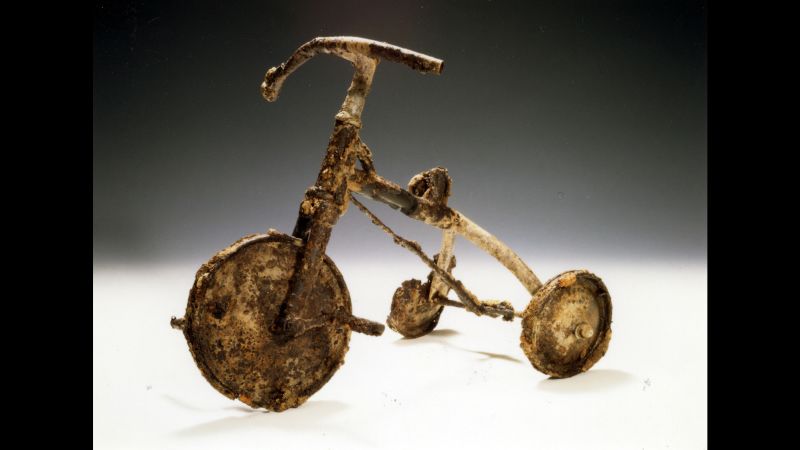
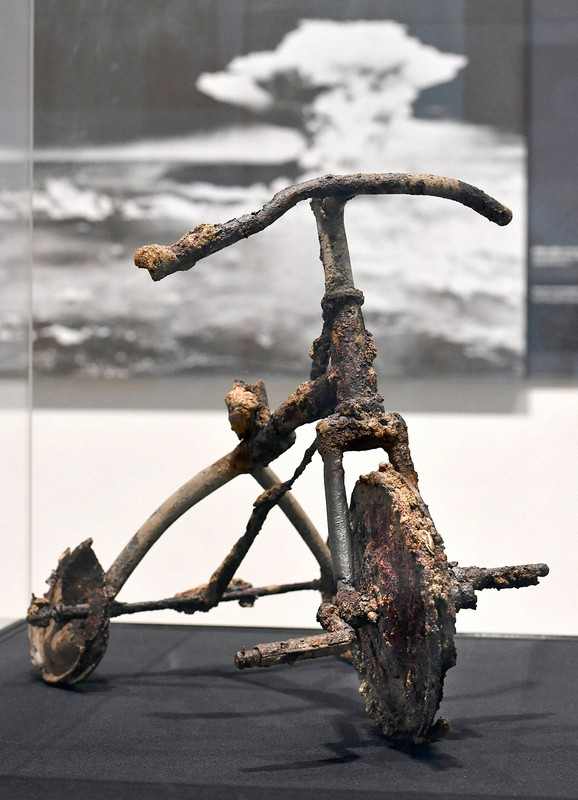
In 1985, four decades after the explosion, Shinichi’s father decided to move his son’s remains to the family tomb. As he carefully unearthed the small grave, he discovered the tricycle, rusted and broken but still intact beside fragments of his child’s bones. He lifted it with trembling hands and thought, “This should never happen to children. The world should be a peaceful place where children can play and laugh.”.
Unable to part with this reminder, he donated the tricycle to the Hiroshima Peace Memorial Museum, where it became one of the most poignant artifacts in its collection.
The Tricycle at the Hiroshima Peace Memorial Museum
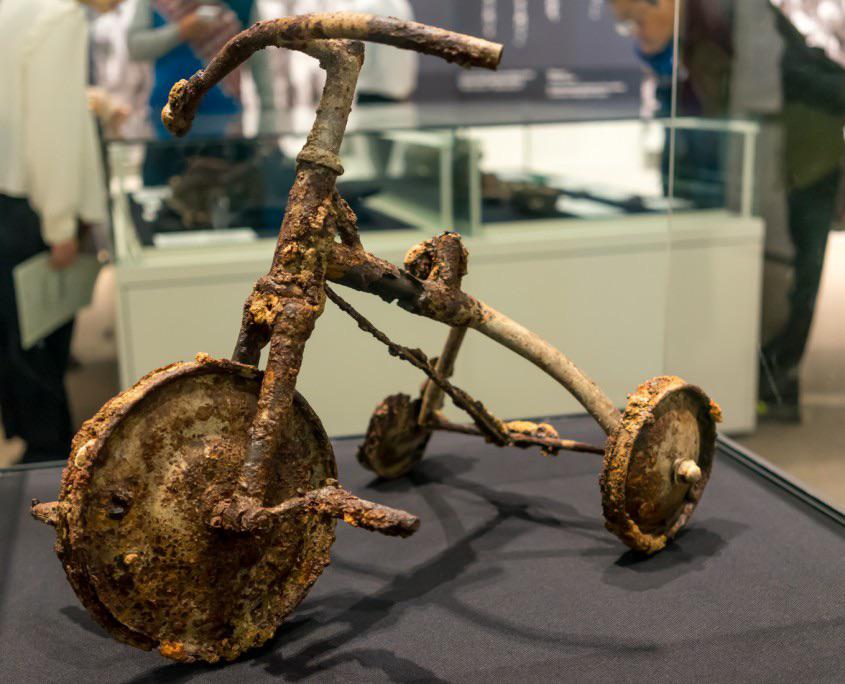
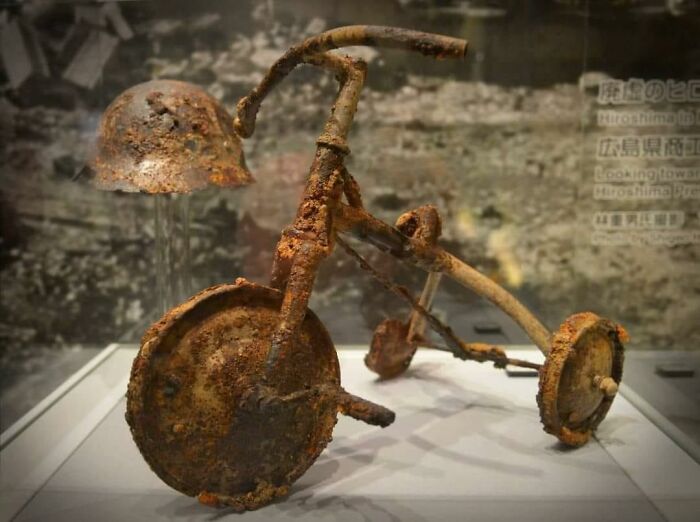
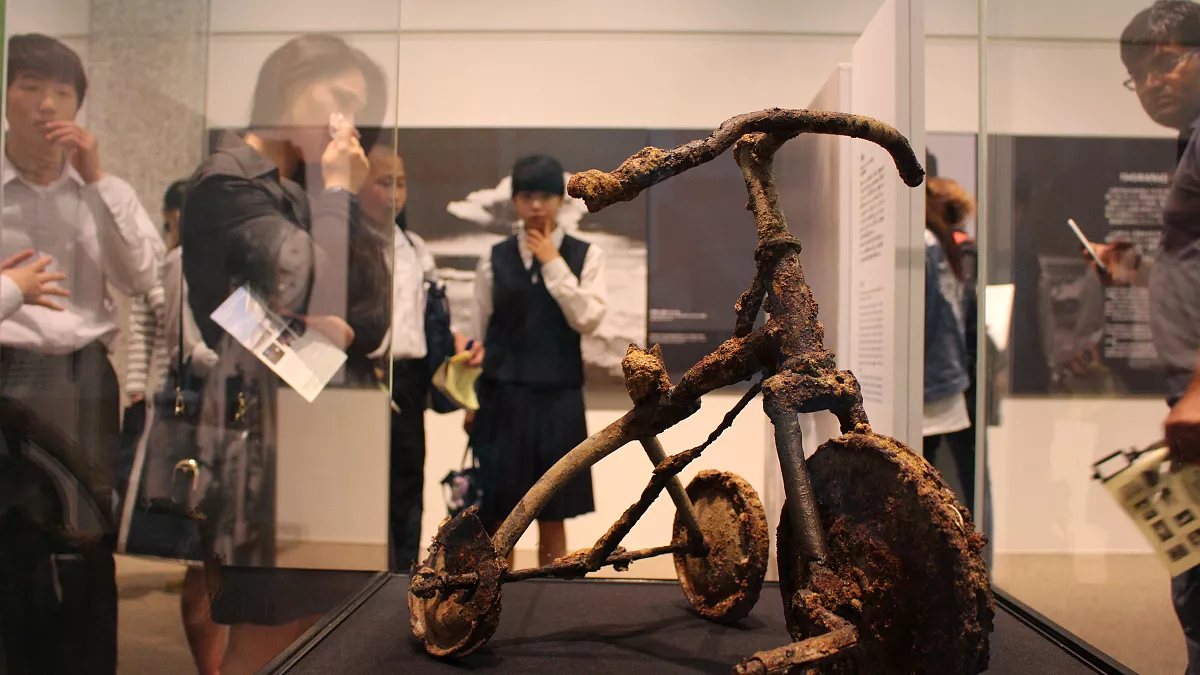
Since 1991, Shinichi’s tricycle has been displayed behind glass at the Hiroshima Peace Memorial Museum. Once painted a vibrant red, its surface is now corroded and brown with rust. The handles and pedals are missing—melted away in the heat of the blast. Yet to millions of visitors, it stands as a silent witness to the cost of war and the fragility of human life.
The museum honors Shinichi and other child victims as part of Japan’s ongoing remembrance of Hiroshima’s tragedy. The tricycle, in particular, has become an enduring symbol of innocence lost to nuclear warfare.
Future Memory: From Hiroshima to the World
In 2024, the International Campaign to Abolish Nuclear Weapons (ICAN) unveiled a bronze sculpture titled Future Memory – Tricycle at the International Red Cross and Red Crescent Museum in Geneva. Created by artists Akira Fujimoto and Cannon Hersey using 3D scans of the original, the artwork immortalizes Shinichi’s story as a global call for peace and disarmament.
The installation honors both the victims of Hiroshima and the global movement to ban nuclear weapons under the Treaty on the Prohibition of Nuclear Weapons (TPNW). Shinichi’s father’s wish—“Please work to create a peaceful world where children can play to their heart’s content”—continues to echo through this sculpture.
The Meaning of the Red Tricycle
The red tricycle represents much more than a child’s toy. It symbolizes the innocence that war destroys, the families that loss forever changes, and the universal plea for peace. The story of Shinichi’s tricycle transcends national boundaries—it is not merely Japan’s tragedy but humanity’s warning.
Every turn of the tricycle’s wheel is a reminder of the three-year-old boy who never got to grow up, whose playtime was stolen by history. It stands as an enduring message to future generations: peace must always begin with protecting the smallest hands.
Lessons for Humanity
Shinichi’s story teaches that the true casualties of war are often the ones too young to understand it. His tricycle, preserved in silence, speaks louder than any speech or monument. It reminds us that humanity’s progress must never come at the cost of compassion, and that the legacy of Hiroshima is not just sorrow—but a promise: never again.
Conclusion: A Child’s Toy That Changed Nations
The story of The Little Boy and the Red Tricycle is one of heartbreak and hope. From the ruins of Hiroshima to the halls of Geneva, Shinichi’s memory endures. His rusted tricycle now serves as both a memorial and a mirror. Reflecting the world’s darkest hour and humanity’s ongoing pursuit of light.
Today, visitors to Hiroshima pause before that fragile relic, humbled by the knowledge. That a simple child’s toy carries the weight of the 20th century’s greatest tragedy—and the enduring dream of peace.
ALSO READ: The Genius of Roman Engineering and the Rio Tinto Mines