The Jockey of Artemision: A Hellenistic Bronze Masterpiece
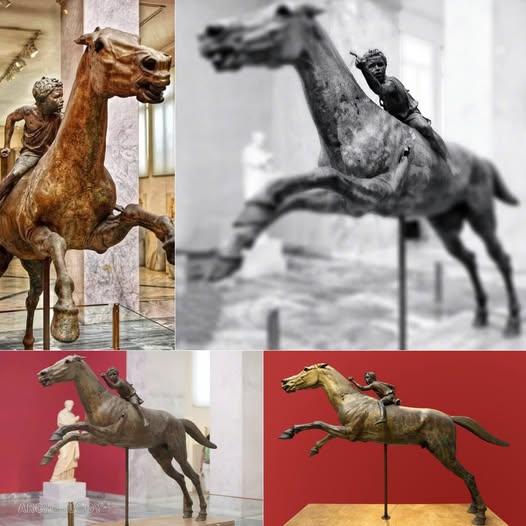
Among the treasures of ancient Greek art, few works capture the raw energy and emotional power of the Jockey of Artemision. This life-sized bronze sculpture of a young boy riding a galloping horse is a striking representation of motion, youth, and artistic excellence from the Hellenistic period, dated around 140 BCE. Recovered from the depths of the sea, the statue remains one of the most dramatic and rare surviving examples of large-scale Greek bronze sculpture.
Discovery at Sea: The Shipwreck at Cape Artemision
The statue was discovered in the 1920s and 1930s during underwater excavations near Cape Artemision, located off the northern coast of Euboea, Greece. It had been lost in a shipwreck in antiquity, likely on its way to Rome, where Greek artworks were highly prized by the Roman elite. The discovery of such a monumental bronze sculpture was remarkable, as most ancient bronzes were melted down over the centuries for their valuable metal.
Thanks to the protection of the sea, the Jockey of Artemision survived the ravages of time and now resides in the National Archaeological Museum of Athens, where it continues to awe scholars and visitors alike.
Hellenistic Dynamism: A Scene Frozen in Motion
The sculpture stands out for its extraordinary realism and vitality, typical of the Hellenistic period, which followed the classical era. Unlike earlier, more static Greek statues, this work captures a single, electrifying moment: a boy racing at full speed on a powerful horse. The sculptor shows the horse mid-gallop, with tensed muscles and flared nostrils, while the rider leans forward, grips the reins, and urges the animal onward.
This composition embodies the Hellenistic fascination with movement, emotion, and theatrical expression. Every detail, from the wild energy of the horse’s mane to the intense gaze of the young jockey. Reflects an advanced understanding of anatomy, psychology, and drama.
Youth and Power: A Symbolic Contrast
One of the most striking elements of the Jockey of Artemision is the size contrast. The small, wiry figure of the boy and the large, muscular horse. This disproportion creates a compelling visual tension. It suggests themes of human struggle, control, and harmony with nature—common motifs in Hellenistic art.
The boy, possibly of African origin, wears sandals and a short tunic. Details that add to the sculpture’s realism and raise questions about his identity. Was he a professional jockey, a servant, or perhaps a youth of noble birth? These unanswered questions only deepen the sculpture’s mystique.
Rare Survival of a Greek Bronze
Because people lost or melted down most large ancient Greek bronzes. The survival of the Jockey of Artemision holds particular significance. It is one of the very few full-scale bronze sculptures from antiquity that still exists today. Allowing modern audiences to appreciate the techniques, scale, and ambition of ancient Greek metalworkers.
The statue was made using the lost-wax casting method. A complex process that enabled artists to achieve fine detail and dynamic poses. Its preservation at sea means we can still study its original craftsmanship. A rare privilege in the field of ancient art.
Cultural Legacy: Greek Art Valued by Romans
The likely transport of the sculpture to Rome highlights its value and the Roman admiration for Greek art. At the time of the shipwreck highlights the immense value Romans placed on Greek art. Roman elites collected Greek sculptures, especially bronzes, as symbols of status and cultural refinement. They probably intended the Jockey of Artemision to adorn a villa or public space. Testimony to the cross-cultural appreciation of artistic excellence.
Conclusion: A Testament to Hellenistic Brilliance
The Jockey of Artemision is more than a statue—it is a dynamic, emotional, and technical triumph. Hellenistic artists elevated realism, movement, and dramatic contrast to new heights, capturing the true spirit of their era. Today, this remarkable bronze stands as a powerful reminder of the artistic innovations of ancient Greece and the enduring legacy of its creators.
ALSO READ: The Aztec Skull Tower: A Chilling Discovery Beneath Mexico City