Frozen in Time: 17th–18th Century Whalers’ Cemetery Unearthed in Svalbard, Norway
An Arctic Graveyard Emerges from the Ice
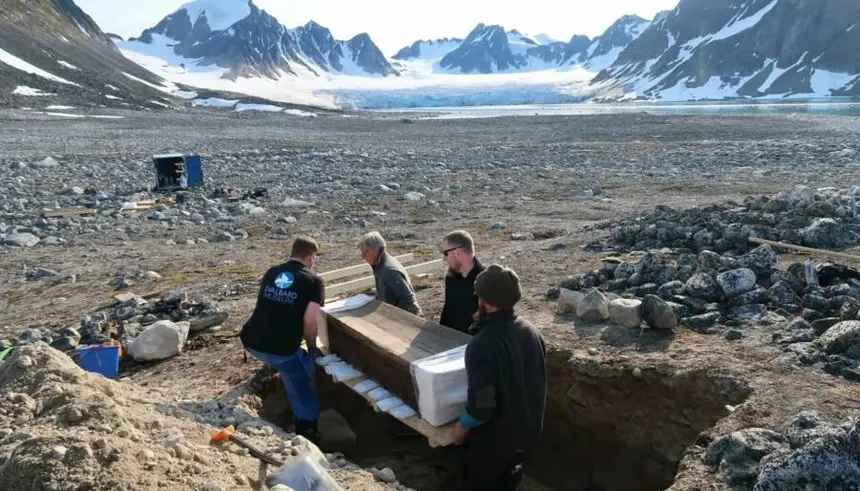
In the far north, where icy winds sweep across desolate tundra and the midnight sun glows over frozen seas, archaeologists are racing against time to save a piece of maritime history. On an island in Norway’s Svalbard archipelago, researchers have begun excavating a whalers’ cemetery containing around 800 graves, dating to the 17th and 18th centuries.
The graves, remarkably preserved by centuries of permafrost, belong to the European whalers who ventured into these Arctic waters during the height of the Greenland and Svalbard whaling boom. But today, the same frozen soil that kept their remains intact is rapidly thawing. Coastal erosion, driven by climate change, now threatens to wash this frozen chapter of history into the Arctic Ocean.
The Discovery: A Maritime Necropolis in the High Arctic
A Cemetery Frozen in Time
The site was first documented by Norwegian and Russian explorers in the 19th century, but only recently have archaeologists begun large-scale excavations. Located along a wind-swept shore, the cemetery contains hundreds of wooden coffins, textile fragments, personal artifacts, and skeletal remains that tell stories of life — and death — in one of the harshest environments on Earth.
Permafrost acted as a natural preservative, keeping the organic materials — including leather, wool, and even soft tissue — astonishingly intact. These rare conditions offer scientists a direct connection to the daily realities of Arctic whaling life in the early modern period.
A Multinational Heritage
The majority of the graves belong to Dutch, English, and Danish-Norwegian whalers, part of the early European expeditions that hunted whales for their valuable oil and baleen. Ships often overwintered in the Arctic, and many sailors succumbed to scurvy, frostbite, and disease.
For archaeologists, the site provides a unique multinational record of maritime expansion, cross-cultural contact, and survival in the Arctic frontier.
Life and Death Among the Ice
The Rise of Whaling in the Arctic
By the early 1600s, the demand for whale oil — used for lamps, soap, and industrial lubricants — had spurred an intense whaling rush to the Arctic seas. Svalbard, known as Spitsbergen to early whalers, became a hub of activity. Dozens of ships sailed north each summer to hunt bowhead whales, which thrived in the icy waters.
Whaling stations dotted the coastline, processing blubber into oil using massive copper cauldrons. The work was grueling, the climate unforgiving, and medical knowledge limited. As a result, many sailors perished — not from whale attacks, but from exposure, malnutrition, and infection.
Arctic Burials: Honoring the Lost at Sea
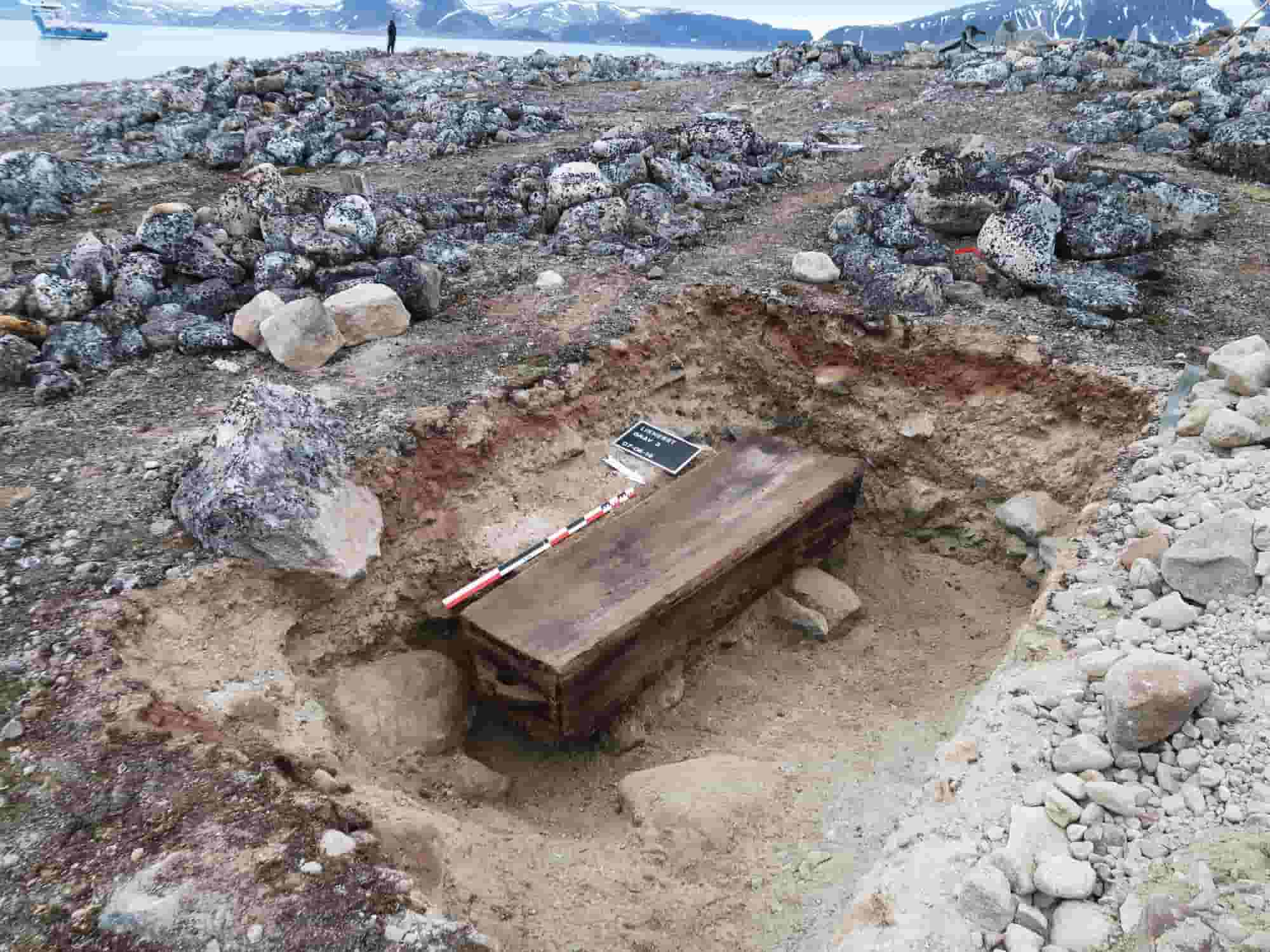
When death came, the whalers were often buried onshore in shallow graves carved into the permafrost. Some were laid to rest in simple wooden coffins, others wrapped in sailcloth. Few headstones survived, but archaeological evidence shows that communities maintained a sense of ritual even in isolation.
Analysis of grave orientation, artifacts, and burial depth reveals care and consistency — a poignant reminder that even in the Arctic wilderness, seafarers clung to traditions of faith and respect for the dead.
Archaeological Insights: What the Graves Reveal
Remarkable Preservation of Human Remains
Excavations have uncovered human remains so well-preserved that in some cases, hair, nails, and even clothing fibers remain intact. DNA analysis and isotope studies are helping researchers trace the origins of these individuals, revealing that many came from coastal towns in the Netherlands, England, and Scandinavia.
Chemical testing of bone collagen provides insight into diet and health, confirming that many sailors suffered from vitamin deficiencies, lead poisoning, and severe physical strain. Some graves show signs of frostbite and malnutrition, underscoring the extreme toll of Arctic labor.
Artifacts of Maritime Life
Beyond human remains, the site has yielded a wealth of material culture — tools, buckles, pipes, and fragments of wool clothing. Each item helps reconstruct the social and economic world of the whalers.
Findings include:
-
Clay pipes used during long shipboard watches
-
Bronze buttons and belt buckles from uniforms
-
Wooden combs and small mirrors suggesting personal grooming and identity
-
Religious tokens and crosses, indicating the enduring role of faith amid isolation
These artifacts serve as time capsules, preserving everyday details that written records rarely capture.
The Threat: Climate Change and Coastal Erosion
Permafrost Thawing at Alarming Rates
The preservation of the Svalbard whalers’ cemetery owes everything to Arctic permafrost — and that very permafrost is now vanishing. Average temperatures in the region have risen more than four times the global average, causing the ground to thaw and destabilize.
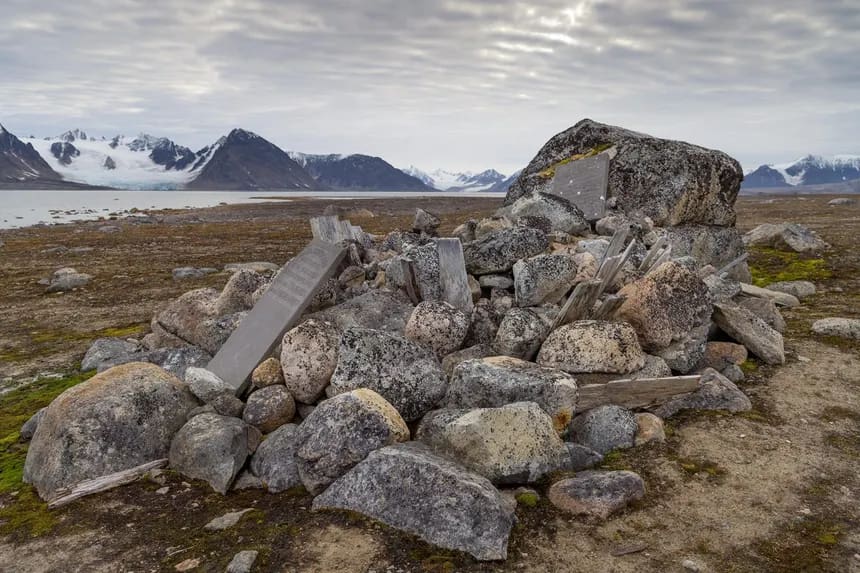
As permafrost melts, graves collapse, exposing remains to wind and water. The cemetery, once securely frozen, now lies on an eroding coastal bluff vulnerable to storm surges and wave action.
Archaeology in the Age of Acceleration
Researchers describe the situation as a race against time. Each summer thaw exposes new graves, and each winter storm washes more soil into the sea. Teams must balance scientific precision with urgency — documenting and recovering what they can before it disappears forever.
This crisis mirrors a broader trend across the Arctic, where thousands of archaeological sites are being lost to climate-driven erosion. Svalbard’s whalers’ cemetery is not just a local concern, but a global warning about the fragility of the world’s frozen heritage.
Cultural Heritage and International Cooperation
Preserving Shared Maritime History
The Svalbard excavation is a collaborative effort between Norwegian archaeologists and international researchers from the Netherlands, the UK, and Denmark — countries whose sailors once crewed the very ships represented in these graves.
Together, they aim to document, conserve, and digitally reconstruct the site. Using 3D mapping, photogrammetry, and isotopic analysis, scientists are building a comprehensive picture of life in the Arctic whaling industry.
The project also seeks to raise awareness about Arctic heritage preservation amid accelerating climate change. In many ways, the Svalbard graves symbolize the shared human cost of exploration and exploitation — a reminder of both our ingenuity and our vulnerability.
A Legacy Carved in Ice
Echoes of the Past in a Changing Arctic
As the ice retreats and permafrost gives way, the long-forgotten whalers of Svalbard are returning to view — not through myth, but through science. Their graves reveal a world of danger, endurance, and ambition that shaped Europe’s early maritime economies.
Yet their reemergence also underscores the urgency of our time. What was preserved by cold is now being undone by warmth. Every artifact uncovered is both a window into the past and a warning for the future.
The Svalbard whalers’ cemetery stands as a frozen archive of human endeavor — one that the sea is steadily reclaiming.