The Sutton Hoo Helmet: Unearthing the Glory of Anglo-Saxon England
Rediscovering a Lost World Beneath English Soil
In 1939, on a quiet hill overlooking the River Deben in Suffolk, England, archaeologists uncovered one of the most breathtaking discoveries in British history — the Sutton Hoo Ship Burial. Within the outline of a 27-meter-long ship lay the richest Anglo-Saxon grave ever found in Europe. Among its treasures was an object that would redefine early English history: the Sutton Hoo Helmet.
Though unearthed in hundreds of corroded fragments, its meticulous reconstruction revealed a masterpiece of art, technology, and symbolism. This helmet — both regal and fearsome — transformed our understanding of the so-called “Dark Ages,” revealing a civilization of remarkable sophistication, artistry, and global connections.
The Groundbreaking Discovery of Sutton Hoo
The Sutton Hoo excavation began on the eve of World War II, led by archaeologist Basil Brown and commissioned by Edith Pretty, the landowner who had long suspected that the mounds on her property concealed something extraordinary.
Their instincts proved correct. Beneath one of the largest mounds, they discovered the ghostly impression of a ship, its timber long decayed but its outline preserved in the sandy soil. Inside, they uncovered a royal burial chamber filled with a king’s ransom of treasure — gold jewelry, silver vessels, ceremonial weapons, and fragments of armor.
At the heart of this treasure trove was the Sutton Hoo Helmet, initially a pile of rusted iron shards. Over decades, conservators at the British Museum painstakingly reconstructed it, transforming fragments into one of the most iconic symbols of early medieval Europe.
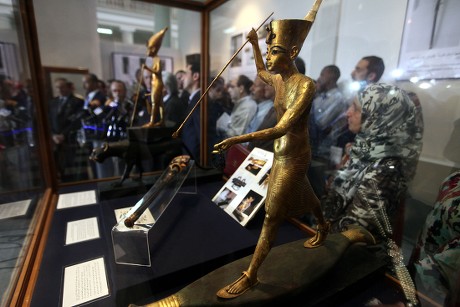
Today, the Sutton Hoo site and its discoveries are often called “Britain’s Tutankhamun,” a fitting comparison given both their richness and their revelation of a forgotten world of royal splendor.
A Masterpiece of Anglo-Saxon Art and Engineering
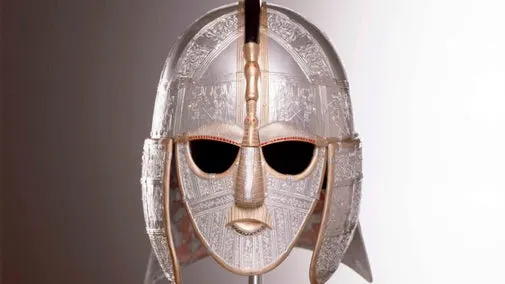
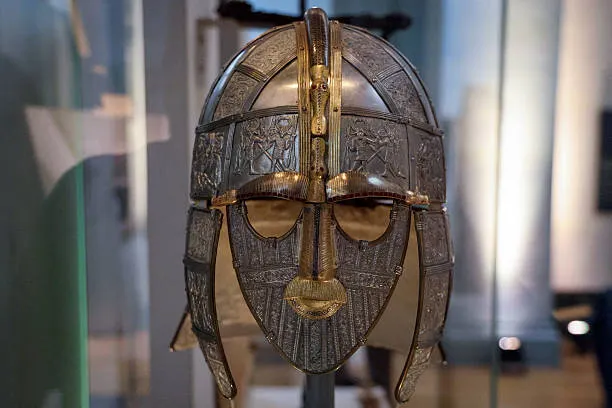
Dating to around AD 625, the Sutton Hoo Helmet is a technical and artistic marvel. Crafted from iron, it was originally covered with tinned bronze panels — thin sheets of metal decorated with intricate reliefs and shimmering silver tones.
The helmet’s face mask is its most striking feature. It combines human and animal imagery with breathtaking creativity:
-
The eyebrows are made of tinned bronze and inlaid with garnet, each terminating in a boar’s head — a traditional symbol of courage and protection in Anglo-Saxon warfare.
-
The nose, mustache, and eyebrows form the body of a soaring dragon, with the nose as its body, the eyebrows as its wings, and the mustache as its tail.
-
The cheek guards and neck guard provided full coverage, marking it as both ceremonial and functional armor.
The decorative panels depict mythological and martial scenes — warriors on horseback, combat between men and beasts, and motifs influenced by Norse and Germanic legend. Each panel was produced with repoussé and punchwork techniques, showing a mastery of metal craftsmanship that rivals anything produced in continental Europe at the time.
The helmet’s sophistication disproved the myth of the “Dark Ages” as a time of barbaric decline. Instead, it revealed an Anglo-Saxon elite engaged in high art, long-distance trade, and cultural exchange.
Global Connections: From Suffolk to Sri Lanka
The helmet’s materials also tell a story of global interconnection. The garnets used to decorate the Sutton Hoo treasures likely originated in Sri Lanka or India, transported through Byzantine and Persian trade networks.
This demonstrates that 7th-century Anglo-Saxon England, far from being isolated, was woven into a global economy stretching from the North Sea to the Indian Ocean.
The other artifacts found in the burial — including Byzantine silver bowls, a Coptic-style ladle, and fine textiles — further confirm that King Rædwald’s court stood at the crossroads of East and West, absorbing influences from Scandinavia, the Mediterranean, and beyond.
The Royal Connection: King Rædwald of East Anglia
Who was buried at Sutton Hoo?
The consensus among historians points to King Rædwald of East Anglia, a powerful 7th-century ruler mentioned by the Venerable Bede. Rædwald was known for balancing Christian and pagan beliefs and for his political ambition, uniting East Anglia into one of the most powerful kingdoms in early England.
The grandeur of the burial — featuring regalia, weaponry, armor, and gold ornaments — supports the idea of a royal entombment, befitting a warrior-king. The ship burial was not just a grave but a statement of divine kingship, meant to ensure the ruler’s safe journey into the afterlife.
The inclusion of the Sutton Hoo Helmet, both protective and symbolic, perfectly aligns with the idea of a king as both warrior and priest, embodying martial valor and divine legitimacy.
The Helmet’s Reconstruction: A Puzzle of the Ages
When excavated, the Sutton Hoo Helmet lay shattered into over 500 corroded fragments. For decades, it remained a puzzle for conservators.
The first attempt at reconstruction in the 1940s was incorrect — it wasn’t until the 1970s that specialists at the British Museum, led by Nigel Williams, managed to reassemble the pieces accurately. Using microscopic analysis, radiography, and 3D modeling, they restored the helmet to its full glory.
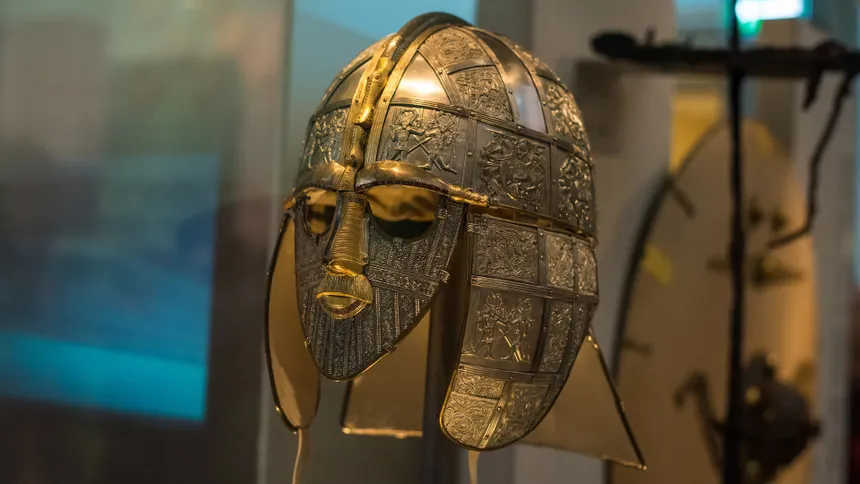
This reconstruction was hailed as a triumph of archaeological conservation, and today the original fragments and a faithful replica are displayed side-by-side at the British Museum. Allowing visitors to appreciate both the helmet’s artistry and the painstaking labor behind its rebirth.
Symbolism and Meaning: Power, Myth, and Identity
The Sutton Hoo Helmet is more than a military artifact — it’s a visual manifesto of kingship and belief.
-
The dragon motif embodies divine protection and the cosmic power of the ruler.
-
The boars represent courage and resilience, sacred to the god Freyr in Norse mythology.
-
The warrior scenes evoke the heroic ethos of Beowulf, reflecting the same Anglo-Saxon ideals of bravery, loyalty, and fame.
In this way, the helmet functioned as both armor and icon. Turning its wearer into a living symbol of divine order and martial might.
Legacy and Lasting Impact
The discovery of the Sutton Hoo Helmet reshaped the understanding of early medieval Britain. It demonstrated that the Anglo-Saxons were not a primitive people. But heirs to a vibrant, cosmopolitan civilization with links stretching across Europe and Asia.
The Sutton Hoo treasures also inspired modern culture. Influencing everything from Tolkien’s Middle-earth armor designs to museum exhibitions and historical documentaries. The helmet itself has become an emblem of England’s early identity, appearing in countless history books, coins, and artworks.
Today, the Sutton Hoo site is protected by the National Trust, and the British Museum. Continues to showcase the helmet as one of the crown jewels of its collection.
Conclusion: The Face of a Forgotten King
The Sutton Hoo Helmet stands as one of the most important archaeological finds in the world. A relic that speaks not only of ancient craftsmanship but of human imagination, ambition, and belief.
Through it, we see the face of a forgotten king. The artistry of his people, and the interconnected world they inhabited. From the fragments of rusted iron emerged not merely a helmet. But a story of civilization reborn, proving that even in the so-called Dark Ages. The light of human creativity burned brightly.
ALSO READ: Cliff Palace of Mesa Verde – The Ancestral Puebloans’ Stone Sanctuary