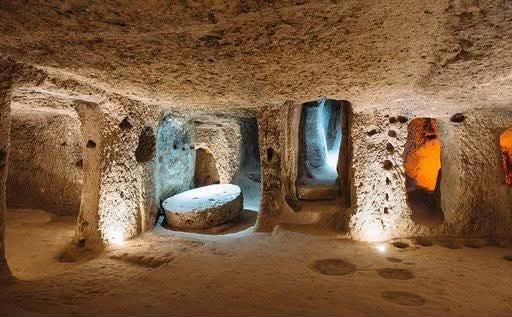
The Stepwell of the Pharaohs – Egypt’s Hidden Depths
Descending into Egypt’s Hidden Depths
Beneath the golden sands of Saqqara, one of Egypt’s most sacred necropolises, lies a structure unlike any other — the Stepwell of the Serapeum. Built over 3,400 years ago during Egypt’s New Kingdom period (circa 1400 BCE), this subterranean marvel is both a feat of engineering and a monument of spiritual symbolism.
Far from the grandeur of towering pyramids or sunlit temples, the Stepwell of the Serapeum reveals a different face of ancient Egyptian genius — one turned inward, downward, and into the mysteries of the earth. Its geometric precision, carved stairways, and smooth limestone surfaces tell of a civilization whose understanding of both stone and spirit transcended time.
The Historical Context: Saqqara and the Serapeum
Saqqara – The Eternal Necropolis
Located just south of Cairo, Saqqara served as a vast burial ground for Egypt’s ancient capital, Memphis. It is home to the Step Pyramid of Djoser, the world’s first monumental stone structure, as well as countless tombs, mastabas, and subterranean temples.
Among these sacred spaces, the Serapeum of Saqqara holds special significance. Dedicated to the Apis Bull, a living manifestation of the god Ptah, the Serapeum was both a burial place and a sanctuary. When each Apis Bull died, it was mummified and entombed with great ceremony — symbolizing the eternal cycle of life, death, and divine renewal.
It is within this complex that archaeologists uncovered a stepwell-like structure, descending deep into the limestone bedrock. Though long forgotten by the sands of time, it has now emerged as one of Egypt’s most enigmatic and awe-inspiring architectural relics.
Unearthing the Stepwell of the Serapeum
The Stepwell of the Serapeum was rediscovered during modern archaeological excavations led by Egypt’s Ministry of Antiquities and supported by international Egyptologists.
At first glance, the structure resembles a typical well shaft, but further exploration revealed a series of descending staircases and chambers, carved with astonishing precision. Each level of the descent opens into side chambers, possibly used for offerings, purification rituals, or symbolic rites of passage.
The walls, made of finely polished limestone blocks, bear tool marks and inscriptions suggesting both practical construction techniques and ritual dedication. The depth of the structure and its architectural symmetry evoke the dual nature of Egyptian spirituality — engineering as devotion, and stone as scripture.
Engineering Genius: The Architecture of Descent
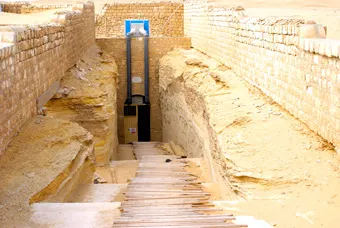
Geometry and Design
The well is built with an extraordinary sense of proportion. Its steps are cut in uniform width and depth, forming a spiraling or linear descent that guides the visitor gradually from light into shadow. This architectural transition mirrors the Egyptian concept of duality — the journey from the world of the living to the afterlife.
Limestone blocks interlock seamlessly, creating smooth, watertight walls. Drainage channels at the base indicate that the structure may have been designed to manage underground water flow, preventing flooding in nearby burial chambers.
Symbolism in Architecture
For the ancient Egyptians, water was a sacred element, associated with both life and rebirth. The Nile River was the source of all fertility, and underground wells or reservoirs often symbolized the primeval waters (Nun) from which creation began.
Thus, the Stepwell of the Serapeum was not merely a functional space — it was a symbolic descent into the cosmic waters, representing purification, transition, and communion with the divine.
Purpose and Ritual Significance
The exact purpose of the Stepwell remains a subject of scholarly debate. Archaeologists and historians propose several possibilities:
-
Ritual Descent Chamber: A sacred route for priests conducting purification rituals before entering the Apis Bull tombs.
-
Water Management System: An ingenious drainage system to protect the Serapeum’s subterranean galleries from seasonal groundwater infiltration.
-
Symbolic Underworld Passage: A metaphorical stairway into the Duat — the Egyptian underworld — used during ceremonial processions.
-
Repository of Offerings: Chambers along the descent may have stored ritual vessels, oils, or papyri associated with funerary rites.
Whatever its function, the Stepwell stands as a testament to the Egyptians’ unique ability to merge engineering, cosmology, and spiritual symbolism into a unified architectural language.
The Artisans of Stone: Ancient Egyptian Craftsmanship
The Stepwell’s construction reveals techniques that challenge modern assumptions about ancient technology.
Archaeologists have found chisel marks, copper tool fragments, and alignment grids etched into the rock, proving that the ancient builders used advanced measurement systems based on cubit rods and plumb lines. The precision of the cuts, often within millimeters, suggests not only technical mastery but also ritual intentionality — each stroke guided by spiritual purpose.
This aligns with what Egyptologist Dr. Salima Ikram describes as the Egyptians’ philosophy of building: “Every act of construction was an act of creation — to shape stone was to mirror the gods themselves.”
A Descent into Symbolism: Light, Shadow, and the Divine
Walking down the ancient stairway of the Stepwell, one experiences an intentional shift in sensory perception.
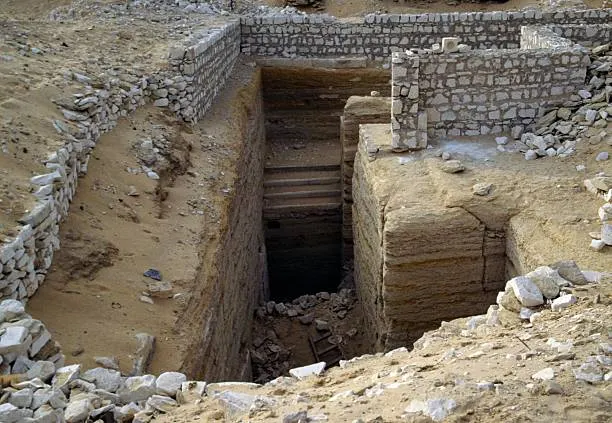
At the surface, sunlight floods the entrance, illuminating the desert horizon. As one descends, light narrows to a dim glow, then fades into darkness. This gradual extinguishing of light is more than atmospheric — it represents the soul’s journey into the afterlife, mirroring the mythic passage of Osiris, the god of resurrection.
At the lowest chamber, where air cools and echoes linger, visitors report a profound sense of stillness — as if time itself slows. It is easy to imagine priests chanting hymns here, their voices rising toward the shaft’s opening, bridging heaven and earth through sound and stone.
Modern Excavations and Preservation Efforts
Today, the Egyptian Ministry of Tourism and Antiquities continues to study and preserve the Stepwell as part of the greater Serapeum complex. Ground-penetrating radar, 3D mapping, and laser scanning have allowed researchers to reconstruct the well’s original dimensions and analyze its geological context.
Restoration teams have stabilized the stairways and chambers to prevent collapse, ensuring that this extraordinary relic remains accessible for future generations. Visitors can now explore guided portions of the site under controlled conditions, gaining a rare glimpse into Egypt’s hidden subterranean world.
Spiritual Resonance: A Staircase into Eternity
Standing above the Stepwell of the Serapeum, one feels the profound intersection of engineering and eternity. Each block of limestone, each chisel mark, tells of a civilization that saw the divine in every detail — where architecture was prayer, and stone was scripture.
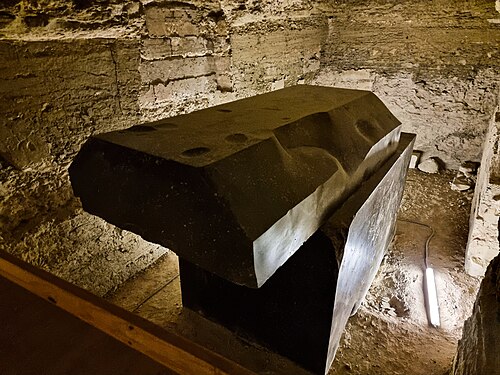
Unlike the pyramids that point upward toward the sun, the Stepwell points downward — into the earth, into mystery, into the heart of creation itself. It is a reminder that for the ancient Egyptians, the afterlife was not a distant heaven, but a mirrored continuation of existence — as infinite and layered as the descent into their sacred wells.
Conclusion: Where Stone Meets the Divine
The Stepwell of the Pharaohs stands as one of the most haunting and poetic symbols of ancient Egypt’s spiritual and architectural genius. Hidden beneath the sands of Saqqara, it invites us to reflect on the timeless dialogue between human craftsmanship and cosmic belief.
It is not merely a structure — it is a philosophy carved into stone. A descent into silence that speaks of eternity. A bridge between worlds, where even the humblest drop of water becomes divine.
To stand at its edge is to stand at the threshold of time itself — where the ancient Egyptians once reached downward toward the gods and found eternity waiting in the depths.
ALSO READ: The 17th-Century Ottoman Tent: Luxury and Power at the Battle of Vienna