The Sail Rock – Nature’s Monument by the Sea
A Stone Sail Against the Sea
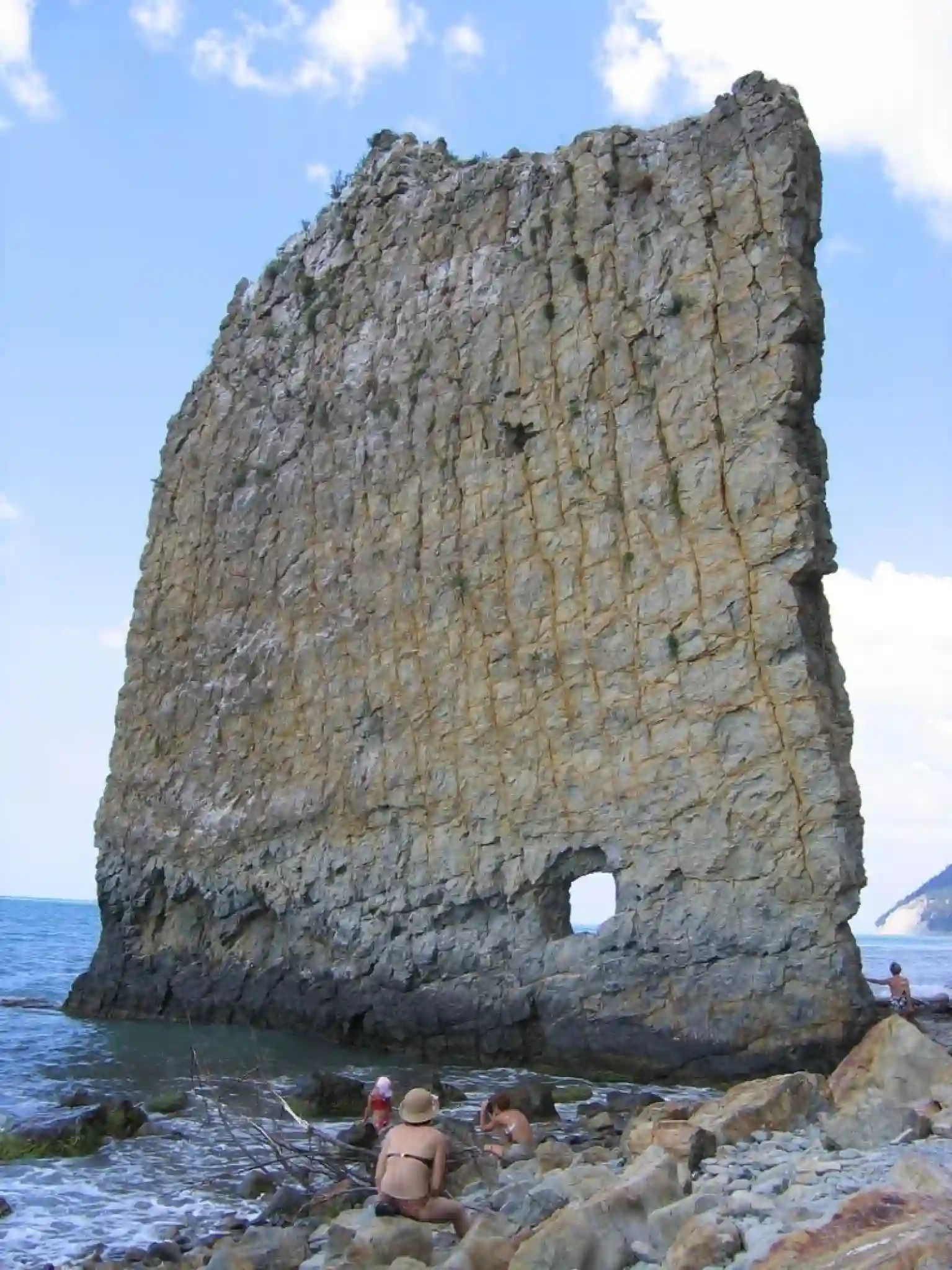
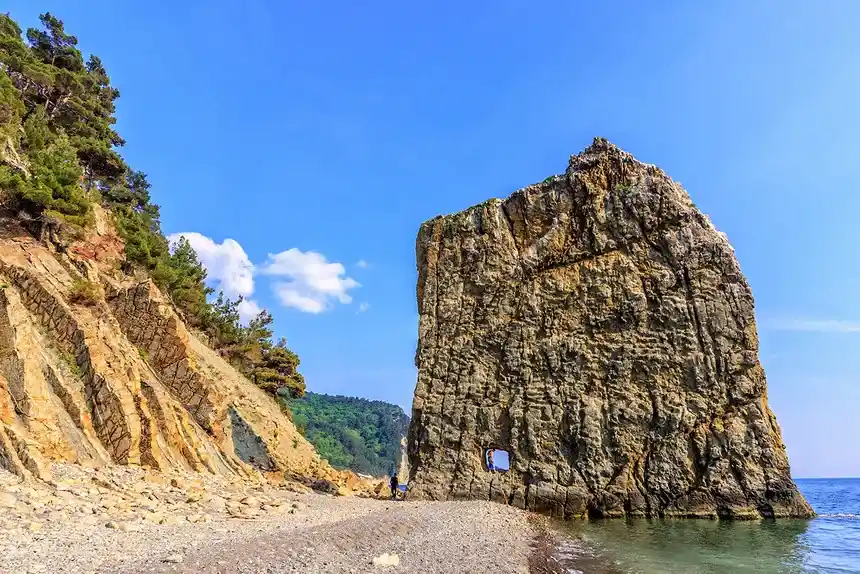
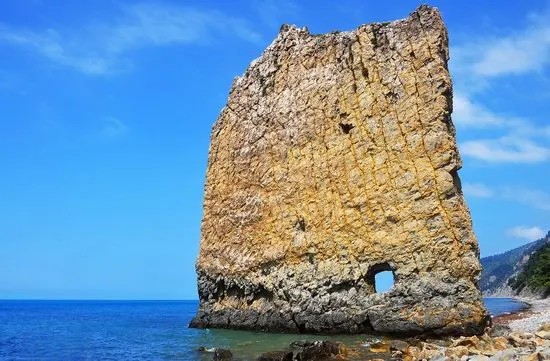
Along the rugged coastline of the Black Sea near Gelendzhik, Russia, stands a breathtaking natural monument — Sail Rock, or as locals call it, Parus Rock (Парус). Rising 25 meters high and scarcely a meter thick, it resembles a giant stone sail eternally poised to catch the sea breeze.
To gaze upon Sail Rock is to witness the dialogue between time, water, and stone — a masterpiece sculpted not by human hands but by the relentless artistry of nature. Towering above the waves like a silent ship, it has become a symbol of strength, solitude, and endurance, captivating geologists, travelers, and photographers from around the world.
The Geological Origins of Sail Rock
🪨 Shaped by Time and the Sea
The story of Sail Rock’s formation stretches back millions of years, when layers of sandstone and marl were deposited along the ancient seabed. Over epochs, tectonic uplift exposed these sediments to the open air, where wind, waves, and rain began their slow, persistent sculpting.
Erosion acted as both artist and chisel — carving away softer rock, leaving behind a thin, resilient wall of stone. The result is a natural formation that seems impossibly delicate yet remarkably stable, standing like a vertical blade against the horizon.
Geologists describe Sail Rock as an erosional remnant, meaning it’s a leftover fragment of a once-larger cliff face. Continuous wave action at its base and the salt-laden winds above gradually shaped its iconic sail-like profile.
The Unique Structure of Parus Rock
⚓ Dimensions and Composition
Sail Rock stands approximately 25 meters high, 20 meters long, and only 1 meter thick. Its astonishing slenderness has made it an icon of natural symmetry and balance.
Composed primarily of sandstone interbedded with marl, the rock’s alternating light and dark strata are visible from a distance, giving it a textured appearance that reflects its layered geological history.
The formation’s resilience lies in the hardness of the sandstone, which resists erosion far better than surrounding materials. This combination of structure and composition allows it to remain upright, even as the sea continues to wear at its base.
🕳️ The Mysterious Hole
Near the bottom of the formation is a small, rectangular hole — roughly man-sized — that adds an intriguing detail to its silhouette. Local lore offers two main explanations:
-
Human origin: The hole may have been created by artillery fire during the Caucasian War in the 19th century, when Russian forces clashed with mountain tribes in the region.
-
Natural cause: Others argue it was formed through natural collapse, where weaker material eroded faster than the surrounding stone.
Whatever its origin, the hole has become part of the legend, adding a sense of mystery to Sail Rock’s already dramatic appearance.
Location: The Jewel of Gelendzhik’s Coast
🌊 Where Sea and Stone Meet
Sail Rock is located near the resort town of Praskoveyevka, about 17 kilometers south of Gelendzhik, in Krasnodar Krai, Russia. It sits right on the Black Sea coast, a region famous for its rugged cliffs, pebble beaches, and subtropical climate.
Accessible via a short hike or boat trip, the site has become a favorite destination for tourists, geologists, and photographers. The best time to visit is at sunrise or sunset, when the golden light turns the rock into a glowing sail adrift on the sea.
From the nearby Markotkh Mountains, one can view Sail Rock against the endless blue of the Black Sea — a sight that embodies both serenity and grandeur.
The Symbolism of the Stone Sail
🌅 A Metaphor for Endurance
Beyond its geological significance, Sail Rock has taken on a symbolic meaning in Russian culture. Its solitary stance against the sea evokes feelings of perseverance and timelessness, qualities that resonate deeply in art and poetry.
To many, it represents the strength of the human spirit, standing tall in the face of life’s relentless forces — much like the stone withstands the sea’s constant assault.
📷 Inspiration for Artists and Travelers
Photographers often describe Sail Rock as “a sculpture in motion,” changing moods with every wave and sunset. Artists have painted it as a metaphor for freedom, solitude, and balance, while travelers speak of its quiet majesty, likening it to a ship forever anchored in time.
Local legends even suggest that Sail Rock was once a real ship, turned to stone by divine will — a poetic way to express the rock’s uncanny resemblance to a sail catching an eternal wind.
The Science of Erosion: Nature’s Silent Sculptor
🌬️ Wind, Waves, and Time
The formation of Sail Rock exemplifies the power of natural erosion. Over countless centuries, the combined action of wind, saltwater spray, and storm waves carved away softer rock layers, leaving behind the resilient sandstone spine.
This ongoing process continues today. Geologists monitoring the site note that minor pieces of rock occasionally fall away, reshaping its edges. While Sail Rock has stood for millennia, it too is subject to the same forces that created it — a poignant reminder that even the most enduring structures evolve with time.
🔎 Lessons from Geology
Studying Sail Rock offers insight into coastal geomorphology — how shorelines evolve through the balance of constructive and destructive forces. The rock’s preservation teaches scientists about erosional resistance, sedimentary layering, and the long-term effects of wave dynamics.
In this sense, Sail Rock is not just a natural wonder — it’s also a living textbook for understanding Earth’s geological rhythms.
Sail Rock in Modern Culture and Tourism
🧭 A Landmark of Southern Russia
Today, Parus Rock is a protected natural monument and one of the most photographed sites along the Black Sea coast. It appears in travel brochures, postcards, and documentaries, symbolizing the wild beauty of Russia’s southern shores.
Tour operators in Gelendzhik and Novorossiysk frequently organize excursions to the site. Many visitors choose to swim, kayak, or sail near the rock. Experiencing firsthand the awe of standing beside this geological giant.
🎥 A Cinematic Icon
Sail Rock’s striking silhouette has also made appearances in films and media. Often used to evoke themes of isolation, endurance, and nature’s grandeur. Its simplicity — a single, thin wall of stone against an infinite sea. Lends it a power that few landscapes can match.
The Eternal Sail: A Meeting of Art and Nature
As the sun sets over the Black Sea, Sail Rock glows with hues of amber and rose, casting a long shadow across the waves. It seems less like a rock and more like a dream suspended between sea and sky.
If nature could dream, perhaps it would imagine itself as this — a sail of stone, timeless and free.
Sail Rock reminds us that beauty often arises from resistance, that even under pressure, something delicate can endure. It stands as a monument to time, resilience, and the poetry of the Earth itself.
ALSO READ: “Marsh Arabs in a Reed Boat” — A Reflection of Sumerian Life and Humanity’s Bond with Water