The Interior of the Red Pyramid at Dahshur: A Journey into Egypt’s Oldest True Pyramid 🏜️🔺
Unlocking the Secrets of the Red Pyramid
Standing tall on the sands of Dahshur, just south of Cairo, the Red Pyramid is one of Egypt’s greatest monuments—and one of its least crowded treasures. Built during the reign of Pharaoh Sneferu (c. 2613–2589 BCE), founder of the Fourth Dynasty, it is considered the world’s first true smooth-sided pyramid, predating the Great Pyramid of Giza.
While its striking red limestone exterior captures attention, it is the interior of the Red Pyramid that offers visitors a truly breathtaking journey back into ancient Egypt’s architectural ingenuity. With steep descending passages, corbelled vaults, and burial chambers hidden deep inside, the pyramid’s interior reveals both the engineering mastery and spiritual beliefs of the Old Kingdom.
Sneferu’s Architectural Masterpiece: Why the Red Pyramid Matters
Before entering the pyramid, it helps to understand why the Red Pyramid holds such importance in Egyptian history. Sneferu, father of Khufu (builder of the Great Pyramid), was an ambitious king who experimented with pyramid design.
-
His first attempt at Meidum collapsed.
-
His second attempt, the Bent Pyramid at Dahshur, had a change of angle midway due to structural concerns.
-
Finally, the Red Pyramid achieved success as the first true pyramid with smooth, straight sides.
At 105 meters (345 feet) tall, it is Egypt’s third-largest pyramid after those of Khufu and Khafre at Giza. Its interior demonstrates both caution and confidence—the product of lessons learned from earlier failures.
Entering the Pyramid: A Steep Descent into Darkness
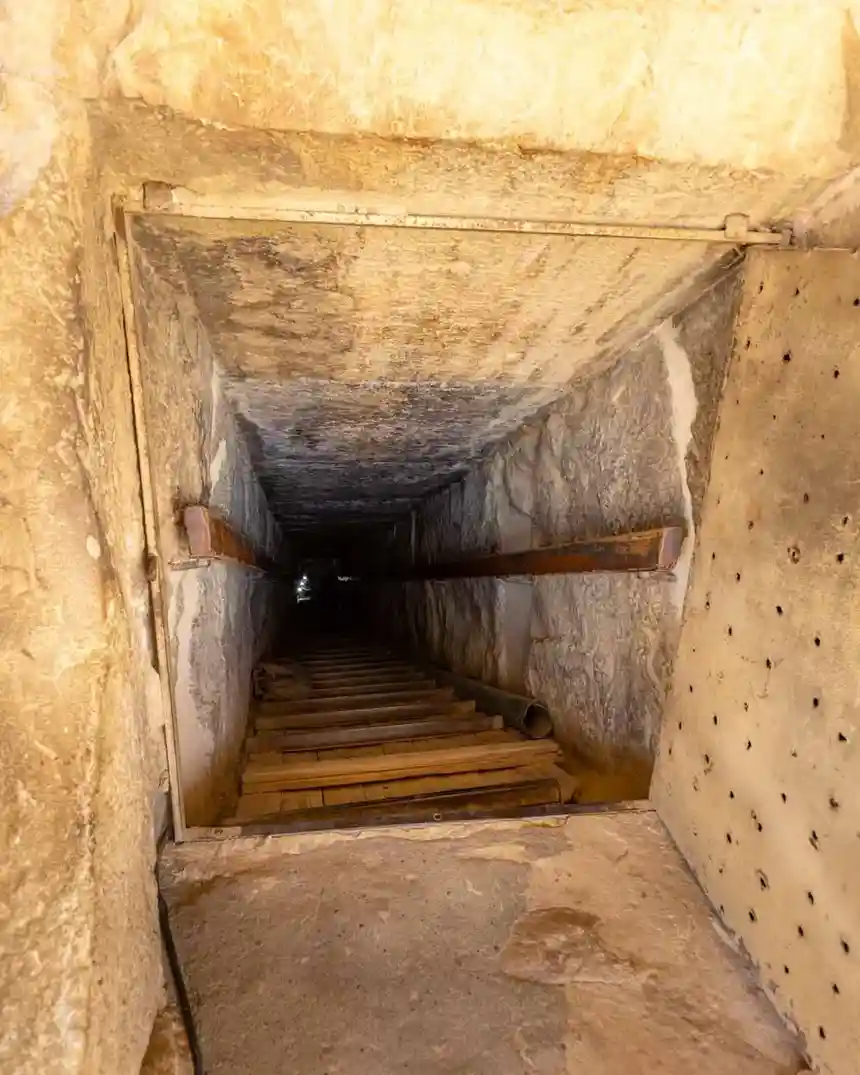
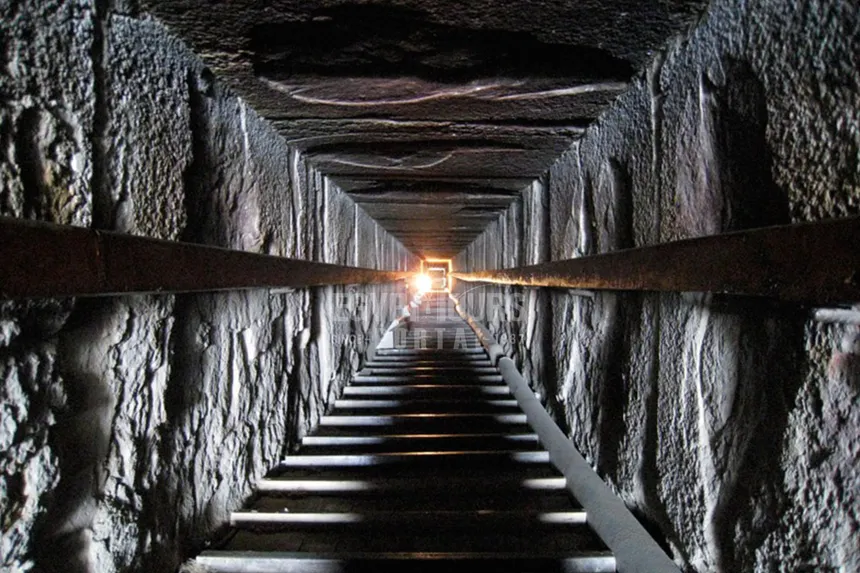
The entrance lies on the north face, about 28 meters above ground. To enter, visitors climb a modern staircase to a narrow opening and then descend through a long sloping passageway.
The Entrance Passage
-
Length: About 61 meters (200 feet).
-
Width: Just 0.9 meters (3 feet) wide and 1.2 meters (4 feet) tall.
-
Angle: Descends at about 27 degrees, forcing visitors to stoop while walking.
This tight corridor plunges deep into the heart of the pyramid, immersing explorers in the experience of descending toward the underworld—mirroring the ancient Egyptian belief in the pharaoh’s journey to the afterlife.
The Chambers of the Red Pyramid: A Corbelled Wonder
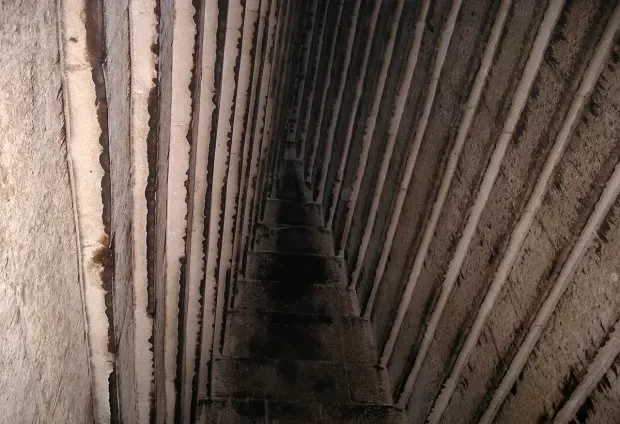
Once inside, visitors encounter a series of remarkable chambers showcasing corbelled vaulting, an architectural technique where stones are stacked slightly inward at each level to form a pointed ceiling.
First Chamber
-
Located at the end of the entrance passage.
-
Features walls rising upward in corbelled layers to a height of 12 meters (40 feet).
-
Likely served as an antechamber or symbolic transitional space.
Second Chamber
-
Accessible via a short horizontal passage.
-
Similar design with corbelled walls, also reaching impressive heights.
-
Possibly functioned as an additional protective chamber or space for rituals.
Final Burial Chamber
-
Reached by climbing a short passageway leading upward.
-
The chamber lies at the pyramid’s geometric center, unusual for pyramids of this era.
-
Ceiling height: About 15 meters (50 feet), also corbelled.
-
The walls and ceiling still bear the reddish hue of limestone blocks, giving the pyramid its modern name.
Though no sarcophagus or funerary goods remain, scholars believe this was meant to house Pharaoh Sneferu’s burial, although some debate whether he was ever interred here.
Architectural Brilliance: The Corbelled Vaults
One of the most striking features of the Red Pyramid interior is the corbelled vaulting technique, which distributes the immense weight of the pyramid away from the chambers below.
-
This innovation ensured the pyramid did not collapse, unlike Sneferu’s earlier attempts.
-
The vaults create dramatic, soaring ceilings, still awe-inspiring after 4,500 years.
-
Visitors often remark on the acoustics inside the chambers—sounds reverberate eerily through the corbelled stone.
These techniques influenced the later construction of the Great Pyramid, showing the Red Pyramid’s pivotal role as a stepping stone in pyramid evolution.
The Atmosphere Inside: A Journey Through Time
Visiting the interior of the Red Pyramid is an experience unlike any other in Egypt.
-
The air is warm, heavy, and often carries a faint mineral scent.
-
The narrow descending passage can feel claustrophobic but adds to the sense of discovery.
-
The silence inside the chambers is profound, broken only by footsteps and whispers.
Standing in the central burial chamber, one feels the immensity of ancient engineering and the mystery of Sneferu’s vision—a structure meant to last for eternity.
Historical Mysteries: Was Sneferu Buried Here?
Despite its grandeur, archaeologists have found no definitive evidence of Sneferu’s burial inside the Red Pyramid. Some theories suggest:
-
Sneferu may have been buried in the Bent Pyramid or in a now-lost tomb.
-
The Red Pyramid might have served as a cenotaph (a symbolic tomb).
-
Looting in antiquity may have removed burial goods and remains.
The absence of a sarcophagus adds to the enigma, but the pyramid’s architectural legacy is beyond doubt.
Visiting the Red Pyramid Today 🧭
The Red Pyramid is part of the Dahshur Necropolis, about 40 kilometers south of Cairo. Unlike Giza, it is far less crowded, offering a more peaceful and intimate experience.
Tips for Visitors
-
Wear comfortable shoes—the passages are steep and narrow.
-
Bring water—it can get very warm inside.
-
Be mindful of claustrophobia—the descent is tight and lengthy.
-
Combine your visit with the nearby Bent Pyramid for a complete picture of Sneferu’s architectural journey.
The site is overseen by the Supreme Council of Antiquities, and visitors today enjoy safe access thanks to modern staircases and lighting.
Fun Facts About the Red Pyramid 🎉
-
It is called the “Red Pyramid” because of the reddish hue of its limestone blocks.
-
Locally, it is known as the “Bat Pyramid” due to the colonies of bats once living inside.
-
It is older than the Great Pyramid, making it Egypt’s earliest successful true pyramid.
-
It was the tallest man-made structure in the world before being surpassed by Khufu’s Great Pyramid.
-
Some visitors claim the chambers produce a resonance effect, leading to theories of acoustic design.
Conclusion: A Monument of Innovation and Legacy
The Red Pyramid at Dahshur is more than just a monument—it is a turning point in history. Its interior chambers, corbelled ceilings, and burial passages reflect both the failures and triumphs of Pharaoh Sneferu’s reign.
As Egypt’s first successful true pyramid, it paved the way for the golden age of pyramid building at Giza and beyond. For visitors today, descending into its depths is to walk the same path envisioned for a pharaoh’s soul—through darkness, silence, and stone, toward eternity.
If the Great Pyramid represents Egypt’s glory, the Red Pyramid interior represents its innovation, the first time human ambition and engineering truly conquered stone.
ALSO READ: Belogradchik Fortress: Bulgaria’s Cliffside Stronghold of Stone and History 🏰⛰️