Queen Nefertari at the Temple of Abu Simbel – The Eternal Consort of the Sun
The Queen Who Became Eternal
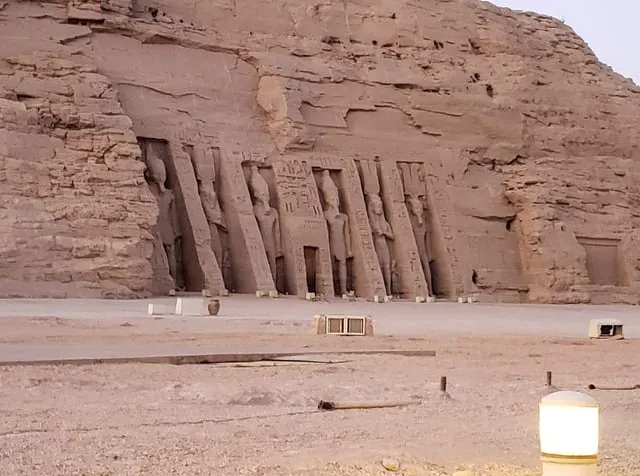
In the sunbaked cliffs of southern Egypt, where the Nile bends toward Nubia, stands one of the most breathtaking tributes to love and divinity — the Small Temple of Abu Simbel, dedicated to Queen Nefertari and the goddess Hathor. Carved during the reign of Pharaoh Ramesses II in the 13th century BCE, this temple immortalizes a queen whose beauty and wisdom earned her not only her husband’s devotion but also a place among the gods.
Today, more than 3,200 years later, the temple still radiates with her presence — an enduring reminder of a love story etched in stone and sunlight.
A Monument to Love: Ramesses II and Queen Nefertari
Few stories from ancient Egypt capture the imagination like that of Ramesses II and Queen Nefertari Meritmut, whose name means “Beautiful Companion, Beloved of Mut.” Ramesses II, often hailed as one of Egypt’s greatest pharaohs, ruled for over six decades during a time of prosperity, military triumph, and monumental architectural achievement.
Among his many building projects, none speak so eloquently of personal affection as the temple he built for Nefertari at Abu Simbel. While pharaohs often celebrated their divine power and victories, Ramesses chose to carve in stone his reverence for his queen — a rare gesture in the annals of Egyptian history.
The Temple of Abu Simbel: A Twin Marvel
The Abu Simbel complex consists of two grand temples hewn from the cliffs overlooking the Nile: the Great Temple, dedicated to Ramesses II himself, and the Small Temple, dedicated to Nefertari and the goddess Hathor.
While the Great Temple glorifies the might of the pharaoh and the gods of Egypt, the Small Temple stands as a softer, more intimate counterpart — a symphony of devotion, artistry, and divine femininity.
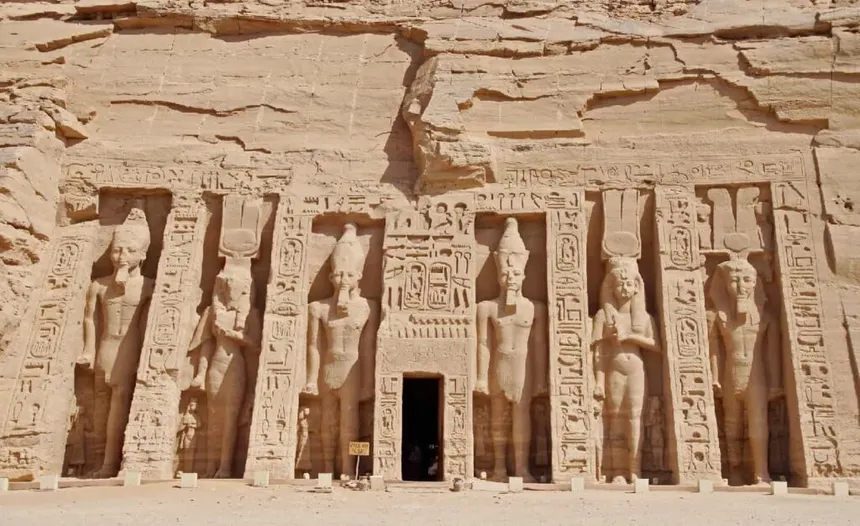
What makes this temple extraordinary is the equal scale of Nefertari’s statues to those of Ramesses II. In most Egyptian monuments, queens were depicted much smaller than their royal husbands, symbolizing secondary status. But here, Nefertari stands as his equal, carved with the same grandeur — a testament to her significance and the deep affection Ramesses bore for her.
The Divine Queen and the Goddess Hathor
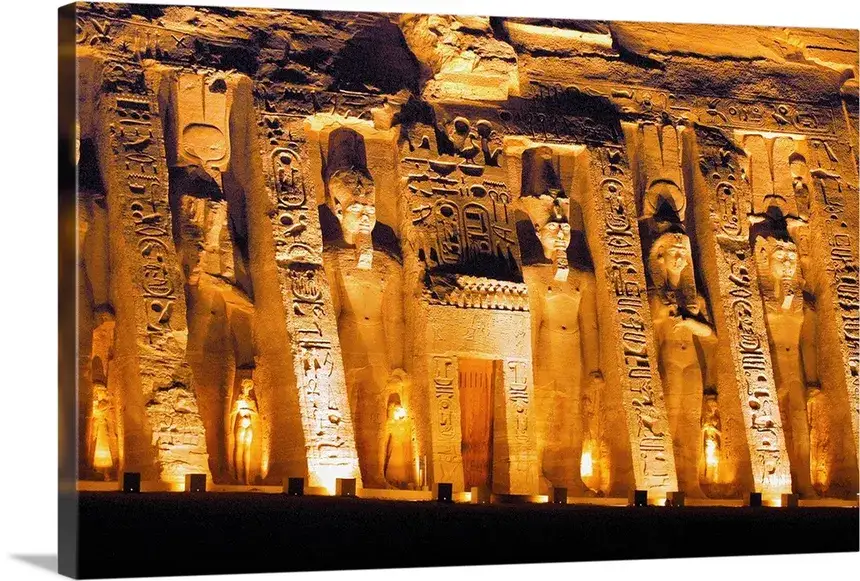
At the entrance of the Small Temple, six colossal statues rise — four of Ramesses II and two of Queen Nefertari. Each figure stands over ten meters tall, carved directly into the sandstone cliffs. Nefertari is easily recognizable by her Hathoric crown — a solar disk embraced by cow horns, a symbol of fertility, motherhood, and celestial protection.
Hathor, the goddess of love, music, and joy, was believed to embody the feminine essence of creation and was often associated with queens. Through this temple, Nefertari is not only celebrated as a beloved wife but also as the earthly manifestation of Hathor, merging mortal grace with divine power.
Inscriptions around the statues proclaim her as “the one for whom the sun rises,” suggesting that Nefertari was the very light that illuminated the life of the pharaoh.
Artistry in Stone: The Inner Chambers
Stepping into the temple’s interior, visitors are greeted by a symphony of ancient Egyptian art, color, and symbolism. The walls are adorned with vivid reliefs depicting Nefertari participating in rituals. Playing music before Hathor, and standing alongside Ramesses in acts of devotion.
In the sanctuary, the goddess Hathor herself is represented as a sacred cow. Emerging from the mountain — her divine face watching over Nefertari. Every carving, every hieroglyph, and every hue of faded pigment tells a story of reverence and eternal harmony.
The artistry demonstrates not just architectural brilliance but also a deep understanding of spiritual symbolism. An intertwining of love, divinity, and immortality.
Rediscovery of the Temple: A Gift from the Sands of Time
For centuries, the temples of Abu Simbel lay buried under desert sands, hidden from human eyes. In 1813, Swiss explorer Johann Ludwig Burckhardt stumbled upon the upper part of the Great Temple’s façade. A year later, Italian adventurer Giovanni Belzoni succeeded in excavating the entrance. Revealing one of the most remarkable archaeological treasures of ancient Egypt.
The Small Temple of Nefertari was soon uncovered, its carvings and inscriptions remarkably well preserved. Scholars were stunned not only by its beauty but also by its message. A rare and profound declaration of love and respect between a pharaoh and his queen.
A Modern Miracle: The Rescue of Abu Simbel
In the 1960s, the construction of the Aswan High Dam threatened to submerge Abu Simbel beneath the rising waters of Lake Nasser. In an unprecedented international effort led by UNESCO. The entire temple complex was dismantled and relocated piece by piece to higher ground.
Over 2,000 blocks, each weighing up to 30 tons, were carefully moved and reassembled to preserve this world wonder. Today, the temples of Abu Simbel stand not only as monuments of ancient glory. But also as symbols of modern unity in preserving humanity’s shared heritage.
Symbolism and Legacy of Nefertari
Queen Nefertari’s image at Abu Simbel transcends time. She represents not only royal elegance but also the spiritual harmony between man and woman, pharaoh and queen, human and divine.
Her serene face, crowned with the sun disk and horns of Hathor. Reflects the Egyptian belief that love itself was a sacred force — one capable of bridging heaven and earth.
Nefertari’s tomb in the Valley of the Queens (QV66). Often called “the Sistine Chapel of Ancient Egypt,” echoes this same reverence. Its vivid paintings celebrate her journey to eternity, guided by the gods she once worshipped.
Together, her tomb and the Abu Simbel temple form a complete narrative: life, love, death, and rebirth. The eternal cycle of devotion.
Conclusion: The Stone That Still Breathes Love
Standing before the temple of Nefertari at Abu Simbel. It’s impossible not to feel the pulse of ancient affection carved into the rock. The desert wind whispers across millennia, carrying echoes of a pharaoh’s voice. A hymn to his queen, his muse, his goddess.
“The one for whom the sun rises”. These words remain inscribed in eternity, proving that even stone can carry the warmth of a beating heart. In Nefertari’s calm smile and Hathor’s divine gaze. The world finds not just art or history, but the eternal heartbeat of devotion that transcends time itself.
ALSO READ: The Mummified Head of a Woman – Whispers Through Time