Puma Punku: The Mysterious Megalithic Marvel of Tiwanaku 🗿✨
A Timeless Enigma in the Andes
High in the Bolivian Andes, on the windswept plains near Lake Titicaca, stands one of the most perplexing archaeological sites in the world—Puma Punku. Part of the ancient city of Tiwanaku, Puma Punku has fascinated archaeologists, historians, and enthusiasts alike for centuries.
Constructed around 536 AD, this monumental complex showcases stonework so precise and sophisticated that it continues to defy complete explanation. While the Tiwanaku civilization thrived between 300 and 1000 AD, much of their culture—including their writing system—remains lost to time. This leaves Puma Punku not only as a site of architectural brilliance but also as a puzzle that raises more questions than it answers.
The Tiwanaku Civilization: Architects of the Altiplano
A Pre-Inca Powerhouse
The Tiwanaku civilization was one of the most influential pre-Columbian cultures in South America. Centered around the city of Tiwanaku, it flourished on the Altiplano, a high-altitude plateau nearly 13,000 feet above sea level.
Cultural Significance
-
Tiwanaku served as a religious, political, and economic hub.
-
Its influence stretched across modern-day Bolivia, Peru, and Chile.
-
The Tiwanaku left no written records, making their belief systems, technologies, and history enigmatic.
Puma Punku remains one of the civilization’s crowning achievements, reflecting both its engineering prowess and cultural complexity.
Puma Punku: A Megalithic Wonder
The Monumental Stones
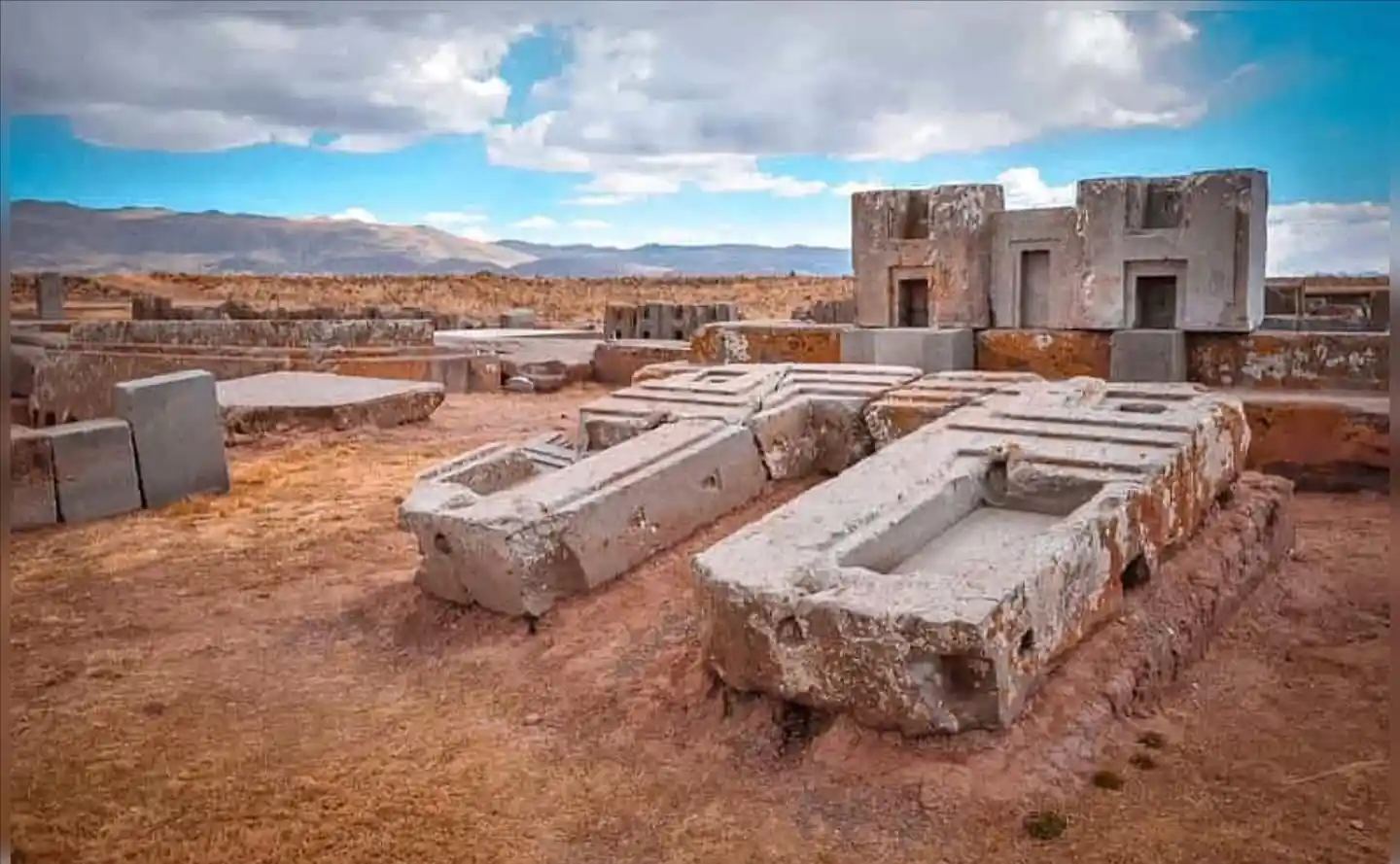
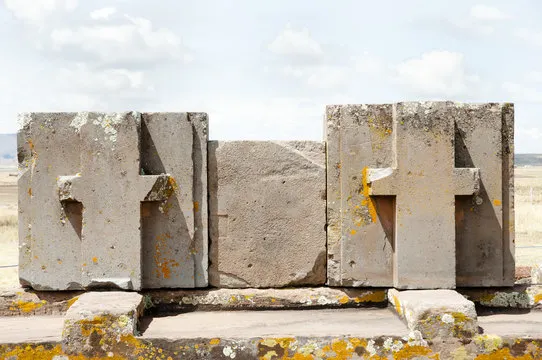
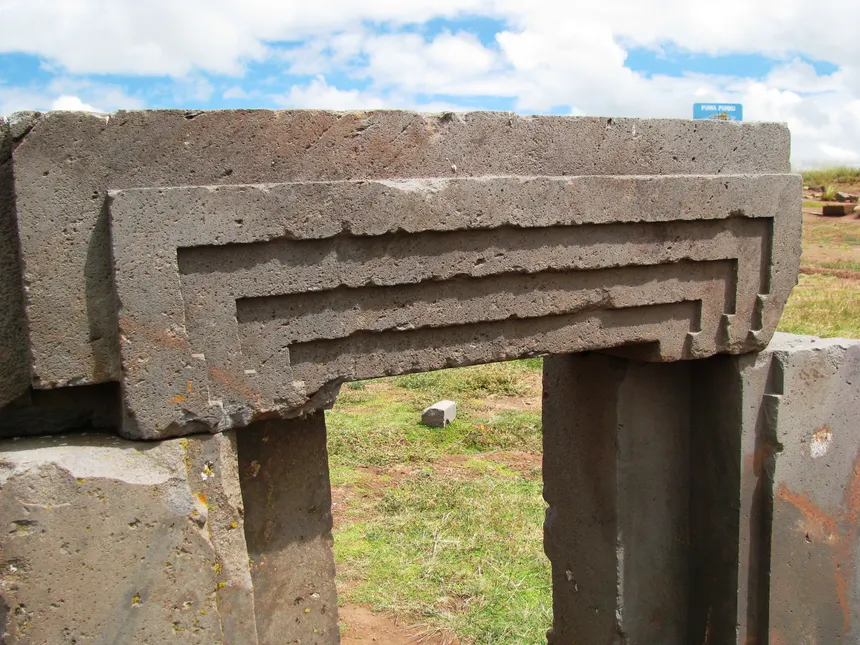
At the heart of Puma Punku are massive sandstone and andesite blocks, some weighing over 100 tons. These stones are not only enormous but also carved with incredible precision—a hallmark of the site’s mystery.
The Iconic H-Shaped Blocks
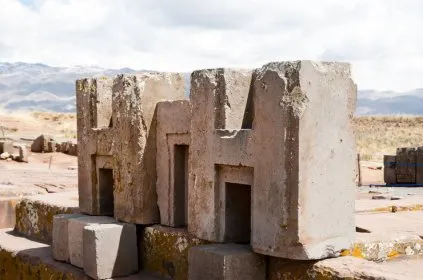
The most famous feature of Puma Punku is its interlocking H-shaped blocks:
-
Each block has around 80 faces, cut with perfect right angles.
-
The stones fit together so precisely that even today, a razor blade cannot pass between them.
-
Their modular design suggests an advanced understanding of geometry and construction.
Modular Engineering
Unlike other ancient structures, Puma Punku’s blocks appear to be designed in a prefabricated, modular system. This points to a level of planning and standardization rarely seen in ancient architecture.
The Mysteries of Construction
How Were the Stones Cut?
One of the greatest puzzles of Puma Punku is the stone-cutting techniques:
-
Traditional tools like bronze chisels would not have been strong enough to shape hard andesite.
-
Some researchers speculate about the use of sophisticated tools or even geopolymer “concrete” techniques.
-
Others propose that the Tiwanaku had access to unknown stone-softening methods, though this remains speculative.
Transportation and Placement
Equally baffling is how the Tiwanaku transported these colossal stones:
-
Some blocks weigh over 100 tons and were quarried miles away from the site.
-
Moving them across the rugged Andean terrain at such altitude seems almost impossible without advanced logistics.
-
The placement of stones with such exactness raises further questions about the methods employed.
Purpose and Function: What Was Puma Punku For?
Religious and Ceremonial Center
Many archaeologists believe Puma Punku was part of a spiritual or ceremonial complex:
-
It may have served as a gateway or temple within the broader Tiwanaku city.
-
Its alignment with astronomical events suggests it may have been connected to cosmology and ritual practices.
Symbol of Power and Knowledge
The precision of Puma Punku could also have symbolized the authority and sophistication of the Tiwanaku civilization, projecting power to allies and rivals alike.
Alternative Theories
Beyond mainstream archaeology, Puma Punku has inspired more speculative ideas:
-
Some suggest it was built with knowledge from lost civilizations.
-
Others theorize it reflects extraterrestrial influence due to its futuristic design.
While such ideas remain unproven, they highlight the site’s enduring aura of mystery.
Archaeological Discoveries and Research
Excavations and Findings
Over the years, excavations at Puma Punku have uncovered:
-
Remnants of stone foundations suggesting large temple structures.
-
Evidence of metal clamps or “I-shaped” fasteners once used to hold blocks together.
-
Artifacts linking the site to ritual practices and Tiwanaku cosmology.
The 536 AD Connection
Interestingly, Puma Punku is believed to have been constructed around 536 AD, a year marked globally by a climatic catastrophe caused by volcanic eruptions. Some scholars suggest that Puma Punku’s construction may have been part of a spiritual or cultural response to environmental upheaval.
Puma Punku in Comparison with Other Ancient Sites
Puma Punku stands alongside the world’s most mysterious megalithic sites:
-
Stonehenge (England): Known for astronomical alignment but far less precise in stonework.
-
Machu Picchu (Peru): Another Andean marvel, though built centuries later by the Inca.
-
Egyptian Pyramids: Massive in scale but lacking the modular precision of Puma Punku.
These comparisons highlight Puma Punku’s uniqueness and its place as one of the greatest enigmas of ancient engineering.
Preservation and Challenges
Current Condition
Much of Puma Punku lies in ruins, with stones scattered as if toppled by a great force—possibly earthquakes or even looting over centuries.
Conservation Efforts
Bolivian authorities and UNESCO have recognized Puma Punku’s importance, but challenges remain:
-
Weathering at high altitude continues to erode the stones.
-
Limited resources hinder comprehensive excavation and restoration.
-
Growing tourism risks damaging the fragile site.
Why Puma Punku Still Captivates the World
Puma Punku is more than just an archaeological site—it is a symbol of human ingenuity and mystery. Its allure lies in the balance between what we know and what remains unanswered:
-
We know it was built by the Tiwanaku with extraordinary skill.
-
We don’t know how they achieved such precision with the tools available.
-
We don’t know the exact purpose of the complex or why it eventually fell into ruin.
This blend of knowledge and enigma keeps Puma Punku at the center of both scientific study and popular imagination.
Conclusion: The Eternal Puzzle of Puma Punku
The mystical precision of Puma Punku challenges our assumptions about ancient civilizations. Built nearly 1,500 years ago by the Tiwanaku, this megalithic marvel showcases engineering skills that seem centuries ahead of their time.
From its massive interlocking stones to its mysterious construction techniques, Puma Punku continues to raise questions that modern science has yet to fully answer. Whether seen as a triumph of ancient ingenuity or as a riddle still awaiting its solution, Puma Punku remains one of the world’s greatest archaeological enigmas.
As the winds sweep across the Bolivian highlands, the stones of Puma Punku whisper stories of a civilization both brilliant and mysterious—inviting us to keep searching for answers hidden in the past.
ALSO READ: The Lost Cities of the Amazon: Unveiling Ancient Civilizations with LIDAR Technology 🌿✨