The Precision of Priene: Ancient Greek Stonework That Defies Time and Tools
A City Carved with Unnatural Precision
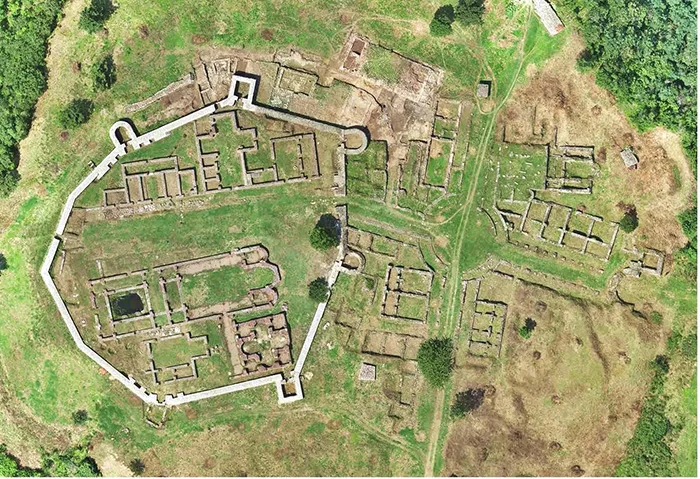
High in the hills of western Turkey, the ruins of Priene stand as a testament to the architectural brilliance of ancient Greece. Once a thriving city of philosophers, artists, and builders, Priene is now a site of intrigue—not just for its beauty, but for the astonishing precision of its stonework.
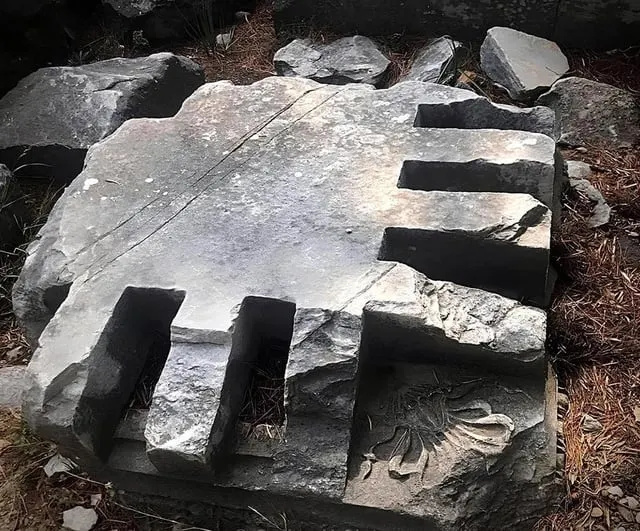
Recent archaeological studies and on-site observations have revealed blocks of marble and limestone carved with mathematical accuracy—edges so sharp and surfaces so smooth that they seem to defy the crude hand tools of the 4th century BC. Some stones appear to have been cut with mechanical precision, as if sliced by a machine capable of uniform depth and symmetry.
These findings have ignited one of archaeology’s most enduring debates: how did ancient craftsmen achieve such perfection with only bronze and iron chisels, wooden mallets, and rudimentary measuring tools?
1. The City of Priene: A Jewel of the Classical World
Founded in the 4th century BC, Priene was a meticulously planned city overlooking the Maeander River Valley (modern-day Menderes River). Built during the Hellenistic period, it reflected the ideals of order, geometry, and harmony that defined Greek civilization.
At its heart stood the Temple of Athena Polias, designed by Pytheos, the same architect behind the Mausoleum at Halicarnassus—one of the Seven Wonders of the Ancient World. The temple, along with Priene’s grid-patterned streets, theaters, and public buildings, showcased the pinnacle of Greek urban design.
Yet it’s the stone blocks themselves, found throughout the city, that have captivated modern researchers. Their edges are perfectly squared, their joints so tight that a blade cannot fit between them, and their carved surfaces display a smoothness rivaling modern machining.
2. The Enigma of the Perfect Cuts
What makes the Priene stone cuts so mysterious is not merely their precision, but their uniformity. Across multiple structures—including temples, retaining walls, and stairways—archaeologists have found:
-
Parallel grooves with consistent depth and spacing.
-
Angle cuts at near-perfect right angles.
-
Smooth, polished faces lacking visible tool marks.
-
Symmetrical notches and channels, as if machined.
When viewed closely, these details challenge the notion of hand-carved stone. Even with sharp chisels and years of training, such uniformity would require extraordinary skill—and time.
Some experts argue that the cuts appear too refined for bronze or iron chisels to have achieved without modern aids. Others, however, point to the Greeks’ mastery of geometry, measurement, and repetitive craftsmanship, suggesting that patience and technique—not technology—were the keys to their success.
3. Mainstream Archaeology: Skill, Tools, and Time
According to mainstream archaeology, the precision of Priene’s stonework was accomplished through traditional hand tools and systematic labor. Ancient builders employed:
-
Bronze or iron chisels, sharpened regularly.
-
Stone hammers and wooden mallets for impact.
-
Polishing abrasives, like emery or sand, for smooth finishes.
-
Measuring cords, plumb lines, and set squares to maintain accuracy.
Each block would have taken days or weeks to carve and fit. The Greeks, deeply devoted to proportion and harmony, invested meticulous effort into achieving visual and structural perfection—especially in sacred buildings like the Temple of Athena.
In this view, the precision cuts are not evidence of lost technology, but of extraordinary human dedication and mathematical understanding.
4. Alternative Theories: Lost Knowledge or Ancient Technology?
Despite the mainstream consensus, many independent researchers and alternative historians propose that something more sophisticated was at play.
They point to the following anomalies:
-
Some cuts appear laser-straight, as though made by a mechanical saw.
-
Surfaces show microscopic striations inconsistent with hammer-and-chisel work.
-
The hardness of local stone, such as marble, would have quickly dulled bronze tools.
This has led to speculation about lost techniques or forgotten technologies—methods perhaps using early forms of abrasive cutting wheels, heat treatment, or even vibration-assisted tools unknown to modern archaeology.
Others go further, suggesting that Priene’s builders inherited advanced stonemasonry knowledge from earlier civilizations, possibly from Egypt or Mesopotamia, where similarly inexplicable precision has been observed in monuments like the Pyramids of Giza or the Osireion of Abydos.
While there is no direct evidence of machines or power tools, the idea that the ancients possessed unrecorded engineering techniques continues to fascinate researchers who see the Priene stones as echoes of lost mastery.
5. Geometry, Symmetry, and the Greek Mind
Regardless of the tools used, what truly sets Priene apart is the mindset behind its construction. Ancient Greek architecture was guided by mathematical order and proportion—concepts tied to both aesthetics and philosophy.
The architects of Priene followed the principles of Pythagoras and Euclid, applying geometry to achieve visual harmony. Even if done by hand, each groove and angle was calculated to align with precise ratios that governed the city’s design.
For the Greeks, architecture wasn’t merely functional—it was a spiritual and intellectual expression of cosmic balance. Thus, every perfect cut served a higher purpose: to mirror the perfection of the divine order.
6. The Temple of Athena: Perfection in Stone
The Temple of Athena Polias remains the crowning achievement of Priene’s builders. Its foundations reveal immaculately joined marble blocks, each shaped to fit seamlessly without mortar.
The temple’s geometry was based on modular design, where each element—from columns to capitals—followed exact proportional rules. Even after 2,300 years, the alignment of its surviving stones remains near-perfect, with no significant shifting or deformation.
To ancient observers, such craftsmanship symbolized divine harmony and permanence—a monument that could withstand both time and nature.
7. Lessons from Priene: Rediscovering Ancient Genius
The mystery of Priene’s precision stonework invites us to reconsider the capabilities of ancient engineers. Whether achieved by hand tools or forgotten techniques, the results demonstrate incredible discipline, intellect, and artistry.
It challenges the modern assumption that technological progress is linear—that sophistication always increases over time. Instead, sites like Priene remind us that ancient civilizations possessed forms of knowledge and craftsmanship that we are only beginning to appreciate.
Perhaps what seems mysterious today will one day be understood not as alien or supernatural, but as the product of a deeply human pursuit of perfection.
8. Preserving the Legacy of Priene
Today, Priene is one of Turkey’s most well-preserved ancient cities, drawing archaeologists, architects, and tourists from around the world. Walking through its ruins, one can still see the impeccable lines and angles carved over two millennia ago—each a silent testament to the genius of its builders.
Preservation efforts continue under the Turkish Ministry of Culture and international teams, who seek to document and protect these irreplaceable relics of the ancient world. As technology advances, 3D scanning and laser mapping may one day reveal the precise methods used to create these enigmatic cuts.
Until then, the stones of Priene remain both a scientific puzzle and a philosophical wonder—proof that the quest for perfection is as old as civilization itself.
Conclusion: The Enduring Enigma of Priene’s Stonework
Whether explained by traditional craftsmanship or lost technology, the Priene stone cutting mystery endures as one of archaeology’s most fascinating enigmas. The city’s razor-sharp lines and seamless joins remind us that ancient architects were not merely builders—they were visionaries who merged art, science, and spirit into every block they shaped.
From the Temple of Athena to the city’s grid-lined streets, Priene stands as a monument to precision, intellect, and timeless beauty—a masterpiece that continues to blur the line between ancient genius and ancient mystery.
ALSO READ: The Baigong Pipes Mystery: China’s 150,000-Year-Old Enigma Beneath Mount Baigong