Plimpton 322: The Babylonian Clay Tablet That Rewrote the History of Trigonometry
A Puzzle from the Past
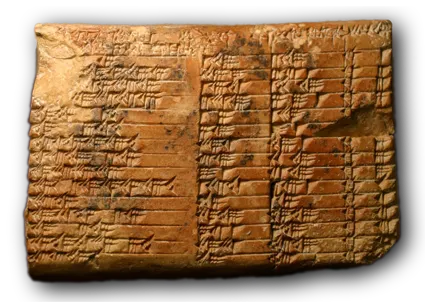
In a museum drawer in New York City sat an unassuming fragment of clay. Its surface was etched with wedge-shaped marks—cuneiform, the writing system of ancient Mesopotamia. To the casual observer, it looked like just another relic from a world long gone. To scholars, it was Plimpton 322, a Babylonian artifact dated to around 1800 BCE, over 3,700 years ago.
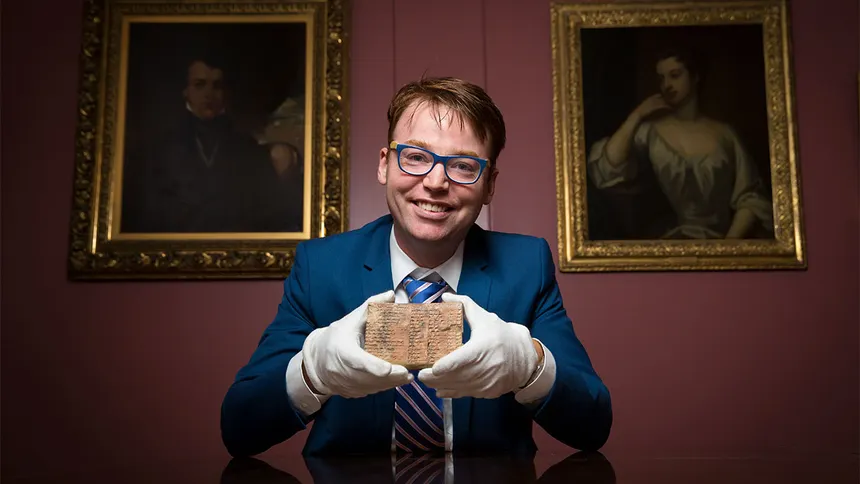
For decades, its meaning remained a mystery. Then, in 2017, a breakthrough came. An Australian mathematician, Dr. Daniel Mansfield of the University of New South Wales, decoded its true purpose. What he discovered stunned the world: Plimpton 322 is the oldest known trigonometric table, predating Greek geometry by more than a thousand years.
This discovery not only reshaped our understanding of mathematics but also highlighted the astonishing sophistication of Babylonian science and engineering.
The Discovery of Plimpton 322
Plimpton 322 was named after George Arthur Plimpton, an American publisher and collector of rare manuscripts. He purchased the clay tablet in the early 20th century, and it eventually became part of Columbia University’s collection.
The tablet itself is modest in size—about 13 centimeters wide and 9 centimeters tall. Broken and incomplete, it carries four columns and fifteen rows of numbers written in cuneiform script. For nearly a century, researchers debated its meaning, some suggesting it was a list of mathematical exercises, others seeing it as a set of astronomical records.
The real revelation, however, came only in the 21st century.
Cracking the Code: A Babylonian Trigonometric Table
Dr. Mansfield and his team realized that the numbers on Plimpton 322 weren’t random. Instead, they represented a systematic list of Pythagorean triples—sets of three whole numbers that satisfy the equation:
a2+b2=c2a^2 + b^2 = c^2
For example, the classic triple (3, 4, 5) forms a right-angled triangle. What the Babylonians had done, however, was extraordinary. Instead of expressing trigonometry in terms of angles and circles, as later Greek mathematicians like Hipparchus or Ptolemy did, they used ratios of sides.
This approach made their trigonometry more precise, since they avoided the rounding errors introduced by angle-based calculations.
Why It Matters: Babylonian Genius Ahead of Its Time
The implications of Plimpton 322 are staggering. It shows that:
-
Trigonometry did not begin with the Greeks: The Babylonians had already developed an advanced system of right-angled triangle mathematics a millennium earlier.
-
Base-60 mathematics was incredibly powerful: Their sexagesimal (base-60) number system allowed for more accurate fractions than our modern base-10 system. This same logic still governs how we measure time—60 seconds in a minute, 60 minutes in an hour.
-
Practical engineering drove mathematical innovation: The table likely served as a tool for architects and engineers designing canals, ziggurats, and temples, ensuring structural precision.
In other words, the Babylonians were not only doing mathematics—they were applying it to reshape their world.
Plimpton 322 and Pythagorean Triples
At the heart of the tablet lies a catalogue of Pythagorean triples. These sets of numbers describe perfect right-angled triangles.
For example:
-
(3, 4, 5)
-
(5, 12, 13)
-
(8, 15, 17)
Plimpton 322 contains 15 rows of such ratios, each row more complex than the last. This systematic list suggests not just mathematical curiosity, but a deliberate attempt to construct a reference table for practical use.
How Did the Babylonians Use It?
So, what exactly was Plimpton 322 for? Scholars believe it had several possible applications:
-
Architectural Design: Builders may have used the table to calculate precise right angles when constructing monumental buildings, from ziggurats to palaces.
-
Surveying and Land Division: Accurate right triangles would have been essential for measuring fields and plotting irrigation canals.
-
Astronomical Calculations: Babylonian priests were keen astronomers; such mathematics may have supported their celestial observations.
Regardless of the specific use, the tablet demonstrates that mathematics was not an abstract pursuit in Babylon—it was a practical tool of empire and religion.
Comparison with Greek Trigonometry
The discovery of Plimpton 322 challenges a long-held narrative: that trigonometry began with the Greeks around 120 BCE.
Greek mathematicians like Hipparchus are often credited with inventing trigonometric tables, but the Babylonians had already compiled one over a thousand years earlier.
The main difference lies in method:
-
Babylonians: Used ratios of sides, avoiding approximation errors.
-
Greeks: Introduced angles, arcs, and circles, shaping the trigonometry we know today.
Ironically, in certain calculations, the Babylonian system was more accurate than the Greek one, a reminder that progress is not always linear.
Legacy of Plimpton 322
Today, Plimpton 322 is more than an artifact—it is a testament to the brilliance of ancient civilizations. It reveals:
-
The Babylonians had mathematical insights long before they were thought possible.
-
Knowledge in history often shifts when new evidence emerges.
-
Ancient innovations still shape our modern world in subtle ways.
This clay tablet, carved nearly four millennia ago, continues to rewrite the story of human knowledge.
The Human Side of the Tablet
Beyond numbers and equations, Plimpton 322 invites us to imagine the scribe who created it. Picture a Babylonian scholar, stylus in hand, carefully pressing wedge-shaped marks into wet clay. He wasn’t just recording numbers—he was encoding a system of knowledge that would outlast empires.
For him, these ratios weren’t abstract puzzles. They were tools of creation, guiding the construction of canals that fed cities and temples that touched the sky.
Conclusion: Clay, Cosmos, and Human Ingenuity
Plimpton 322 reminds us that the story of mathematics is not just about numbers—it’s about people, cultures, and civilizations reaching for order in the cosmos.
The Babylonians carved into clay a system of trigonometry so advanced that it still challenges our modern assumptions. They were not simply keeping records; they were solving the universe with clay and a stylus.
The world once thought the Greeks invented trigonometry. The truth? The Babylonians were already there, quietly shaping their world with precision, vision, and genius nearly 4,000 years ago.
ALSO READ: The Mold Gold Cape: A Masterpiece of Bronze Age Craftsmanship