The Mystery of the Phaistos Disc: An Undeciphered Ancient Enigma
A Timeless Archaeological Puzzle
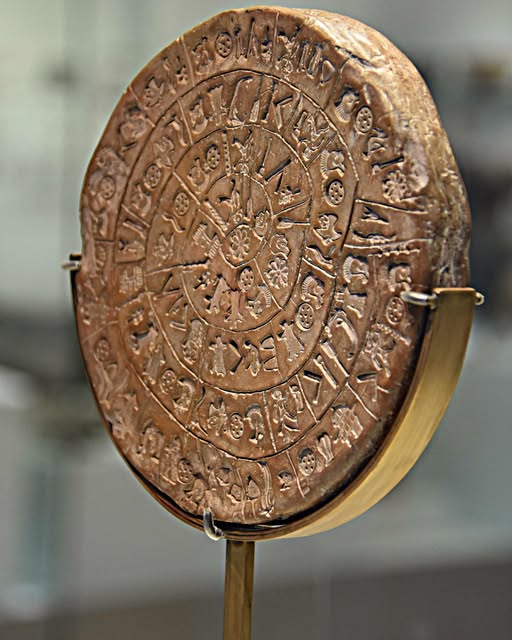
Discovered in 1908 by Italian archaeologist Luigi Pernier, the Phaistos Disc stands as one of the most intriguing and unsolved mysteries of archaeology. This small clay artifact, dating back to the second millennium B.C., was unearthed at the Minoan palace of Phaistos on the island of Crete. What makes it extraordinary are the 241 unique symbols arranged in a spiral pattern across both sides of the disc. Despite over a century of study, the meaning and purpose of these symbols remain undeciphered, sparking endless debates among historians, archaeologists, and linguists.
Today, the disc is preserved at the Heraklion Archaeological Museum in Crete, where it continues to captivate scholars and visitors alike. But what is the Phaistos Disc, and why does it remain such a compelling archaeological mystery?
Discovery of the Phaistos Disc
In July 1908, Luigi Pernier, an Italian archaeologist, discovered the Phaistos Disc during excavations at the Minoan palace of Phaistos in southern Crete. The palace itself was one of the largest and most important centers of the Minoan civilization, a culture that flourished between 2000 and 1400 B.C.
The disc was found in a basement room believed to be a shrine or storeroom. Made of fired clay and about 16 cm (6.3 inches) in diameter, it featured a design unlike anything else from the ancient world. Its most unusual feature is the set of stamped symbols—created using pre-formed stamps rather than being inscribed by hand—making it one of the earliest known examples of movable type printing in history.
Physical Description of the Disc
The Phaistos Disc is circular and relatively flat, with a diameter of about 16 cm and a thickness of 2 cm. Both sides are decorated with spirals of carefully arranged symbols that appear to radiate toward the center.
-
Total symbols: 241
-
Distinct signs: 45
-
Arrangement: Spiraling inward in clockwise order
The symbols themselves include representations of human figures, animals, tools, plants, and abstract patterns. Some of the most recognizable signs resemble shields, arrows, boats, and even a plumed head.
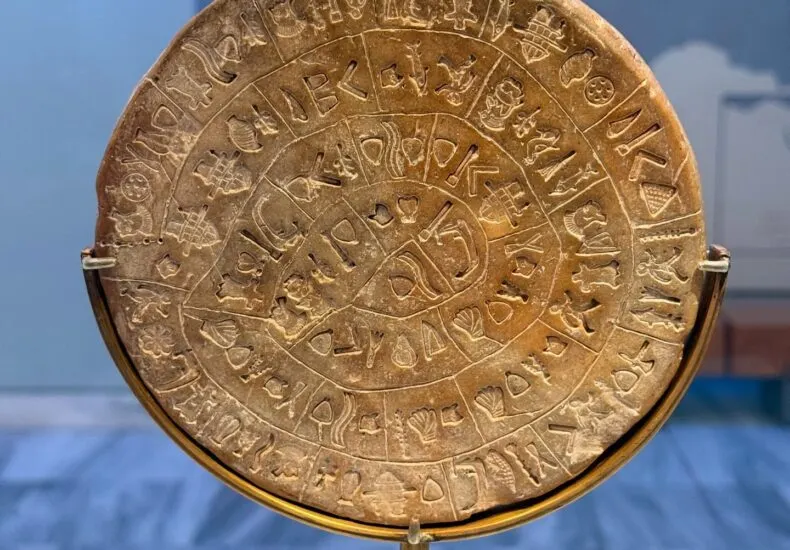
The Unique Symbols of the Phaistos Disc
The symbols are unlike any known writing system from the ancient world. While they bear superficial resemblance to scripts like Egyptian hieroglyphs or Linear A (another undeciphered Minoan script), they form a distinct system with no confirmed connections.
The disc’s spiral arrangement suggests a deliberate and possibly ritualistic purpose. Some scholars believe it could represent a hymn, a prayer, or even a calendar. Others argue it might have served as a game, a legal document, or a magical charm.
Theories Surrounding the Phaistos Disc
1. A Religious Text
Many researchers propose that the disc could have had a religious function, possibly recording hymns, prayers, or ceremonial chants. Its spiral design may symbolize the cyclical nature of life and death, a common theme in Minoan spirituality.
2. A Calendar or Astronomical Tool
Some scholars suggest that the 45 distinct symbols and their arrangements may represent astronomical or calendrical cycles. The Minoans were skilled astronomers, and the disc could have been used to track lunar or solar events.
3. A Legal or Administrative Record
Given the prominence of the palace at Phaistos, the disc may have contained official records—perhaps inventories, laws, or treaties. However, the uniqueness of the script makes this difficult to verify.
4. A Board Game or Puzzle
Another intriguing theory is that the disc functioned as a form of entertainment. Its spiral design could resemble a game board, though no similar artifacts have been discovered to support this theory.
5. A Forgery?
A controversial minority theory suggests the Phaistos Disc might be a modern forgery planted in the early 20th century. However, most experts dismiss this idea, pointing to its stylistic and archaeological consistency with other Minoan artifacts.
Why Has the Disc Not Been Deciphered?
Unlike other undeciphered scripts, such as Linear A, the Phaistos Disc poses a unique challenge because it exists as a single artifact. Without additional examples for comparison, linguists have no way to establish grammar, syntax, or vocabulary.
Furthermore, since the symbols are not identical to any known writing system, scholars cannot rely on cross-references to decipher their meaning. The lack of context makes interpretation nearly impossible, leaving the disc an open-ended mystery.
The Phaistos Disc in Modern Culture
The disc’s enigmatic nature has captured the imagination of people beyond the field of archaeology. It frequently appears in:
-
Documentaries and books about ancient mysteries
-
Museums and exhibitions as a symbol of the unknown
-
Popular culture, including video games, novels, and movies, where it often represents lost knowledge or secret codes
Its combination of artistry, mystery, and historical importance has made the Phaistos Disc an enduring symbol of humanity’s unending curiosity about the past.
Visiting the Phaistos Disc Today
The original Phaistos Disc is housed at the Heraklion Archaeological Museum in Crete, Greece. Visitors can see it alongside other remarkable Minoan artifacts, including frescoes, pottery, and jewelry.
Standing before the disc, one can’t help but feel awe at its mysterious symbols, knowing that despite over a century of research, the artifact still refuses to reveal its secrets.
Why the Phaistos Disc Matters
The significance of the Phaistos Disc lies not only in its mystery but also in what it represents:
-
Innovation: It may be one of the earliest known examples of stamping or printing technology.
-
Cultural insight: It offers a rare glimpse into Minoan symbolism and communication.
-
Enduring mystery: Its undeciphered script highlights the limitations of modern archaeology and reminds us that the past still holds secrets.
By studying the disc, scholars are reminded that history is not a closed book but a puzzle still waiting to be solved.
Conclusion: A Mystery That Endures
More than a century after its discovery, the Phaistos Disc mystery remains one of archaeology’s most captivating enigmas. Whether it was a religious text, a calendar, or something else entirely, its symbols continue to puzzle scholars and inspire the public.
Until more evidence is uncovered—or a breakthrough occurs in decipherment—the Phaistos Disc will remain a timeless symbol of the unknown, a reminder that even in our modern age, the past still keeps its secrets.
ALSO READ: The Inzerki Apiary: Morocco’s World-Famous Collective Beehive