Oskar Speck: The Man Who Paddled from Germany to Australia (1932–1939)
A Journey That Began with a Modest Goal
In 1932, a young German named Oskar Speck set out on what he thought would be a short, practical journey. His plan was simple — to paddle his folding kayak from Hamburg down to Cyprus in search of work in the copper mines.
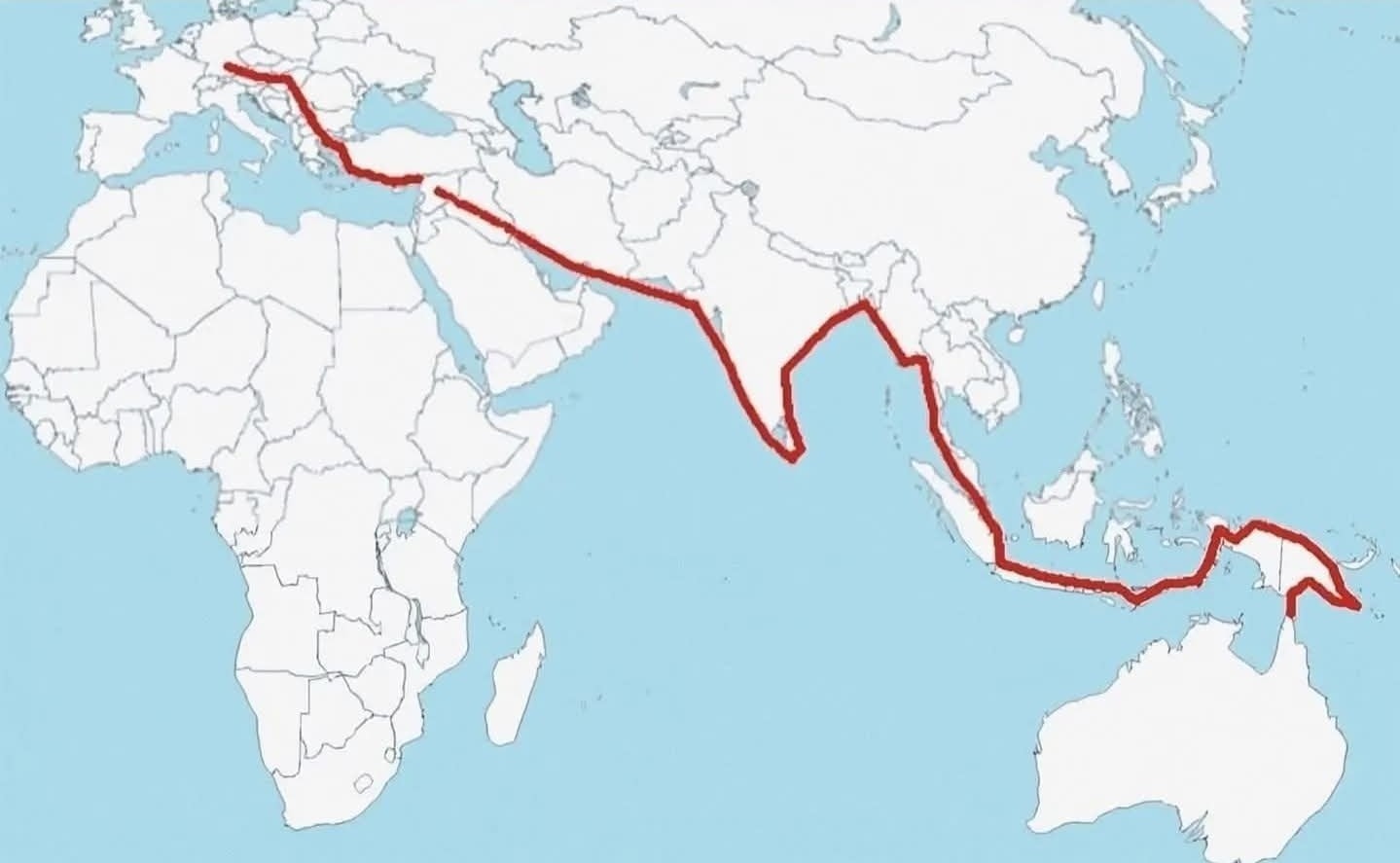
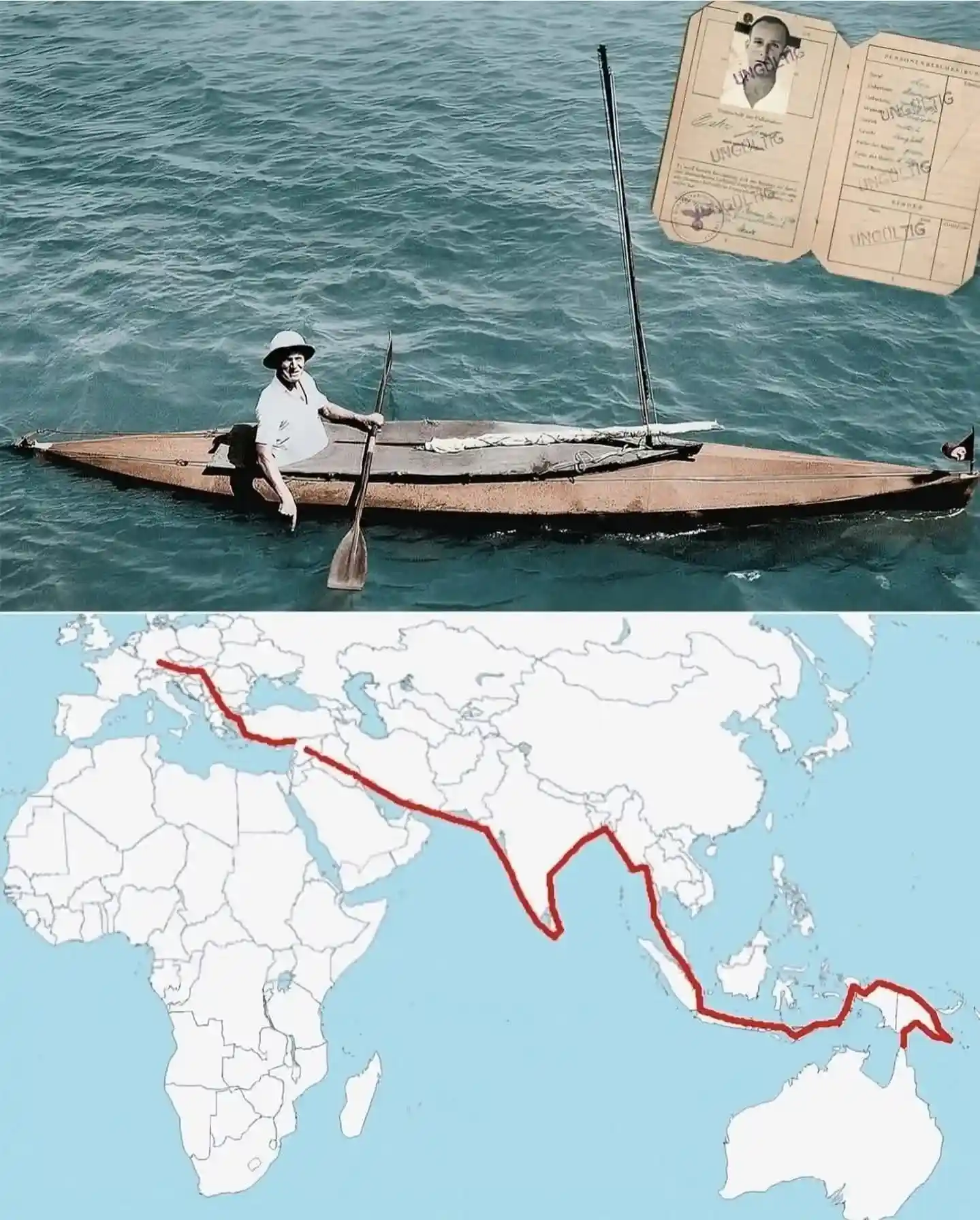
But what began as a modest voyage soon became one of the most extraordinary solo expeditions in modern history. Over the next seven years, Speck would paddle through some of the most dangerous and remote waterways on Earth — covering more than 50,000 kilometers across Europe, the Middle East, India, and Southeast Asia — before finally reaching the shores of Australia in 1939.
His adventure was one of endurance, perseverance, and pure human spirit. Yet, fate would deal him an ironic twist upon his arrival.
The Man Behind the Paddle: Who Was Oskar Speck?
Oskar Speck was born in Hamburg, Germany, in 1907, into a middle-class family. Like many in post–World War I Germany, he grew up during economic hardship. A trained electrical contractor, he lost his job during the Great Depression, leaving him searching for opportunity — and perhaps, purpose.
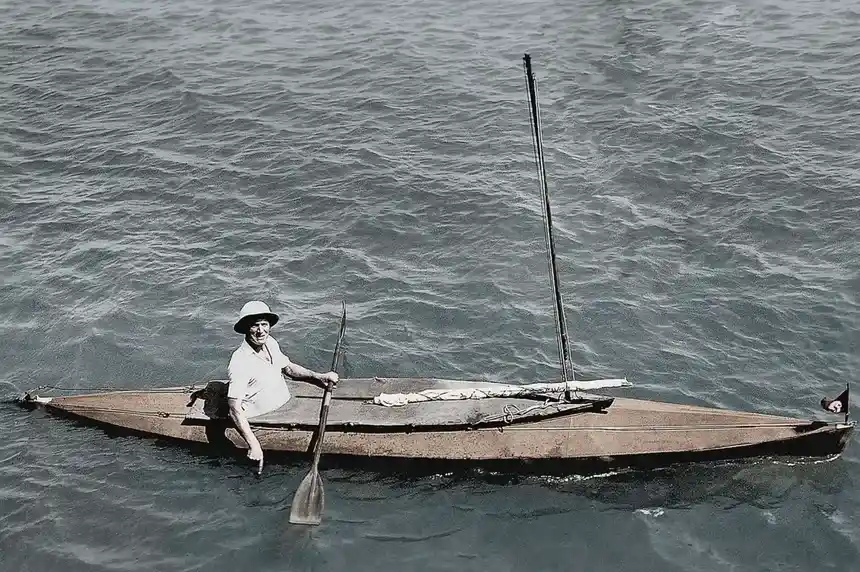
When Speck heard that copper mining jobs were available in Cyprus, he decided to make the journey there — not by train or ship, but in his Klepper folding kayak, a compact, collapsible vessel made of fabric and wood that could be easily carried over land.
It was a bold idea, but it combined two of Speck’s passions: adventure and self-reliance. On May 13, 1932, he launched his kayak into the River Danube — unaware that he was beginning one of the longest kayaking expeditions ever recorded.
Across Europe: The First Leg of the Journey
Speck’s early route took him down the Danube River, flowing through Germany, Austria, Hungary, and Yugoslavia, before entering the Aegean Sea.
He navigated bustling cities and war-scarred villages, often sleeping on riverbanks or in fishermen’s huts. In each country, he became a curiosity — the “German paddler”, traveling alone with nothing but a folding kayak and a few supplies.
By the time he reached the Mediterranean, his goal of reaching Cyprus had already begun to fade. The journey itself had become the purpose. Speck decided to continue eastward — exploring further, pushing harder, and following the call of discovery.
From the Aegean to the Middle East
Speck’s next stage took him across Turkey, paddling through treacherous coastal waters and powerful tides. He often faced hostile conditions — scorching sun, dehydration, and violent storms that could easily have ended his life.
In Syria and Lebanon, he was welcomed by local villagers who offered food and shelter, fascinated by his strange craft. When he finally reached Cyprus, his original destination, he didn’t stop. Instead, he turned south, drawn onward by the challenge of what lay beyond.
Speck’s growing reputation preceded him. Newspapers began reporting on the “German man in the folding kayak,” whose voyage was becoming something of a legend among sailors and explorers.
India and the Longest Stretch of Isolation
By the time Speck arrived in India, it was the mid-1930s. The colonial authorities viewed him with suspicion, but he continued paddling along the coast of the Indian subcontinent, enduring blistering heat, tropical diseases, and exhausting monsoons.
He contracted malaria several times, surviving through sheer resilience and luck. His kayak was damaged by rocks, stolen once, and nearly destroyed by storms on multiple occasions. Yet each time, he repaired it by hand and pushed on.
He wrote later:
“There is only forward. The sea has no sympathy for weakness.”
Along the Indian coast, Speck lived on a diet of fish, coconuts, and canned sardines, sleeping on beaches or in makeshift shelters. His mental endurance was as remarkable as his physical strength.
Through Southeast Asia: Toward the Final Horizon
After years of travel, Speck reached Burma (Myanmar), then Indonesia, and finally Papua New Guinea. By now, he had spent seven years alone at sea, crossing some of the most unpredictable waters in the world.
He paddled through the islands of the Dutch East Indies, navigating coral reefs, crocodile-infested rivers, and dense mangrove swamps. Local villagers often welcomed him, providing food and directions — though some thought him a madman for traveling such distances in a kayak.
His small folding boat, weather-beaten and patched countless times, had become both his home and his lifeline.
Arrival in Australia — and the Twist of Fate
In September 1939, Oskar Speck finally arrived on the northern coast of Australia, near Saibai Island, in the Torres Strait. Exhausted but elated, he had completed a journey of nearly 50,000 kilometers (31,000 miles) — an unprecedented feat of human endurance.
But unknown to him, the world had changed. Germany had just invaded Poland, and World War II had begun.
To Australian authorities, Speck was not an adventurer but a German national arriving during wartime. He was promptly arrested and interned as an “enemy alien.” Instead of being celebrated, he spent the next seven years in internment camps in South Australia and New South Wales.
Despite this tragic irony, Speck bore his fate with the same quiet resilience that had carried him across the world.
Life After the Journey: From Paddles to Opals
When World War II ended in 1945, Oskar Speck was finally released in 1946. Rather than return to Germany, he chose to remain in Australia — the land where his journey had ended.
He settled in Lightning Ridge, New South Wales, where he became an opal miner, living a modest and solitary life. He rarely spoke about his voyage, refusing fame or recognition.
When asked about his motivation, he once said:
“I am satisfied. I know what I’ve done.”
He died in 1993, at the age of 86, leaving behind one of the most astonishing yet understated stories of exploration in modern history.
Legacy: The Forgotten Hero of Exploration
Oskar Speck’s seven-year kayak journey from Germany to Australia remains one of the greatest feats of solo endurance ever recorded. Unlike celebrated explorers with sponsors or crews, Speck traveled alone, without financial backing, and with a folding kayak that he repaired and rebuilt countless times along the way.
Modern adventurers often cite him as an inspiration — proof that determination can defy geography, politics, and even fate itself.
His story also serves as a poignant reflection on how history can misplace its heroes. While others sought fame, Speck sought meaning in motion, and in doing so, achieved something truly extraordinary.
Conclusion: The Quiet Triumph of a Relentless Spirit
Oskar Speck’s journey is more than an adventure story — it is a testament to human perseverance, curiosity, and courage. From the rivers of Europe to the reefs of Australia, he faced every hardship imaginable and refused to quit.
He began as a job seeker, became an explorer, and ended as a legend few knew existed. His kayak carried him across continents, but his will carried him across history.
Though he died quietly, his life remains an anthem for anyone who dares to follow the current beyond the horizon.
ALSO READ: Dance of Death: A 15th-Century Masterpiece at the National Gallery of Slovenia