Operation Beluga: The Incredible 1984 Rescue of 3,000 Trapped Beluga Whales
A Frozen Crisis in the Arctic
In December 1984, the frigid waters of the Chukchi Sea, north of Russia, became the stage for one of the most dramatic wildlife rescue operations in history. Thousands of beluga whales—gentle, intelligent marine mammals known for their distinctive white color and melodic calls—were trapped by fast-forming sea ice. The event, later named Operation Beluga, would unite nations, scientists, and sailors in a daring rescue that combined engineering ingenuity, compassion, and even classical music.
This is the story of how 3,000 beluga whales were given a second chance at life in one of the coldest and most remote regions on Earth.
The Trapping: Nature’s Ice Prison
In late 1984, Arctic temperatures plummeted unusually fast, freezing the Chukchi Sea earlier and thicker than expected.
>A migrating group of approximately 3,000 beluga whales (Delphinapterus leucas) became surrounded by solid ice up to 3 meters thick, leaving them confined to small breathing holes known as polynyas.
These openings, only a few meters wide, were the whales’ only access to air. As the ice thickened, the whales became increasingly desperate, swimming from one small hole to another in search of oxygen. Many began to weaken, and rescuers feared mass suffocation if conditions did not change quickly.
Discovery and First Response
The trapped whales were discovered by local Chukchi hunters and Soviet scientists conducting Arctic research. Word of the crisis soon reached Moscow, prompting a swift and large-scale mobilization.
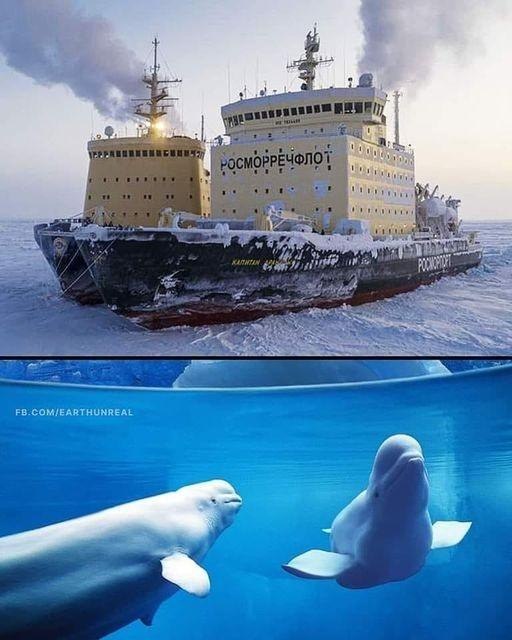
The Soviet authorities decided to send one of their most powerful icebreakers, the Admiral Makarov, to the scene. The Makarov was a reinforced icebreaker vessel, capable of cutting through thick sheets of ice that no ordinary ship could manage.
By December 1984, the rescue operation—later dubbed Operation Beluga—was underway.
The Arrival of the Icebreaker Admiral Makarov
The Admiral Makarov, under the command of Captain Gennady Mikhailovich Yurchenko, reached the trapped pod after a treacherous voyage through shifting ice fields and sub-zero temperatures.

The crew immediately assessed the situation: the whales were scattered across several small open ponds, surrounded by vast expanses of frozen sea. Their survival depended on access to the open ocean, which lay almost 100 miles (160 km) away.
Yurchenko and his crew began to break a path through the ice, creating a narrow channel of open water leading southward. The idea was to guide the belugas through this channel toward the unfrozen sea. However, the whales—weak, disoriented, and fearful—refused to follow.
An Unlikely Solution: Music Under the Ice
After several unsuccessful attempts to lure the whales forward, the crew tried something unconventional. One of the sailors proposed using music to attract the belugas—creatures known for their complex hearing and vocalizations.
The ship’s speakers were lowered toward the water, and the crew began playing classical music, including compositions by Tchaikovsky, Mozart, and Beethoven.
To everyone’s amazement, the belugas began to react. Drawn by the sound, they approached the icebreaker and started moving in the same direction as the ship. Slowly but steadily, the 3,000-strong pod began following the Makarov through the channel, their clicks and whistles mingling with the strains of symphony music echoing across the frozen expanse.
The Journey to Freedom
Over several grueling days, the Admiral Makarov continued its icebreaking journey toward the open ocean, with the whales following behind. The operation was not without casualties—some belugas succumbed to exhaustion or became trapped again in closing ice—but an estimated 2,000 whales successfully reached safety.
The crew worked around the clock, maintaining the channel and ensuring that the ice didn’t refreeze too quickly. Temperatures hovered around -30°C (-22°F), and visibility was often reduced to near zero by blizzards. Yet, determination and teamwork prevailed.
By the end of the operation, the surviving whales had reached the Bering Strait, where the sea remained ice-free. The mission was hailed as an extraordinary example of human cooperation and compassion.
International Collaboration and Media Attention
Though organized by the Soviet Union, Operation Beluga drew interest and support from several countries, including the United States, Canada, and Japan. Marine biologists from these nations provided expertise on whale behavior and Arctic ecology.
The story made international headlines. Newspapers and television networks described it as a “miracle in the ice,” emphasizing the unusual mix of technology, nature, and art that saved thousands of marine lives.
Operation Beluga also became a symbol of Cold War cooperation—a rare moment when rival nations united for a shared humanitarian and ecological cause.
The Legacy of Operation Beluga
Operation Beluga left a lasting mark on marine conservation and the study of Arctic ecosystems. It demonstrated that even large-scale wildlife rescues were possible under extreme conditions when science, technology, and compassion worked hand in hand.
In later years, researchers analyzed the event to better understand beluga migration patterns, communication, and stress behavior. The operation also spurred the creation of new international agreements on Arctic wildlife protection, including measures to monitor ice entrapments and protect migratory routes.
The story of Operation Beluga continues to be cited in marine biology, environmental education, and even music therapy research. Illustrating how sound and empathy can influence animal behavior.
Beluga Whales: The “Canaries of the Sea”
Beluga whales, often called the “canaries of the sea” for their rich vocal repertoire, are highly social and intelligent animals. They inhabit Arctic and sub-Arctic regions and rely on open water for breathing, feeding, and communication.
Trapping incidents like the 1984 event highlight their vulnerability to rapid climate changes and ice dynamics. While global warming has since reduced some Arctic ice. It has also introduced new challenges. Including pollution and increased shipping noise that disrupts beluga communication.

Today, several conservation groups continue to monitor beluga populations, using satellite tracking and underwater acoustics to prevent future large-scale entrapments.
Conclusion: A Symphony of Survival
The story of Operation Beluga 1984 remains one of the most extraordinary rescues in animal history. Against impossible odds, human ingenuity and compassion broke through walls of ice—literally and figuratively—to save thousands of lives.
When the whales followed the music of Tchaikovsky through the frozen sea, it symbolized more than survival. It represented hope, cooperation, and the deep, mysterious connection between humans and the natural world.
Decades later, Operation Beluga continues to resonate as a powerful reminder:
Even in the coldest places on Earth, empathy can melt the ice.
ALSO READ: Ancient Marble Slab Discovered in Hisarya Reveals Secrets of Roman Thrace and Imperial Baths
Quick Facts: Operation Beluga 1984
-
Location: Chukchi Sea, Arctic Ocean (near Russia)
-
Date: December 1984
-
Number of Whales Trapped: ~3,000
-
Number Rescued: ~2,000
-
Lead Vessel: Icebreaker Admiral Makarov
-
Unique Tactic: Classical music used to guide whales
-
International Involvement: USSR, USA, Canada, Japan
-
Outcome: Successful rescue; inspired conservation efforts