Old Babylonian Hematite Weights from Warka: Standardization in the Ancient World
Glimpse into Ancient Precision
From commerce to construction, standardized weights played a pivotal role in the development of ancient economies. Among the most fascinating examples are the cylindrical hematite weights discovered in Warka (ancient Uruk), Iraq, dating back to the Old Babylonian period (c. 2000–1600 BC). These artifacts, ranging from small shekels to larger minas, showcase not only the mathematical sophistication of Mesopotamian society but also the economic systems that underpinned one of history’s earliest civilizations.
Warka (Uruk): The Cradle of Civilization
The Legacy of Uruk
Warka, known in antiquity as Uruk, is often regarded as one of the world’s first true cities. Located in southern Mesopotamia, it flourished as a center of administration, trade, and culture.
By the Old Babylonian period, Uruk remained a thriving hub of commerce and bureaucracy. Objects such as the hematite weights exemplify how the city maintained precise systems for measurement, exchange, and accountability in daily life.
The Hematite Weights: Description and Characteristics
Cylindrical Design
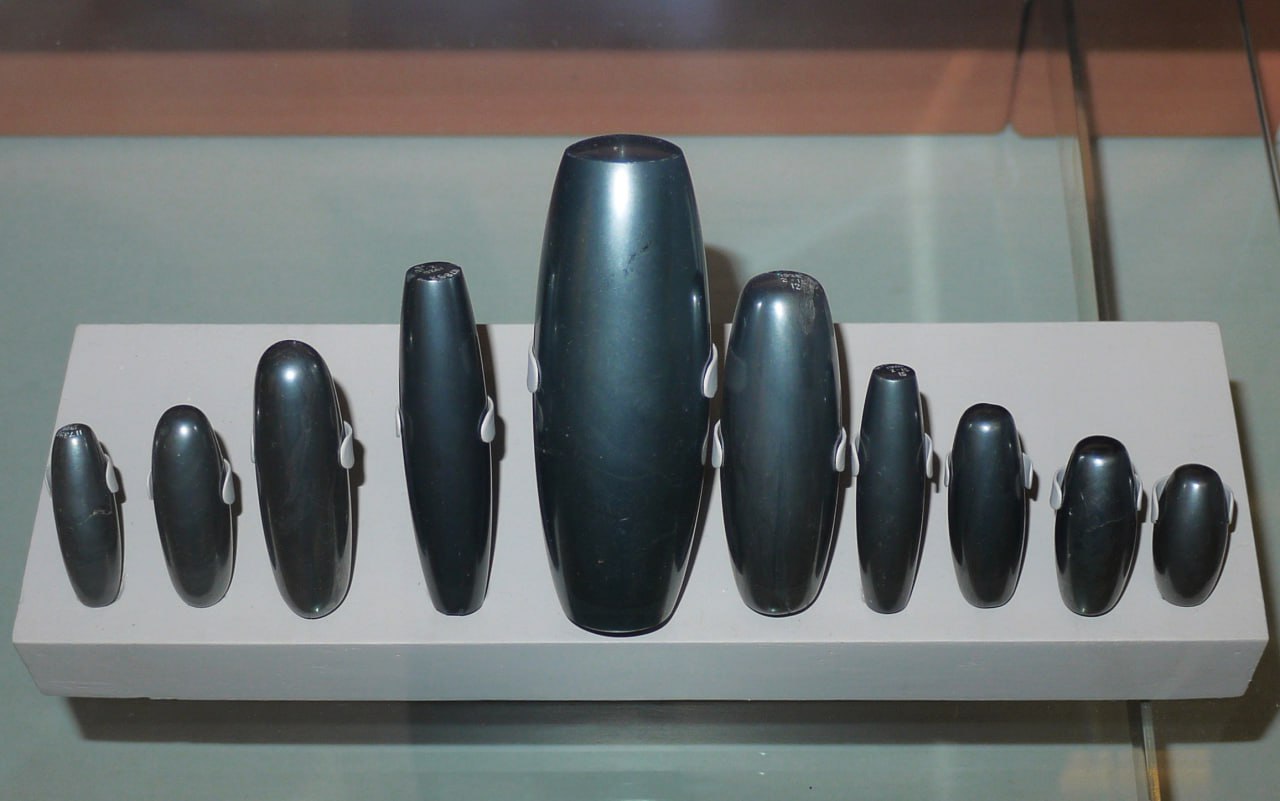
The weights from Warka are cylindrical in form, made of dense, durable hematite, a mineral chosen for its hardness and consistency.
-
Largest weight: Approximately 500 grams, equal to 1 mina.
-
Smallest weight: Around 42 grams, equal to 5 shekels.
-
Proportions: The mina was subdivided into 60 shekels, reflecting the Mesopotamian preference for a sexagesimal (base-60) system.
Physical Dimensions
The largest weight measures 11.4 cm in height with a diameter of 2.5 cm, giving it a slender yet solid appearance. The careful shaping suggests precision was paramount in their manufacture.
The Mina and the Shekel: Babylonian Units of Weight
The Mina as a Standard Unit
Mina was a major weight unit in Mesopotamia, often equivalent to about 500 grams in the Old Babylonian system. It served as a base for calculating larger and smaller measures.
The Shekel: Everyday Utility
The shekel, equal to roughly 8.4 grams, was a smaller unit widely used in daily commerce. The five-shekel weight from Warka, at around 42 grams, demonstrates how practical these measures were for transactions involving grain, silver, and other commodities.
Base-60 System
The division of the mina into 60 shekels reflects Mesopotamia’s sexagesimal system, which also influenced mathematics, astronomy, and timekeeping. This system remains alive today in how we measure minutes and seconds.
Why Hematite? The Choice of Material
Hematite was not only visually striking with its dark, metallic luster but also ideal for creating weights because:
-
Density – Its heaviness ensured compact weights with consistent mass.
-
Durability – Resistant to wear, making them long-lasting.
-
Symbolism – As a valued mineral, it reinforced the importance of trust and fairness in transactions.
The choice of hematite suggests these weights were prestigious tools, perhaps even controlled by officials or temples.
The Role of Weights in Mesopotamian Society
Trade and Exchange
Weights were essential for the exchange of goods, from grain and livestock to metals and textiles. They ensured fairness and trust in trade across markets and between regions.
Administration and Bureaucracy
Mesopotamian states relied heavily on record-keeping and standardization. Weights like those from Warka were likely used in official settings—temples, palaces, and administrative offices—where accurate measures safeguarded tax collection and redistribution.
Legal and Religious Significance
Fair weights carried symbolic value. Ancient texts often stress the importance of honest measurement, linking justice, morality, and divine order to the use of accurate standards. In some cases, fraudulent weights were condemned as a form of corruption.
Archaeological Significance of the Warka Weights
The discovery of these weights in Warka is not only a testament to Mesopotamian ingenuity but also a valuable resource for historians and archaeologists.
-
Dating: Their style and calibration align with the Old Babylonian period (2000–1600 BC).
-
Context: Found in an urban center, they reflect the daily and institutional reliance on standardized systems.
-
Comparisons: Similar weights have been found across Mesopotamia, indicating a widespread and consistent system of measurement.
Mathematics and Measurement in Mesopotamia
The sexagesimal system permeated Mesopotamian thought. By structuring weights around the mina and shekel, the Babylonians demonstrated:
-
Advanced mathematical understanding.
-
Practical application of base-60 calculations in trade and accounting.
-
Enduring influence, as modern units of time and angles still follow this system.
These hematite weights are physical evidence of the fusion of mathematics and daily life in Mesopotamia.
The Broader Context: Standardization in Ancient Civilizations
The Warka weights are part of a global story of measurement. Just as the Egyptians used cubits and the Indus Valley used standardized seals, the Babylonians developed reliable tools to ensure fairness and efficiency in trade.
Such systems not only enabled economic prosperity but also reinforced the authority of rulers and institutions, who controlled and guaranteed these standards.
The Weights Today: A Legacy Preserved
The Warka hematite weights are preserved as part of archaeological collections, studied by scholars to unravel the complexities of Mesopotamian society. Their continued existence provides:
-
Educational value for understanding early economies.
-
Cultural heritage linking modern societies to ancient traditions of measurement.
-
Inspiration in the story of how humans sought order, fairness, and precision thousands of years ago.
Why the Hematite Weights Matter
These artifacts remind us that:
-
Measurement is civilization’s backbone – trade, law, and science depend on accuracy.
-
Mesopotamia’s innovations still resonate – from mathematics to weights and measures.
-
Objects tell stories – a simple cylinder of hematite can reveal entire systems of economy, authority, and culture.
Conclusion: Order in Stone and Numbers
The Old Babylonian hematite weights from Warka embody the brilliance of Mesopotamian civilization. More than simple tools, they represent the drive for order, fairness, and precision in an ancient world. Their cylindrical form, carefully calibrated, linked everyday transactions with the larger framework of justice, administration, and mathematics.
Today, these weights allow us to glimpse how trade, trust, and technology worked together in one of humanity’s earliest and greatest civilizations. From the mina to the shekel, they are echoes of a society that sought to measure not only goods but also its place in the cosmos.
ALSO READ: The Bronze Corinthian Helmet from Taranto: A Masterpiece of Ancient Greek Warfare