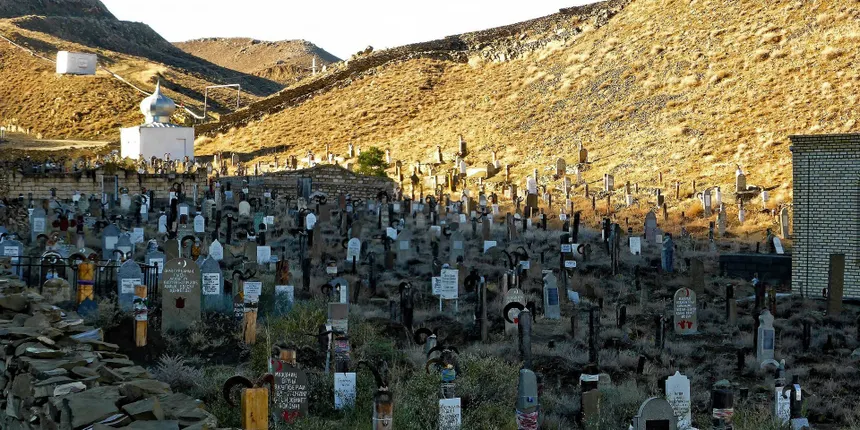
Cemetery with Goat-Horn Bedecked Gravestones in Nokhur, Turkmenistan
Cemetery Unlike Any Other
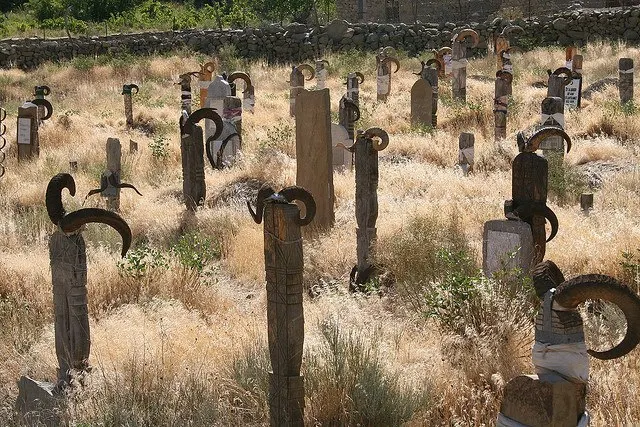
High in the Kopet Dag mountains of southern Turkmenistan lies the isolated village of Nokhur, a place where time appears to stand still. Among its most fascinating cultural landmarks is the cemetery adorned with goat-horn bedecked gravestones, a tradition that sets it apart from other Islamic burial sites in Central Asia. Nearly every grave is crowned with a wooden post or stone marker decorated with the curved horns of mountain goats, creating an atmosphere that is both mystical and deeply symbolic.
These horns are not merely decorative—they are believed to ward off evil spirits and to aid the soul’s safe passage to heaven, reflecting the Nokhuri tribe’s enduring respect for the mountain goat, an animal considered sacred for its strength, endurance, and connection to the natural world.
The Village of Nokhur: A Living Time Capsule
Nokhur is a small, remote village in the mountains near the Iranian border. Its isolation has preserved not only the physical landscape but also the unique cultural identity of the Nokhuri people. Unlike other Turkmen tribes, the Nokhuris have retained elements of their pre-Islamic belief systems, blending them with Islamic traditions introduced later.
Life in Nokhur is characterized by close ties to nature, agriculture, and pastoralism. Mountain goats, which thrive in the rugged terrain, play a central role in both the daily life and spiritual worldview of the Nokhuris.
Goat-Horn Gravestones: Symbolism and Belief
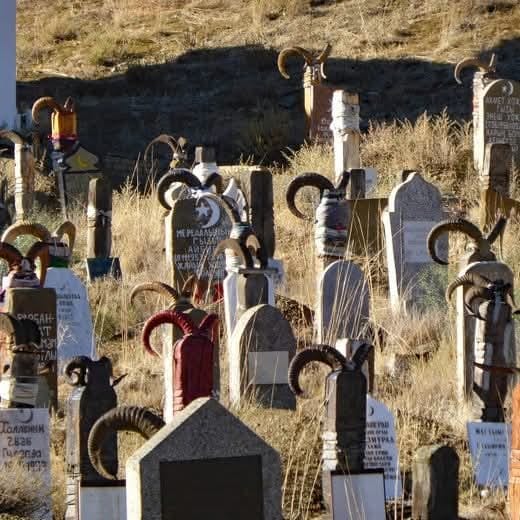
The most striking feature of the Nokhur cemetery is the adornment of graves with horns of mountain goats.
Protective Power
-
The horns are thought to repel evil spirits, preventing them from disturbing the soul of the deceased.
-
They act as spiritual guardians, symbolizing resilience in the afterlife.
Guidance for the Soul
-
Horns also help guide the deceased’s spirit on its journey to the heavens.
-
The upward curve of the horns symbolically points toward the sky, directing the soul to divine realms.
Connection to Ancestral Beliefs
Though the Nokhuris are Muslims today, this practice reflects ancient animistic and shamanistic traditions, where animals held sacred power.
Mountain Goats as Sacred Animals
Mountain goats have always held a special place in Nokhuri culture. Admired for their ability to survive in harsh mountain landscapes, they represent strength, agility, and endurance.
Religious and Spiritual Role
-
Before Islam, the Nokhuris considered mountain goats sacred, possibly linking them to fertility, protection, and the spirit world.
-
Even today, goat horns and skulls are placed not only in cemeteries but also above doorways of houses, offering protection to families.
Symbol of Survival
The goat’s ability to thrive in rocky, inhospitable terrain mirrors the resilience of the Nokhuri people, who have preserved their traditions despite centuries of change.
A Blend of Islam and Ancient Tradition
The Nokhur cemetery reveals how pre-Islamic customs coexist with Islamic belief. While the Nokhuris identify as Muslims, they retain elements of their ancestral worldview:
-
Islamic Burial Practices: Graves are oriented according to Islamic customs, with prayers performed at burials.
-
Ancient Symbols: Goat horns and other motifs add layers of meaning that transcend orthodox Islam.
-
Folk Spirituality: Beliefs in protective symbols and ancestral spirits continue to influence daily life.
This fusion of traditions makes the Nokhur cemetery a powerful example of cultural continuity in Central Asia.
Architecture of the Cemetery
The cemetery is spread across a hillside, with hundreds of graves marked by wooden posts, stone markers, and horns. The sight of rows of curved goat horns jutting into the sky creates a landscape that is both eerie and beautiful.
-
Wooden Posts: Traditionally carved, they provide a base for the horns.
-
Goat Horns: Affixed in pairs or clusters, they dominate the grave markers.
-
Stone Markers: Some graves are enclosed or surrounded by low stone walls.
This unique arrangement gives the cemetery an almost forest-like quality, where each grave marker resembles a sacred totem.
The Social Role of the Cemetery
The cemetery is more than a burial site; it is a place of community memory and identity.
-
Respect for Ancestors: Families continue to visit, leaving offerings and maintaining graves.
-
Transmission of Beliefs: The horns symbolize a living tradition, teaching younger generations about their heritage.
-
Cultural Pride: For the Nokhuris, the cemetery embodies their distinctiveness within Turkmenistan.
Continuity of Tradition in Modern Times
Despite modernization, Nokhuris continue to practice these customs. While urban Turkmenistan has largely abandoned such symbolic practices, Nokhur’s isolation has helped preserve them.
Even today:
-
Goat horns remain prominent in the cemetery.
-
Goat skulls are placed above doorways of houses.
-
Ancient respect for the mountain goat continues to shape spiritual life.
This survival of tradition highlights the resilience of folk beliefs in the face of modernity and religious orthodoxy.
Cultural Significance for Turkmenistan
The Nokhur cemetery is not only a local tradition but also part of Turkmenistan’s broader cultural heritage.
-
Tourism Potential: Increasingly, travelers visit Nokhur to witness this unique cemetery.
-
National Identity: It underscores the diversity of Turkmen traditions, showing how different tribes contribute to the cultural mosaic.
-
Anthropological Interest: Scholars view Nokhur as a rare case of syncretic religion and symbolic continuity.
Comparisons with Other Cultures
The use of animal horns in graves is not unique to Nokhur. Across the world, similar practices have appeared:
-
Scythians and Steppe Cultures: Horns and animal symbols often appeared in burial mounds.
-
Mongolian Shamanism: Animals were believed to protect the soul in the afterlife.
-
Celtic Europe: Horned animals often symbolized fertility and power.
Nokhur’s cemetery fits into this global pattern of animistic burial customs, while retaining its own distinct form.
Why the Nokhur Cemetery Matters
The cemetery of Nokhur matters because it is:
-
A cultural time capsule – preserving beliefs that date back thousands of years.
-
A fusion of traditions – blending Islam with pre-Islamic spirituality.
-
A living practice – still maintained by villagers today.
-
A symbol of resilience – both of the Nokhuri people and of sacred mountain goats.
Conclusion: Horns as Guardians of the Soul
The goat-horn bedecked gravestones of Nokhur represent one of the most unique burial traditions in the world. They are not only markers of the dead but also protective guardians and spiritual guides, carrying echoes of ancient animistic beliefs into the present day.
For the Nokhuris, mountain goats remain sacred companions, their horns a bridge between earth and sky, life and afterlife, tradition and faith. This cemetery, with its forest of horned graves, continues to tell the story of a people who live in harmony with their rugged mountain landscape and who carry their ancestral heritage into the modern age.
ALSO READ: Hans Koch’s 16th-Century Gilt-Brass Clock-Watch: Timekeeping as Art and Science