The Golden Leaf of Napoleon’s Coronation Crown: A Fragment of Imperial Glory👑
A Fragment from an Emperor’s Dream
In 1804, within the grand walls of Notre-Dame Cathedral in Paris, Napoleon Bonaparte crowned himself Emperor of the French. The ceremony was a dazzling spectacle of power and ambition — a deliberate act of self-coronation that declared to the world that his authority came not from divine right, but from his own will and the mandate of the French nation.
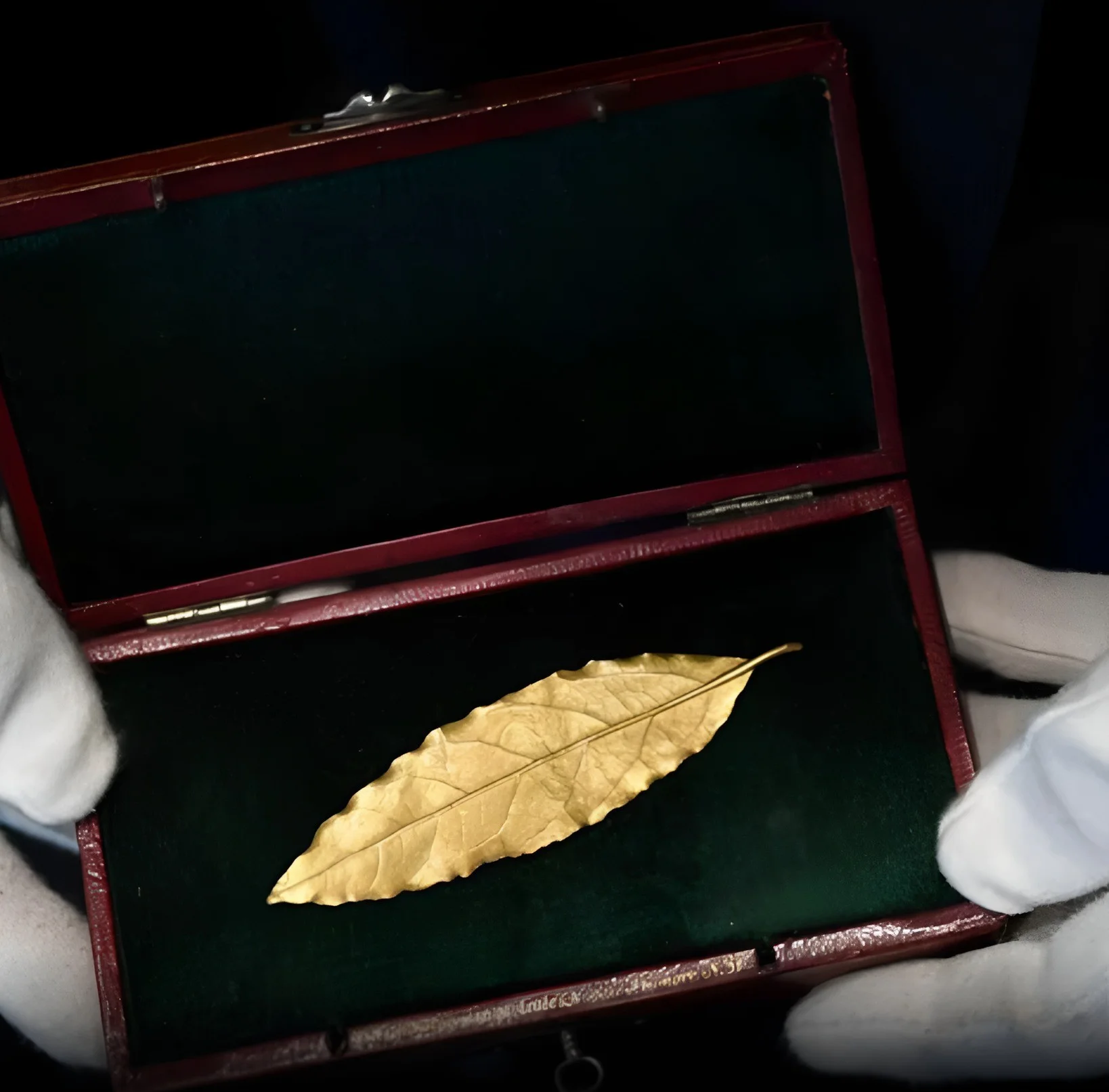
Among the opulent regalia of that day stood the coronation crown, gleaming with golden leaves that embodied the spirit of classical Rome and imperial grandeur. Today, only a single golden leaf from that crown survives — a delicate fragment that carries with it the story of Napoleon’s meteoric rise, his vision of empire, and the enduring allure of his legend.
1. The Coronation of Napoleon: Power and Symbolism
Napoleon’s coronation on December 2, 1804, was one of the most significant political and cultural events of 19th-century Europe. In front of Pope Pius VII, who had traveled from Rome to officiate, Napoleon seized the crown from the altar and placed it upon his own head.
This moment — immortalized by Jacques-Louis David in his famous painting The Coronation of Napoleon — symbolized a reversal of traditional power structures. By crowning himself, Napoleon rejected the notion that emperors derived legitimacy from the Church. Instead, he asserted that his authority came from merit, conquest, and the will of the people.
The coronation crown he wore that day reflected this dual identity: imperial majesty fused with revolutionary self-determination.
2. The Design of Napoleon’s Coronation Crown
Napoleon’s crown, known as the “Golden Laurel Crown”, was inspired by the laurel wreaths of ancient Roman emperors. Designed by the goldsmith Martin-Guillaume Biennais, it was crafted from pure gold and adorned with intricate laurel leaves, each one individually engraved and shaped by hand.
Unlike the heavy jeweled crowns of the Bourbon kings, Napoleon’s coronation crown was simple yet symbolic — a deliberate nod to Julius Caesar and Augustus, whose laurels represented victory and divine favor.

The golden leaves were not only aesthetic but deeply emblematic. Each leaf signified triumph, glory, and renewal — the virtues Napoleon sought to embody in his transformation from revolutionary general to emperor.
3. The Surviving Golden Leaf: A Rare Relic
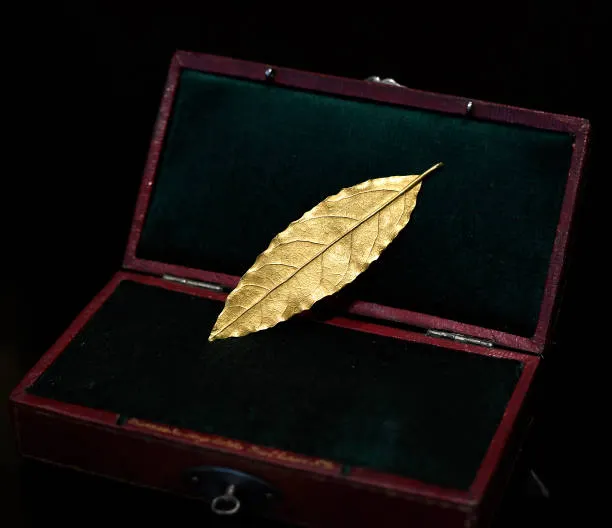
Of the many golden leaves that once formed Napoleon’s crown, only one remains today. This single leaf, preserved as a historical artifact, has become one of the most evocative relics of the Napoleonic era.
Crafted from thin sheets of gold and delicately engraved with vein-like details, the leaf captures the artistry and precision of Biennais’ workshop. Yet beyond its beauty, it carries immense symbolic and historical weight — the tangible remnant of a moment that redefined France and reshaped Europe.
The leaf’s survival through centuries of upheaval — from the fall of the Empire to the Bourbon Restoration — adds to its mystique. It stands today as a silent witness to both the glory and the fragility of power.
4. Symbolism of the Golden Leaf
In classical mythology, the laurel leaf was sacred to Apollo, the god of the sun, prophecy, and victory. Worn by Roman emperors and victorious generals, it symbolized triumph and divine approval.
For Napoleon, the laurel crown represented both his military conquests and his cultural vision — the rebirth of a new Roman Empire with Paris as its capital. The golden leaves that adorned his head during the coronation thus became more than decoration; they were manifestations of destiny.
The surviving leaf today embodies that symbolism still: ambition, victory, and the fleeting nature of greatness.
5. The Fate of the Crown: From Glory to Fragment
After Napoleon’s fall in 1814, much of his regalia was dismantled or destroyed by the Bourbon monarchy in an effort to erase his legacy. The coronation crown was among the casualties of political revenge.
However, some fragments survived — saved by loyalists, collectors, or chance. The golden leaf that endures today is believed to have been removed by Biennais himself as a personal keepsake, preserved through his family until it entered public collections.
Its journey from imperial artifact to museum treasure mirrors Napoleon’s own trajectory: from self-made emperor to legend.
6. Craftsmanship and Artistic Excellence
The surviving golden leaf reflects the exceptional craftsmanship of early 19th-century French artisans. Biennais, Napoleon’s official goldsmith, was celebrated for his ability to combine classical motifs with neoclassical design.
Each leaf of the crown was hand-hammered, polished, and engraved, requiring extraordinary skill and precision. Despite its delicate form, the craftsmanship ensured durability — a testament to the artistry that defined Napoleon’s court.
This attention to aesthetic detail extended beyond jewelry to architecture, furniture, and state regalia, forming part of the Napoleonic aesthetic that shaped European art and design for decades.

7. Historical and Cultural Legacy
The surviving golden leaf serves as a powerful historical symbol — not just of Napoleon’s empire, but of human ambition and the pursuit of legacy.
For historians and collectors, it represents the intersection of art, politics, and personality. For the public, it offers a tangible connection to the man who transformed France and challenged the order of Europe.
Displayed in museums and exhibitions, the leaf continues to inspire fascination and debate. Was Napoleon a visionary or a tyrant? A liberator or a conqueror? The golden leaf, silent and gleaming, leaves the answer open to interpretation.
8. Napoleon’s Vision of Power: Crowned by Himself
Perhaps no artifact better encapsulates Napoleon’s philosophy of power than his self-crowning at Notre-Dame. By placing the laurel crown upon his own head, he rejected submission to Church or tradition. He became a self-made monarch, embodying Enlightenment ideals of merit and destiny.
This act, shocking to contemporaries, defined the modern concept of sovereignty derived from personal achievement rather than divine right.
The surviving golden leaf thus stands as a fragment of that revolutionary moment — a reminder that authority, in Napoleon’s world, was something seized, not bestowed.
9. The Enduring Allure of Napoleon’s Relics
Napoleon’s relics — from his swords and uniforms to this solitary golden leaf — continue to captivate collectors and historians worldwide. Their appeal lies not just in their rarity, but in their emotional power.
Each object connects us to a man whose ambition reshaped Europe, whose image dominated art and propaganda, and whose fall remains one of history’s most dramatic reversals.
The golden leaf, in particular, encapsulates this paradox: grandeur and fragility, immortality and loss.
Conclusion: A Leaf from an Empire
The golden leaf from Napoleon’s coronation crown is more than a relic — it is a symbol of a man’s dream to master his destiny. Though the empire it represented has long vanished, the leaf endures, shimmering as a fragment of imperial ambition and artistic excellence.
In its delicate form survives the story of a soldier who crowned himself emperor, of an age defined by revolution and renewal, and of the timeless truth that power, like gold, can dazzle — but it can also fade.
ALSO READ: The Roman Dracon: Wind, Warfare, and the Dragon Standard🐉