The Mummified Head of a Woman – Whispers Through Time
A Face from Eternity
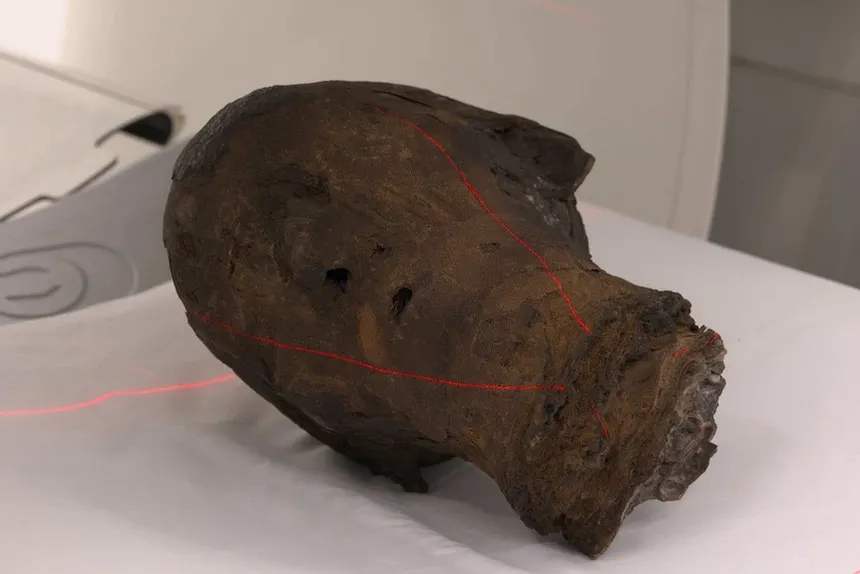
In the golden sands of ancient Thebes, archaeologists uncovered a hauntingly beautiful relic — the mummified head of a woman who lived more than 3,000 years ago, during Egypt’s New Kingdom period (c. 1550–1070 BCE).
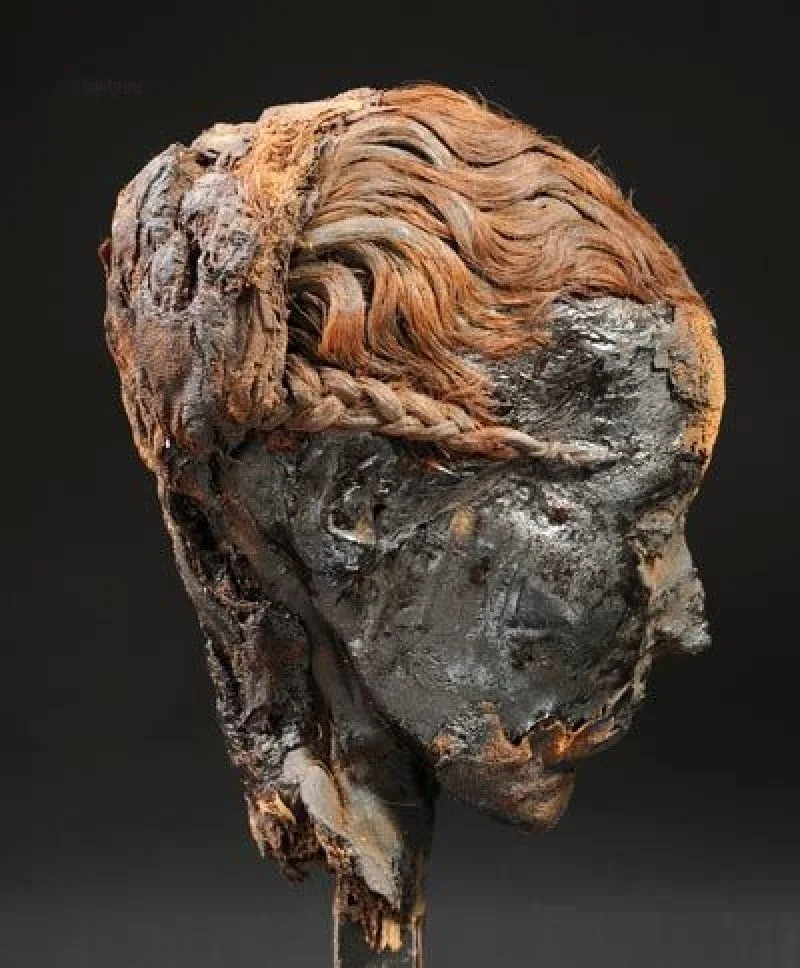
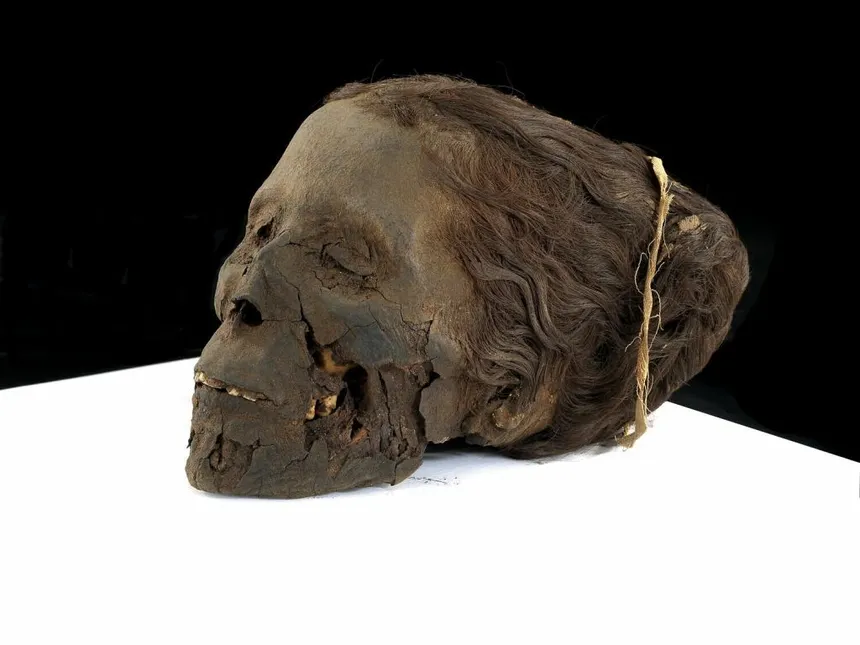
Her reddish-brown hair, still braided with care, whispers of a life once filled with grace and purpose. Her features, softened by time yet preserved through skill and devotion, bear the quiet dignity of one who was deeply loved — perhaps a noblewoman, a priestess, or a matron of high rank.
This delicate remnant of the past is more than an artifact; it is a human echo across millennia, a moment where science, art, and belief intertwined to defy mortality.
Thebes: City of the Dead and Eternal Light
To understand this mummified head, one must first walk through Thebes, known to the ancient Egyptians as Waset — a city sacred to Amun, king of the gods.
Located on the west bank of the Nile, Thebes served as both a royal capital and a spiritual gateway to the afterlife. Its sprawling necropolis, including the Valley of the Kings, Valley of the Queens, and Deir el-Medina, became the eternal resting place for pharaohs, priests, and the elite of Egyptian society.
It was within this sacred landscape that the woman’s body was prepared for eternity — a place where death was not an end but a continuation of existence in another realm.
The Art of Immortality: Egyptian Mummification
The woman’s head bears the mark of a civilization obsessed not with death, but with preservation and transformation. For the ancient Egyptians, to preserve the body was to protect the ka — the life force — ensuring it could recognize and reunite with the spirit in the afterlife.
During the New Kingdom, mummification reached artistic perfection. The process could take up to 70 days and included:
-
Purification: The body was washed with palm wine and Nile water.
-
Removal of organs: Internal organs, except the heart, were removed and placed in canopic jars.
-
Desiccation: The body was covered in natron, a natural salt, to draw out moisture.
-
Anointing and wrapping: Oils, resins, and perfumes were applied before the body was wrapped in linen bandages — layer upon layer of devotion and care.
This woman’s hair, still visible and carefully braided, suggests that her appearance was treated with reverence. Hair, in Egyptian belief, symbolized vitality and identity; its preservation was part of maintaining wholeness in eternity.
A Noblewoman or a Priestess? The Mystery of Identity
While her name is lost to history, subtle details offer clues about her status and role. The precision of her mummification, the preservation of her hair, and the likely presence of resins and fine linen point toward a woman of wealth and significance.
Perhaps she was a priestess of Amun, serving in the grand temples of Thebes. Or maybe she was a member of the royal household, her life intertwined with the court of Pharaohs like Amenhotep III or Ramesses II.
Ancient Egyptian texts and tomb art reveal that women of high rank were often stewards of ritual purity, caretakers of domestic shrines, and bearers of sacred symbols. The care taken in her burial suggests she was honored and remembered — not merely interred, but enshrined.
Science Meets the Sacred: Modern Study of Ancient Mummies
Today, advanced technology allows researchers to explore these ancient mysteries without disturbing the dead. Through CT scanning, radiocarbon dating, and chemical analysis, scientists can reconstruct the life and health of individuals long gone.
Studies of similar mummified heads have revealed:
-
Age at death (often between 25–45 years)
-
Health conditions, such as arthritis or tooth decay
-
Cosmetic use, including oils, henna, and hair dyes
-
DNA traces, connecting mummies to living descendants
While this particular head remains anonymous, it continues to advance our understanding of mummification and daily life in Thebes. Modern imaging reveals that her facial tissues were treated with resins and natural preservatives, while her hair was likely infused with oils such as castor or moringa, used by Egyptians for beauty and ritual anointing.
The Language of Hair: Beauty, Status, and Symbolism
In ancient Egypt, hair was far more than adornment — it was a spiritual symbol. Hairstyles often denoted social class, age, or religious devotion.
Women of status wore elaborate braids or wigs, sometimes perfumed with cones of scented wax. In tomb art, these hairstyles represented order, civilization, and divine favor. To appear with well-kept hair in death was a sign of eternal beauty and completeness.
The reddish hue of this woman’s hair — preserved through millennia — might not be natural but the result of henna or resin staining. Egyptians prized red tones, associating them with vitality and solar energy, gifts from the sun god Ra.
Her braid, still intact, becomes a bridge between the living and the dead — a final gesture of love and care from those who prepared her for eternity.
The Spiritual Journey: From Tomb to Afterlife
In Egyptian belief, death was a rite of passage, a sacred transition guided by the gods. After burial, the spirit embarked on a perilous voyage through the Duat, or underworld, guided by Anubis, the jackal-headed god of embalming.
Her preserved head, serene and timeless, symbolizes recognition of the self — a crucial aspect of rebirth. The body had to remain whole so that the ba (soul) could return each night, ensuring immortality among the stars.
When her family or priests placed her in the tomb, they believed she would awaken into the Fields of Reeds, a paradise where she would live again — beautiful, complete, and eternal.
Rediscovery and Ethical Reflection
The rediscovery of such remains raises questions not only about archaeology but also about ethics. How do we balance the pursuit of knowledge with respect for the dead?
Museums today approach human remains with deep sensitivity, often consulting with Egyptian authorities and cultural institutions to ensure ethical display or repatriation.
The mummified head of this woman is not merely an artifact to be examined; she is a person whose life once had warmth, love, and meaning. As viewers, we are witnesses to her endurance — and stewards of her dignity.
Echoes Through Time
To look upon her face is to stand at the intersection of past and present. Her quiet presence bridges thousands of years of history, art, and faith.
Each line, each strand of preserved hair, is a testament to human devotion. To a civilization that sought to conquer time not through conquest, but through care.
As we gaze upon her, we might ask:
Does she dream still beneath the veil of centuries?
Does her spirit wander the endless sands, touched again by the rising sun?
In her stillness, she teaches us that memory is the truest form of immortality.
Conclusion: Whispers Through Time
The Mummified Head of a Woman from ancient Thebes stands as both scientific evidence and poetic relic. A symbol of humanity’s timeless desire to preserve love, identity, and the soul itself.
Her story transcends archaeology; it is the story of us all — our longing to be remembered. Our belief that life continues beyond the horizon of death.
In her enduring braid and silent grace, we find not horror but humility. The whisper of a life that once laughed, dreamed, and now, through time and dust, still speaks.
ALSO READ: The Old Copper Culture: North America’s First Metalworkers