Mount Nemrut: The Majestic Sanctuary of King Antiochus I in Turkey
A Mountain of Gods and Kings
High in the rugged landscapes of southeastern Turkey rises Mount Nemrut, a 2,134-meter (7,001 ft) peak that houses one of the most remarkable archaeological sites of the ancient world. On its summit lies the sanctuary of King Antiochus I of Commagene (70–36 BC), a monumental complex built as both a royal tomb and a religious center.
The site’s colossal stone statues, some reaching 9 meters (30 feet) in height, represent gods, eagles, lions, and the king himself. Today, Mount Nemrut stands as a UNESCO World Heritage Site (since 1987) and a symbol of cultural blending, where Greek, Persian, and Anatolian traditions meet.
The Kingdom of Commagene: A Cultural Crossroads
The Kingdom of Commagene was a small but strategically important state located between the Roman Empire and the Parthian Empire. Its rulers traced their ancestry to both Persian nobility and Greek dynasties, which gave the kingdom a unique cultural identity.
-
Geography: Situated in modern-day Adıyaman Province, Turkey, the kingdom connected east and west through vital trade routes.
-
Cultural Fusion: The blending of Hellenistic and Persian traditions defined Commagene’s art, religion, and politics.
-
Antiochus I: As king, he embraced both Greek and Persian legacies, presenting himself as a divine ruler and mediator between cultures.
Mount Nemrut’s sanctuary is the most enduring testament to this fusion, a mountaintop shrine meant to honor both the gods and the king’s eternal legacy.
Construction of the Mount Nemrut Sanctuary
Around 62 BC, Antiochus I ordered the construction of a massive sanctuary at the summit of Mount Nemrut. Its purpose was twofold:
-
Royal Tomb – Antiochus believed in divine kingship and sought to secure his place among the gods after death.
-
Religious Center – The sanctuary was dedicated to a pantheon that combined Greek and Persian deities, reflecting his kingdom’s hybrid culture.
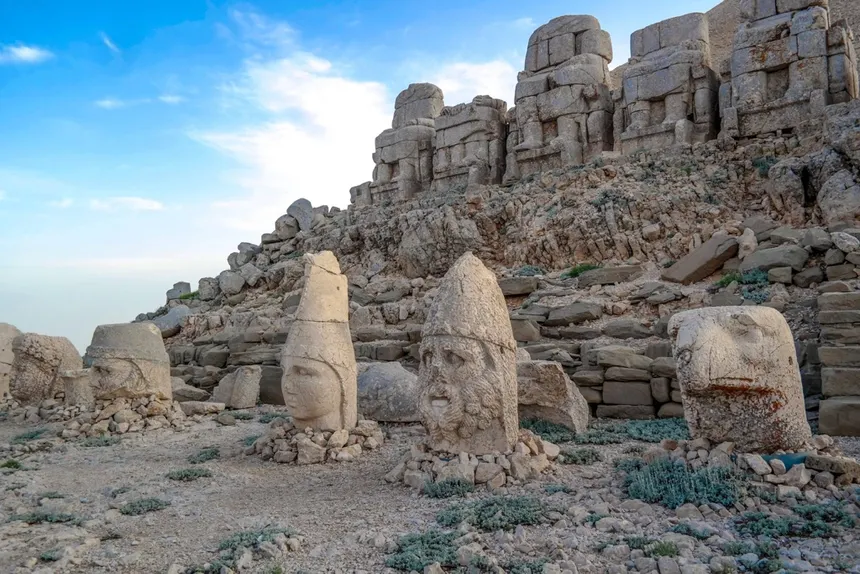
The sanctuary consists of three main terraces—east, west, and north—each featuring colossal statues, stone reliefs, and ceremonial spaces.
The Colossal Statues: Faces of Gods and Kings
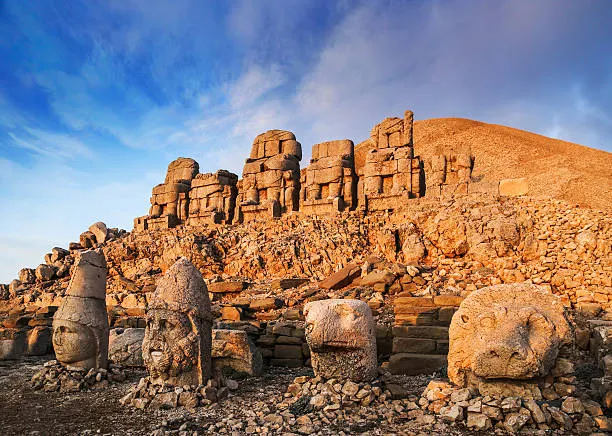
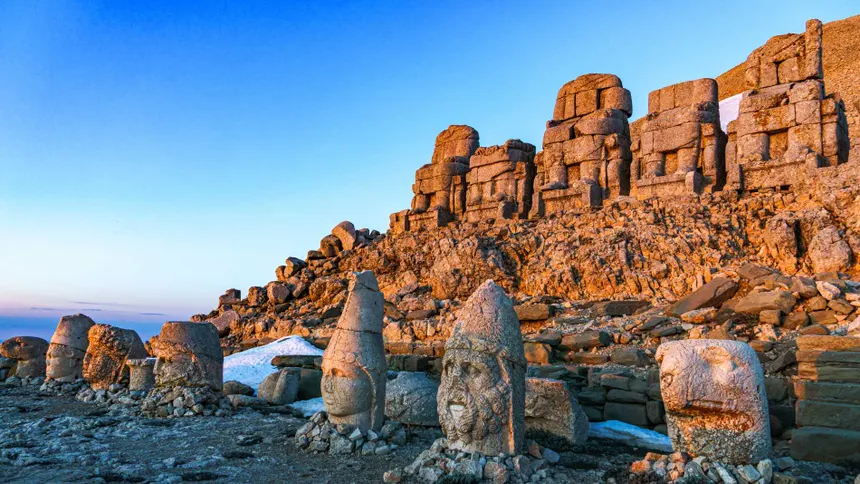
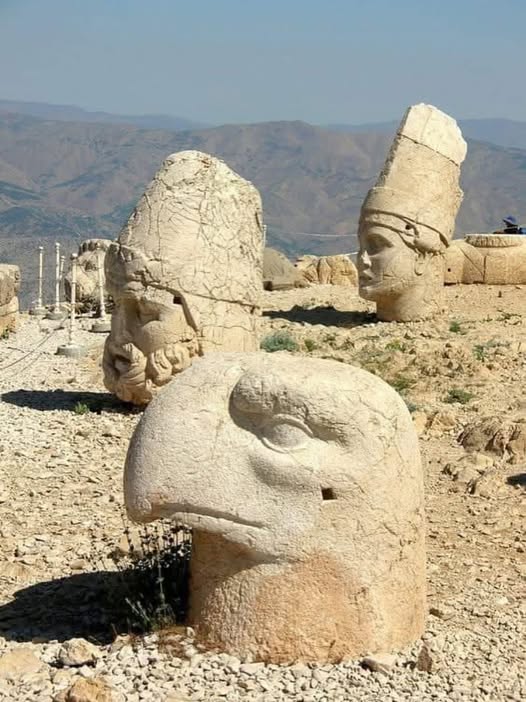
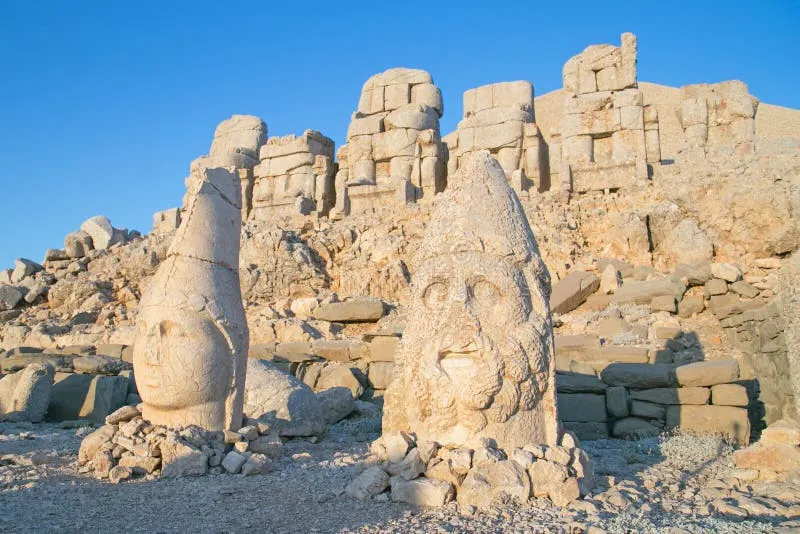
The most striking feature of Mount Nemrut is the row of massive stone statues carved from limestone. Originally seated on thrones, these statues were up to 9 meters tall, though today their heads lie scattered across the terraces due to earthquakes and centuries of erosion.
The Figures Represent:
-
Zeus-Oromasdes – A fusion of the Greek god Zeus and the Persian god Ahura Mazda.
-
Apollo-Mithras-Helios-Hermes – A combined representation of solar and divine power.
-
Heracles-Artagnes-Ares – A hybrid figure of strength and protection.
-
Fortune (Tyche/Commagene) – A female figure symbolizing prosperity and fertility.
-
Antiochus I – The king himself seated among the gods, affirming his divine status.
-
Eagles and Lions – Guardians of the sanctuary, representing royalty, strength, and cosmic order.
The heads, some weighing up to 9 tons, now rest on the ground around the terraces, creating the iconic imagery that defines Mount Nemrut today.
Earthquakes, Erosion, and the Fallen Heads
Mount Nemrut lies in a seismically active region of Turkey. Over the centuries, earthquakes and natural erosion caused the heads of the statues to topple from their seated bodies.
-
Displacement: Today, the heads lie scattered across the terraces, detached but remarkably preserved.
-
Condition: Despite weathering, their facial features remain visible, showcasing intricate craftsmanship.
-
Mystique: The dislocated heads contribute to the site’s otherworldly aura, as if time itself rearranged the sanctuary.
This combination of grandeur and ruin makes Mount Nemrut one of the most visually dramatic ancient sites in the world.
The East, West, and North Terraces
The sanctuary is divided into terraces, each with distinct features and symbolic significance.
The East Terrace
-
Contains the best-preserved statues and reliefs.
-
Served as the main ceremonial space, possibly used for rituals at sunrise.
-
Features a colossal row of seated gods, including Antiochus I.
The West Terrace
-
Offers spectacular views, often associated with sunset rituals.
-
Houses additional colossal statues and reliefs depicting Antiochus shaking hands with gods (the “Dexiosis reliefs”).
-
Statues here are less preserved due to exposure but remain impressive.
The North Terrace
-
Smaller and less elaborate, possibly used for processions.
-
Connects the east and west sides, emphasizing the sanctuary’s symmetrical design.
Religious and Political Symbolism
Antiochus I used Mount Nemrut not only as a tomb but also as a political statement:
-
Divine Kingship: By placing himself among gods, he asserted his authority as a ruler chosen by both Greek and Persian traditions.
-
Cultural Harmony: The blending of deities reinforced unity within his diverse kingdom.
-
Eternal Legacy: The mountaintop sanctuary ensured his memory would endure long after his death.
This fusion of religion and politics mirrors broader patterns in ancient empires, where rulers legitimized their power through divine association.
Mount Nemrut as a UNESCO World Heritage Site
In 1987, Mount Nemrut was designated a UNESCO World Heritage Site, recognized for its outstanding universal value. The designation reflects:
-
Historical Significance: A rare example of cultural fusion between East and West.
-
Architectural Scale: The sanctuary’s sheer size and artistry remain awe-inspiring.
-
Symbolic Depth: The site embodies ancient ideas of kingship, religion, and cultural identity.
Today, UNESCO and Turkish authorities continue efforts to preserve the site against erosion, earthquakes, and tourism pressures.
Visiting Mount Nemrut Today
Mount Nemrut is a popular destination for travelers seeking both history and breathtaking landscapes.
-
Sunrise and Sunset Views: Visitors often climb the peak at dawn or dusk to witness the statues in dramatic lighting.
-
Hiking Routes: Trails lead up the mountain, offering panoramic views of the Euphrates Valley.
-
Cultural Tourism: The site forms part of broader tours exploring southeastern Turkey’s rich archaeological heritage.
Despite its remote location, Mount Nemrut draws visitors worldwide, captivated by its combination of mystery, grandeur, and cultural significance.
Why Mount Nemrut Matters
Mount Nemrut is more than an archaeological wonder—it is a symbol of cultural dialogue, ambition, and human creativity.
-
It demonstrates how ancient societies blended traditions to form new identities.
-
It reveals the political strategies of rulers who sought immortality through monumental art.
-
It continues to inspire awe, reminding us of humanity’s enduring quest to connect earth and sky, mortal and divine.
Conclusion
The sanctuary of Mount Nemrut, perched atop a 2,134-meter peak, is one of the most extraordinary legacies of the ancient world. Constructed by King Antiochus I of Commagene, its colossal statues represent a fusion of Greek, Persian, and Anatolian traditions.
Though earthquakes and erosion scattered the statues’ heads, the site’s grandeur endures, offering a haunting yet beautiful glimpse into a kingdom’s ambition to bridge cultures and secure eternal remembrance. Recognized as a UNESCO World Heritage Site, Mount Nemrut remains a testament to the power of art, religion, and human imagination across millennia.
ALSO READ: Unearthing Egypt’s Ancient Secrets: The Discovery of a Ptolemaic Sphinx at Kom Ombo