The Mysterious Giant Footprint of Mount Etna: Myth, Geology, and the Power of Perception
A Giant Mystery Born of Fire and Stone
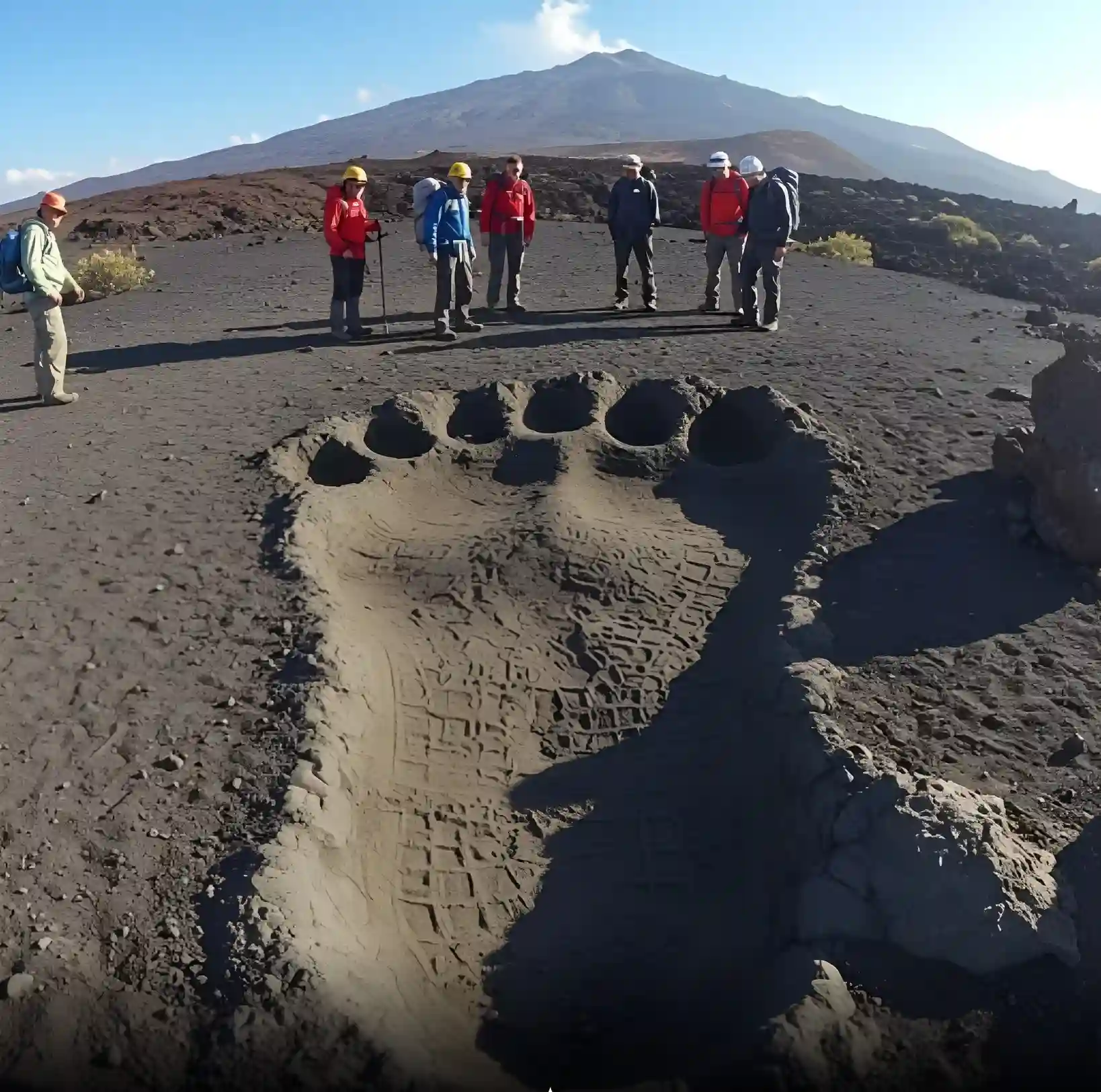
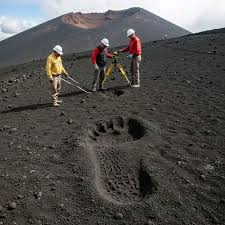
On the fiery slopes of Mount Etna, Europe’s most active volcano, nature has sculpted countless wonders — rivers of molten rock, blackened craters, and surreal landscapes frozen in time. But among these geological marvels, one particular discovery has captured worldwide attention: a massive footprint-like impression, seemingly embedded in hardened lava.
Measuring nearly a meter in length, this formation bears an uncanny resemblance to a humanoid foot, complete with heel, arch, and toe shapes. For some, it’s an eerie testament to a lost race of giants; for others, a stunning example of how nature mimics form through random processes.
This peculiar find near Etna’s lower slopes has reignited debates that blur the line between science and mythology, between observation and imagination.
Mount Etna: The Fiery Forge of Legends
Mount Etna, towering over Sicily, Italy, has been active for over half a million years. Known to the ancient Greeks as Aetna, it was believed to be the forge of Hephaestus, the god of fire and metalworking. In its subterranean chambers, myth said, the Cyclopes — the one-eyed giants — hammered out weapons for the gods, their roaring furnaces the very eruptions of the volcano itself.
Given this rich mythological background, it’s no surprise that any unusual geological formation near Etna often becomes steeped in folklore. The discovery of a giant “footprint” naturally evoked tales of Titans, Cyclopes, and ancient deities, adding a new chapter to the volcano’s mythic narrative.
For locals and enthusiasts, the footprint seemed to be a sign — a trace left behind by the giants who once roamed these fiery lands, immortalized in molten rock.
The Discovery: A Footprint Frozen in Lava
Reports of the “Etna Footprint” surfaced when geologists and hikers encountered the unusual formation while studying lava flows from an earlier eruption. Hardened within a basaltic lava bed, the impression measured approximately 95 centimeters in length and featured contours that strongly resembled a human foot — though far larger than any known human proportion.
High-resolution photographs and drone footage quickly went viral, sparking a flood of speculation online. While some claimed it as evidence of ancient giants or visitors from beyond, scientists took a more measured approach, calling for detailed study of the rock’s formation, structure, and age.
Preliminary analysis indicated that the footprint was part of an ancient lava flow, likely cooled and hardened thousands of years ago. The “footprint” was carved through erosion and weathering, shaped by water, temperature fluctuations, and chemical reactions — processes capable of producing intricate and sometimes eerily familiar forms.
Scientific Explanation: Pareidolia and Volcanic Processes
Most geologists agree that the Mount Etna Giant Footprint is a striking example of pareidolia — the human tendency to perceive meaningful patterns in random shapes, much like seeing faces in clouds or animals in rock formations.
In the context of volcanic landscapes, pareidolia is quite common. As molten rock cools and cracks, it can naturally form cavities, depressions, and ridges that coincidentally resemble organic forms — from hands and feet to animal tracks.
Here’s how the Etna formation likely occurred:
-
Lava flow cooling unevenly: As molten basalt cooled, it fractured along natural fault lines.
-
Erosion and collapse: Water and wind gradually deepened one of these cavities, creating a depression.
-
Differential weathering: Softer portions of the rock eroded faster, enhancing the “toe” and “heel” outlines.
-
Optical illusion: The human brain completed the image, perceiving it as a giant footprint.
In other words, the footprint wasn’t carved by mythical beings — it was sculpted by time, heat, and geology.
The Power of Human Imagination
Yet, despite scientific explanations, the allure of the giant footprint remains. It taps into a universal fascination with mystery, myth, and the unknown. Throughout history, unusual natural formations have often been linked to legends:
-
In Bangladesh, massive indentations in stone are revered as the footprints of Buddha.
-
In Sri Lanka, Adam’s Peak bears a large footprint-shaped hollow attributed to Adam, Shiva, or the Buddha, depending on the faith.
-
In Scotland, giant footprints in rock have been connected to Celtic deities and folkloric heroes.
Such interpretations reveal more about human psychology than geology. We are, by nature, storytellers — seeking meaning and narrative even in random natural forms. The Etna footprint, then, is a perfect meeting point between earth science and cultural imagination.
A Debate Between Science and Speculation
The discovery has not escaped the attention of alternative researchers and ancient mystery enthusiasts. Some claim the impression could be evidence of prehistoric giants. Drawing on myths from the Book of Genesis, Greek Titan lore, and Mesopotamian texts that describe beings of immense size.
However, no credible archaeological or geological evidence supports the existence of giant humanoids. The scale, proportion, and rock type of the “footprint” all align with natural lava formations, not human or animal physiology.
In contrast, the scientific community views the phenomenon as a teachable moment. An opportunity to explore how geological processes and human perception interact. It underscores the importance of critical observation while celebrating the sense of wonder that drives discovery.
Mount Etna’s Long History of Mystique
Mount Etna has always been a mountain of contradictions — both feared and revered. Its eruptions destroy villages but also enrich the soil, making its slopes among the most fertile in Italy. Its glowing craters have inspired poets, philosophers, and scientists alike.
The “Giant Footprint” is only the latest mystery in a long list:
-
Ancient Greeks believed giants and gods battled beneath Etna’s surface, causing its eruptions.
-
The Roman poet Virgil described the monster Enceladus, trapped under the volcano, whose struggles caused the mountain to quake.
-
Modern scientists study Etna to understand tectonic activity, as it sits atop the boundary between the African and Eurasian plates.
Each era, ancient or modern, has seen Etna as a mirror. Reflecting its people’s fears, beliefs, and curiosity about the natural world.
The Symbolic Meaning: Nature’s Footprint on Human Imagination
Ultimately, whether the Etna “footprint” was formed by chance or something more profound. It stands as a symbol of how nature continues to inspire myth. It challenges us to see beyond the surface — to marvel at the artistry of geology. And to reflect on our own desire to find meaning in the world around us.
As geologists study its composition and locals weave new tales around it. The footprint has become a fusion of science, art, and legend. An embodiment of the eternal human quest to understand the unknown.
Conclusion: Mystery in the Molten Earth
The Mount Etna Giant Footprint reminds us that the Earth is still full of wonder. Whether a product of natural forces or a symbol born of human imagination. It draws attention to the dynamic relationship between our planet and our perception.
In the end, this remarkable formation teaches a simple yet profound truth:
Even in the age of modern science, mystery endures. The earth beneath our feet still tells stories — some written in myth. Others carved in stone, and a few, like the Etna footprint, balancing beautifully between the two.
ALSO READ: The Goseck Circle – Europe’s Oldest Solar Observatory