Megalania: The Giant Prehistoric Monitor Lizard That Ruled Ancient Australia
Meet Megalania, the Giant of Prehistoric Australia
Imagine a reptile so large and powerful that even the mighty Komodo dragon would pale in comparison. Meet Megalania (Varanus priscus) — one of the largest monitor lizards to ever walk the Earth. This extinct giant once roamed prehistoric Australia during the Pleistocene epoch, roughly between 2.6 million and 50,000 years ago.
With estimates suggesting lengths of up to 7 meters (23 feet) and weights exceeding 1,000 kilograms (2,200 pounds), Megalania was a true apex predator. It dominated its environment, hunting massive prey and shaping the very ecosystems it inhabited.
Origins and Classification: The Prehistoric Cousin of the Komodo Dragon
Megalania belonged to the Varanidae family, which includes today’s monitor lizards, such as the Komodo dragon (Varanus komodoensis), Nile monitor, and lace monitor.
Scientists believe Megalania evolved as part of a lineage of giant varanids that adapted to Australia’s unique and often harsh environment. Fossil evidence links it closely to the modern lace monitor (Varanus varius), indicating that Megalania was likely an advanced, land-dwelling predator with high intelligence and acute sensory abilities.
Physical Description: A Reptilian Titan
The size of Megalania remains one of its most fascinating aspects. Though estimates vary due to incomplete fossils, paleontologists generally agree that this colossal lizard could reach 5–7 meters (16–23 feet) in length. That’s nearly twice the size of the largest modern Komodo dragon.
Key Physical Features
-
Massive body with muscular limbs designed for power and endurance
-
Long tail, likely used for balance and as a weapon
-
Serrated teeth, ideal for slicing through flesh
-
Powerful jaws, capable of delivering a crushing bite
-
Robust claws, useful for grappling prey or digging
Like modern varanids, Megalania’s skull structure suggests it had excellent vision and a keen sense of smell, allowing it to detect prey from a distance. Its overall build indicates it was both a sprinter and an ambush predator, capable of short bursts of speed to overwhelm victims.
Habitat and Distribution: Dominating Ancient Australia
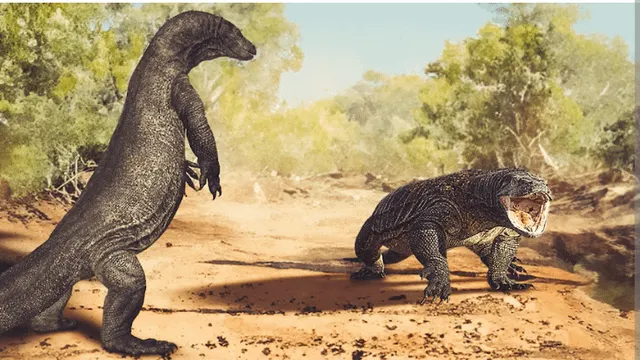
Megalania lived across a variety of habitats in prehistoric Australia, including open woodlands, grasslands, and dry savannas. Fossil evidence places it primarily in the southeastern regions of the continent, where large herbivorous marsupials roamed in abundance.
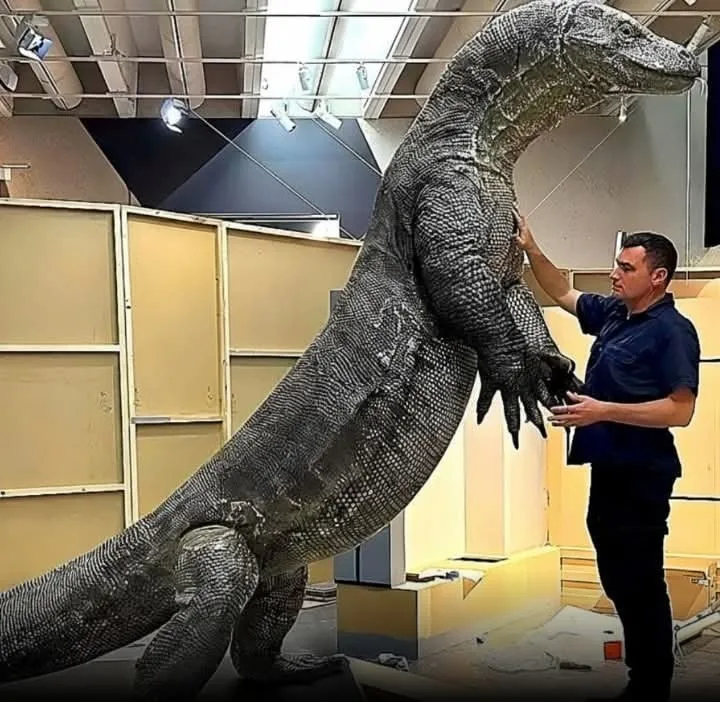
During the Pleistocene, Australia’s landscape was teeming with megafauna, including giant kangaroos, wombats (Diprotodon), and massive flightless birds (Genyornis). In such a setting, Megalania reigned supreme as one of the top terrestrial predators.
Diet and Hunting Strategies: Apex Predator of the Pleistocene
As a carnivore, Megalania’s diet would have included large mammals, reptiles, and carrion. Given its immense size, it could have taken down animals as large as giant marsupials and perhaps even juvenile diprotodons.
Hunting Behavior
Megalania likely used stealth and ambush tactics, lying in wait before launching sudden attacks. Once it bit into prey, its serrated teeth and possibly venomous saliva (a trait seen in modern monitor lizards) would incapacitate the victim quickly.
Its strong limbs and claws helped it hold struggling prey, while its powerful jaws tore through flesh and bone with ease. Like modern Komodo dragons, Megalania may have also been a scavenger, feeding on carcasses when the opportunity arose.
Role in the Ecosystem: The Top of the Food Chain
As an apex predator, Megalania played a crucial role in maintaining the balance of its ecosystem. By controlling populations of herbivorous megafauna, it prevented overgrazing and promoted biodiversity.
Its presence likely influenced the behavior and evolution of other species — smaller predators may have adapted avoidance strategies, while prey animals developed heightened senses or speed to escape this formidable hunter.
Fossil Evidence and Discovery
The first remains of Megalania were described in the 19th century by British naturalist Sir Richard Owen, who named it Megalania prisca (“ancient great roamer”). Over time, additional fossil fragments — including vertebrae, ribs, and skull pieces — have been unearthed across Australia.
Although no complete skeleton has been found, scientists have used comparisons with modern varanids to estimate its full anatomy and behavior. Ongoing discoveries continue to refine our understanding of this prehistoric reptile’s size, distribution, and ecology.
Extinction: What Happened to Megalania?
Megalania is believed to have gone extinct around 40,000–50,000 years ago, coinciding with the arrival of early humans in Australia and the decline of other megafauna.
Several factors likely contributed to its extinction:
-
Climate change — A shift to drier conditions reduced available prey.
-
Human activity — Early humans may have hunted Megalania or competed for similar food sources.
-
Habitat loss — Environmental changes led to shrinking ecosystems and reduced hunting territories.
As apex predators require vast territories and abundant prey, even small ecological disruptions could have triggered Megalania’s decline.
Legacy and Significance: A Window into Evolution
The story of Megalania offers valuable insights into evolution, ecology, and extinction. Studying this giant monitor lizard helps scientists understand how large reptiles adapt to changing environments and how ecosystems respond when apex predators disappear.
Modern varanids, like the Komodo dragon, serve as living reminders of Megalania’s ancient lineage. The similarities between them help researchers reconstruct not only physical traits but also behavioral patterns and predatory dynamics of prehistoric ecosystems.
Megalania in Popular Culture
Megalania’s enormous size and terrifying predatory reputation have made it a favorite subject in documentaries, books, and pop culture. From scientific reconstructions to fictional thrillers, it continues to capture human imagination as the “dragon of the outback.”
Its portrayal often symbolizes power, mystery, and survival, representing the primal forces that once ruled Earth long before humanity’s rise.
Conclusion: The Legacy of a Lost Giant
Megalania was more than just a giant lizard — it was a symbol of Australia’s prehistoric wilderness, an apex predator that shaped the continent’s ecological history. Though extinct, its fossils tell a story of evolution, adaptation, and survival in a world vastly different from our own.
Studying Megalania reminds us how delicate ecosystems can be, and how the disappearance of a single species can ripple through nature’s balance. Today, its story stands as both a scientific marvel and a cautionary tale about extinction and environmental change.
ALSO READ: The Oldest Known Ice Skates — Gliding Through Time