The Enigmatic Skull of Mary Magdalene: History, Legend, and Legacy of a Sacred Relic
The Discovery of Mary Magdalene’s Skull
On December 9, 1279, Charles II of Anjou, then Count of Provence and later King of Naples, ordered excavations beneath the ancient church in the small Provençal town now known as Saint-Maximin-la-Sainte-Baume. Monks and nobles, driven by visions and centuries-old legend, unearthed a marble tomb in the crypt, releasing a supposed wave of fragrant aroma—a sign, in medieval lore, of sanctity.
Within the tomb lay a nearly intact skeleton, missing only its lower jaw and one leg, with hair still encircling the skull. A wax-coated tablet bore the Latin inscription “Hic requiescit corpus Mariae Magdalenae”—“Here lies the body of Mary Magdalene”. The discovery, quickly judged authentic, was celebrated by Provence’s church hierarchy and laity alike.

Charles II sanctioned the construction of a grand Gothic basilica over the site, entrusting the relics to Dominican friars and prompting recognition from Pope Boniface VIII. The relics’ translation in 1281 and papal decrees instigated both public devotion and the development of Mary Magdalene’s cult in southern France.
The Golden Reliquary and the Mark of the Kiss
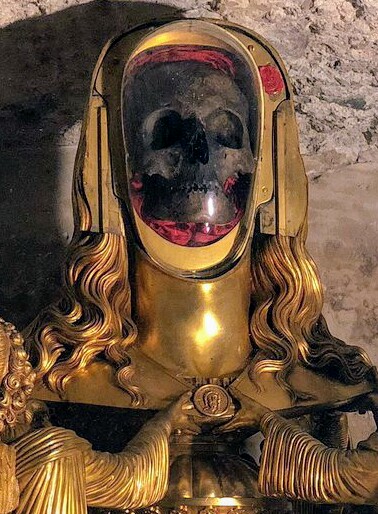
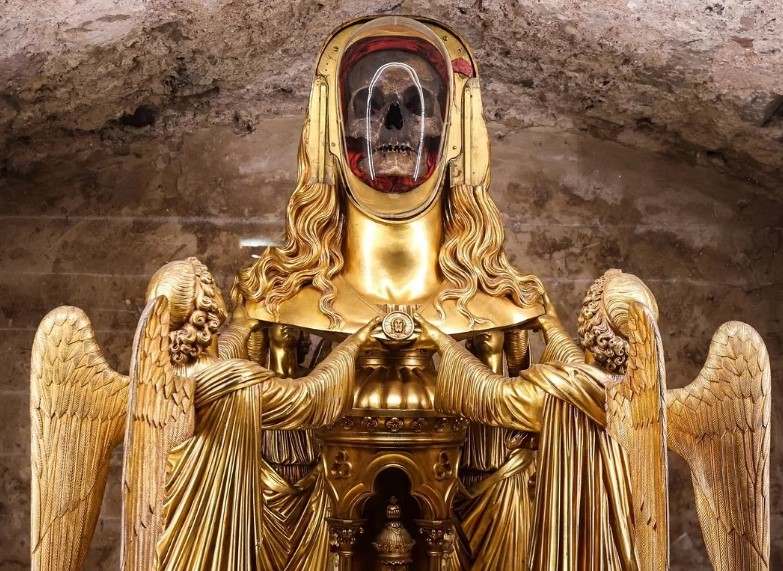
Today, the skull rests within a lavish gold reliquary, its design echoing artistic reverence and legend. After the French Revolution, which saw the desecration and restoration of many relics, a new reliquary was fashioned in 1860 to safely house the skull and a unique relic: the “noli me tangere”—a dried piece of skin purportedly left on the forehead where Christ touched Mary Magdalene after his resurrection.
A glass dome now covers the relic’s face, with a small visible gap displaying this so-called “mark of the kiss”—a powerful detail for pilgrims and believers, signifying Christ’s blessing and the miraculous preservation of his devoted follower.
The crypt’s aura and the annual feast on July 22nd continue to draw pilgrims, who note the deeply spiritual atmosphere that surrounds the displayed skull and its “living” mark.
The Symbolism of the Skull
In Christian art and tradition, Mary Magdalene is often depicted with a skull—symbolizing repentance, contemplation of death, and hope in the resurrection. The actual relic’s presence in southern France is closely linked to local legends: it was said that after Christ’s ascension, Mary Magdalene fled persecution in Judea, sailed across the Mediterranean, and spent her final years as a penitent hermit in the caves of Sainte-Baume, before being buried in the area.
The presence of the skull connects with this iconography, linking the historical figure’s life. The Gospel accounts of her devotion, and ongoing themes of mortality and faith.
Scientific Investigations and Controversy
The tradition holding this as Magdalene’s true skull is deeply entrenched in regional Catholicism. But remains a matter of faith rather than certainty. In recent decades, researchers have examined the skull’s features. With forensic facial reconstructions suggesting traits consistent with a first-century Middle Eastern woman of about 50 years of age. However, scientific tests have yet to conclusively prove the relic’s identity.
Despite the lack of definitive evidence, the preservation of surrounding hair and traces of a facial wound intrigue both historians and believers. Encouraged by these findings, pilgrims and scholars alike perpetuate the relic’s veneration and its link to Christianity’s earliest days.
Mary Magdalene in the Gospels
Mary Magdalene’s prominence in Christian history stems from the Gospels. She was healed by Jesus of “seven demons,” became a steadfast follower. Present at both his crucifixion and burial, and was the first to witness and proclaim his resurrection. Such was her stature among the early disciples that, despite later traditions. Casting her as a penitent prostitute, modern scholars and theologians increasingly emphasize her role as “apostle to the apostles.”
The veneration of her relics in Provence is a testament not only to the power of medieval legend. But also to her enduring legacy as a symbol of repentance, hope, and resurrection.
Pilgrimage and Legacy
For centuries, the Basilica of Saint-Maximin-la-Sainte-Baume has been one of the world’s principal pilgrimage sites for those devoted to Mary Magdalene. The mystery and legend of her skull—combining royal patronage, miraculous elements, artistic craftsmanship, and faith. Keep her story alive, blending tangible history with spiritual inspiration.
Whether or not the skull truly belongs to the woman who witnessed the resurrection. It remains a unique and compelling relic at the intersection of faith, science, and legend.