Lion of Lucerne: Switzerland’s Monument of Loyalty and Bravery
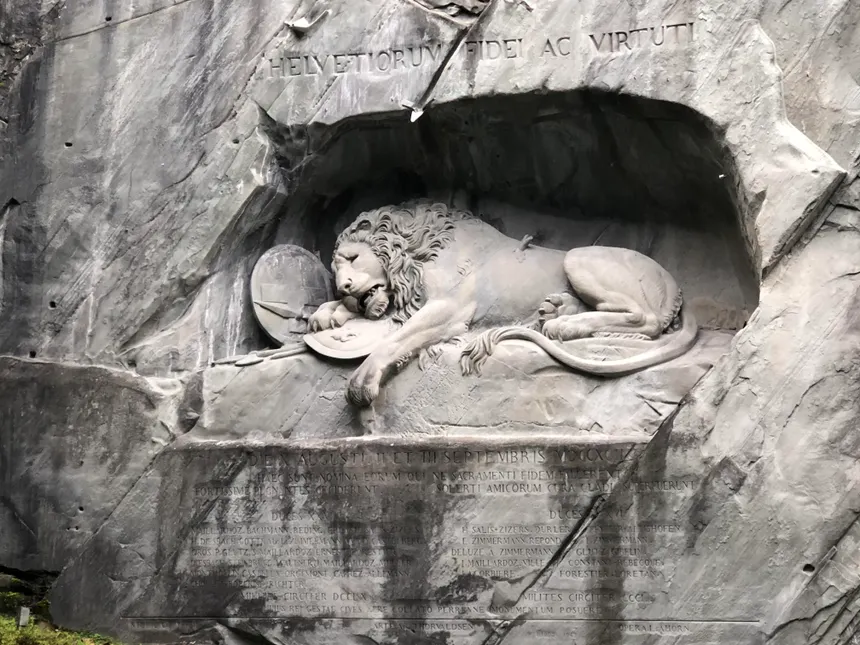
Nestled in the heart of Lucerne, Switzerland, lies one of Europe’s most poignant monuments—the Lion of Lucerne. Designed by the Danish sculptor Bertel Thorvaldsen and carved into a sandstone cliff by Swiss artisan Lukas Ahorn between 1820 and 1821, the memorial is a tribute to the Swiss Guards who died defending the Tuileries Palace in Paris during the French Revolution of 1792.
Praised by Mark Twain as “the most mournful and moving piece of stone in the world,” the Lion of Lucerne continues to draw visitors from around the globe, not only for its artistic brilliance but also for its enduring message of loyalty, sacrifice, and national pride.
The Historical Background
The Lion of Lucerne commemorates the tragic fate of the Swiss Guards, an elite military unit that had long served as protectors of European monarchs.
-
Event: On August 10, 1792, revolutionaries stormed the Tuileries Palace in Paris, where King Louis XVI and his family were residing.
-
Defenders: About 1,100 Swiss Guards stood in defense of the monarchy.
-
Losses: Around 760 guards were killed (DCCLX) during the battle, while 350 survived (CCCL).
The massacre shocked Europe and became a symbol of loyalty and duty unto death. In Switzerland, it cemented the Guards’ sacrifice as an enduring story of national honor.
Design and Symbolism
The Lion of Lucerne is more than a sculpture—it is a masterpiece of symbolism.
-
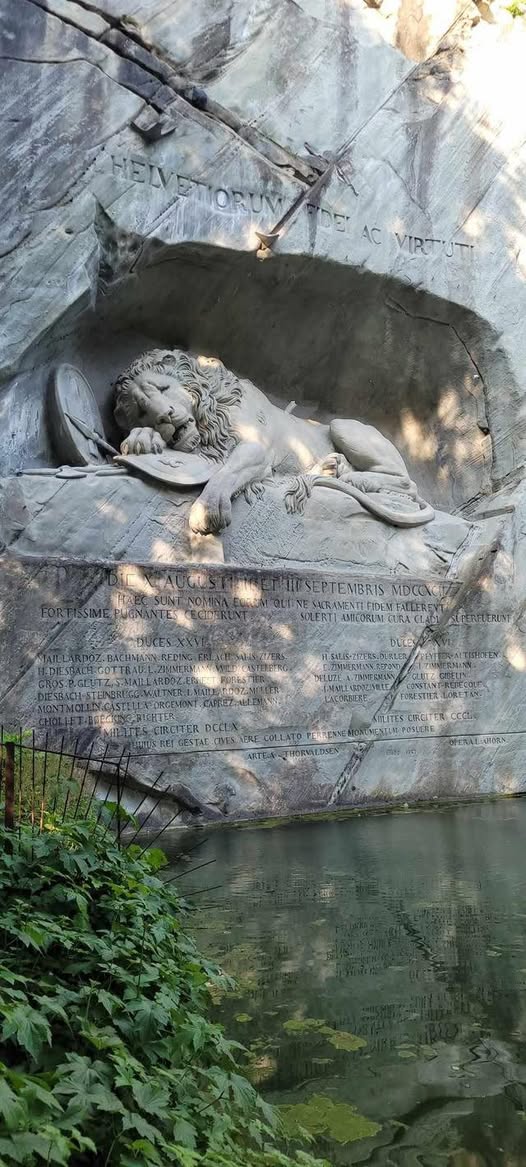
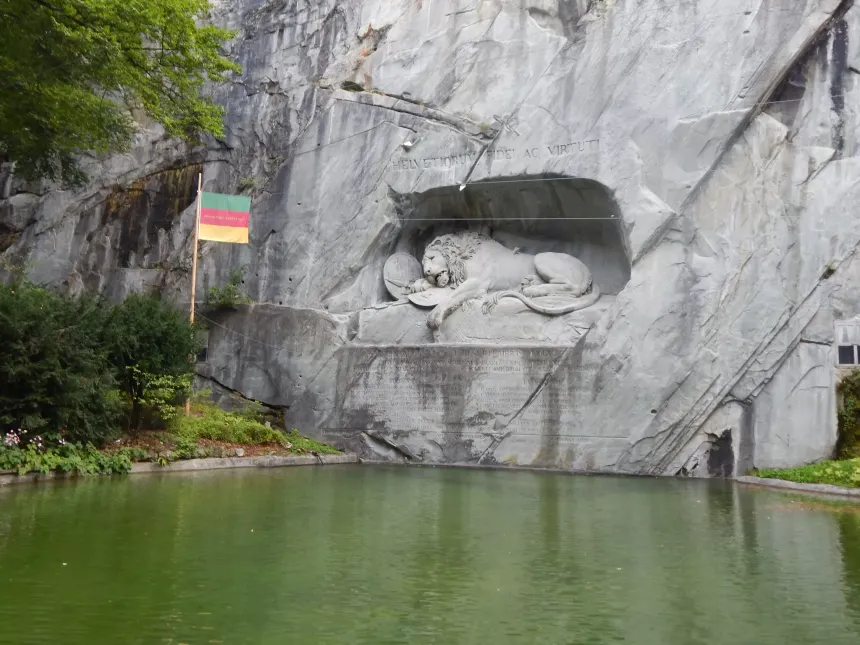
The Lion: Depicted as mortally wounded, the lion lies draped over a shield, pierced by a spear. His expression conveys agony, dignity, and courage in the face of death.
-
The Shields:
-
One shield bears the fleur-de-lis, symbolizing the French monarchy.
-
The other carries the Swiss coat of arms, linking the sacrifice directly to Swiss heritage.
-
-
The Inscription: Above the lion is the Latin phrase Helvetiorum Fidei ac Virtuti, meaning “To the loyalty and bravery of the Swiss.”
-
Names of the Fallen: Below the sculpture are the names of officers and figures recording the number of dead and survivors.
The positioning of the lion within the sandstone rock face creates a natural, solemn backdrop, enhancing the monument’s emotional weight.
The Artists Behind the Monument
The monument’s conception and execution brought together two masters of their craft:
-
Bertel Thorvaldsen (1770–1844): A renowned Danish neoclassical sculptor who designed the lion’s form and expression, capturing its emotional depth.
-
Lukas Ahorn (1789–1856): A Swiss stonemason entrusted with carving the design into the cliff face near Lucerne.
Together, they created not just a sculpture but a national symbol that endures two centuries later.
Mark Twain’s Tribute
The American writer Mark Twain, during his travels through Europe, was deeply moved by the Lion of Lucerne. In his book A Tramp Abroad (1880), he described it as:
“The most mournful and moving piece of stone in the world.”
Twain’s words immortalized the monument in Western literature, helping bring international recognition to Lucerne’s lion.
The Site and Its Atmosphere
The Lion of Lucerne is carved into a natural sandstone wall, creating a solemn, sheltered space that feels almost like an open-air chapel. A tranquil pond lies in front of the sculpture, reflecting the lion’s form and enhancing the sense of quiet mourning.
Visitors often describe the site as:
-
Intimate: Unlike towering monuments, the Lion feels personal and accessible.
-
Emotional: The lion’s expression evokes empathy and sorrow.
-
Reflective: The surrounding garden encourages silence and contemplation.
Legacy of the Swiss Guards
Though the Lion of Lucerne specifically honors the Guards killed at the Tuileries, it also symbolizes the long history of Swiss soldiers serving abroad.
-
The Swiss Guard tradition continues today at the Vatican, where Swiss soldiers protect the Pope.
-
The monument remains a reminder of the values of duty, courage, and sacrifice that shaped Swiss identity.
Visiting the Lion of Lucerne
For travelers, the Lion of Lucerne is one of the city’s most visited landmarks.
-
Location: Northeastern edge of Lucerne’s old town, near Löwenplatz.
-
Accessibility: A short walk from the city center; free to visit year-round.
-
Nearby attractions: Lucerne’s old town, Chapel Bridge, and the Swiss Museum of Transport.
Best times to visit are early morning or late afternoon, when the monument is quieter and the light enhances the lion’s details.
Why the Lion of Lucerne Still Matters
The Lion of Lucerne resonates across centuries because it embodies universal themes:
-
Loyalty and sacrifice – Honoring those who stood firm in duty.
-
Artistic power – A neoclassical masterpiece carved in stone.
-
National pride – A uniquely Swiss monument rooted in shared history.
-
Emotional depth – A work that still moves people to silence and reflection.
In a world filled with grand monuments, the Lion’s enduring strength lies in its quiet dignity and mournful beauty.
Conclusion
The Lion of Lucerne memorial is far more than a tourist attraction—it is a profound symbol of loyalty, bravery, and sacrifice. Designed by Bertel Thorvaldsen and carved by Lukas Ahorn, it commemorates the Swiss Guards who perished in the storming of the Tuileries in 1792.
Admired by Mark Twain as the most moving stone monument in the world, the Lion of Lucerne continues to touch hearts, reminding visitors that true courage lies in standing firm even in the face of death.
For travelers in Switzerland, standing before this dying lion is not just sightseeing—it is an encounter with history, art, and the timeless values of loyalty and honor.
ALSO READ: Stairs of Death at Machu Picchu: Ancient Engineering Meets Adrenaline