Lewisian Gneiss: Scotland’s Ancient Rocks of Deep Time
Along the rugged, windswept coastlines of the Outer Hebrides in Scotland lies one of Europe’s most extraordinary natural wonders: the Lewisian gneiss. Dating back almost 3 billion years, these rocks are among the oldest in Europe and some of the most ancient on the planet.
Exposed dramatically on the Isle of Lewis and Harris, Lewisian gneiss is more than just rock—it is a living geological archive, a record of Earth’s earliest history, formed under unimaginable pressure and heat. To walk among these stones is to step into deep time, touching landscapes shaped long before life itself flourished on Earth.
What Is Lewisian Gneiss?
Lewisian gneiss is a type of metamorphic rock, formed when pre-existing rocks were transformed deep within Earth’s crust through intense heat and pressure. Over billions of years, these rocks were altered, compressed, and recrystallized, producing striking banded patterns of light and dark minerals.
The name derives from the Isle of Lewis, where the rock is widely exposed, though it also appears across the Scottish Highlands and other parts of the Outer Hebrides.
Age and Geological Significance
At nearly 3 billion years old, Lewisian gneiss predates not only the rise of complex life but also the formation of most modern continents.
To put this into perspective:
-
The Lewisian gneiss formed during the Archaean Eon, when Earth’s crust was still stabilizing.
-
These rocks are older than the Himalayas, the Rockies, and even the Atlantic Ocean itself.
-
They represent some of the earliest continental crust still preserved on Earth today.
Their sheer age makes them invaluable to geologists studying the processes that shaped our young planet.
The Distinctive Appearance of Lewisian Gneiss
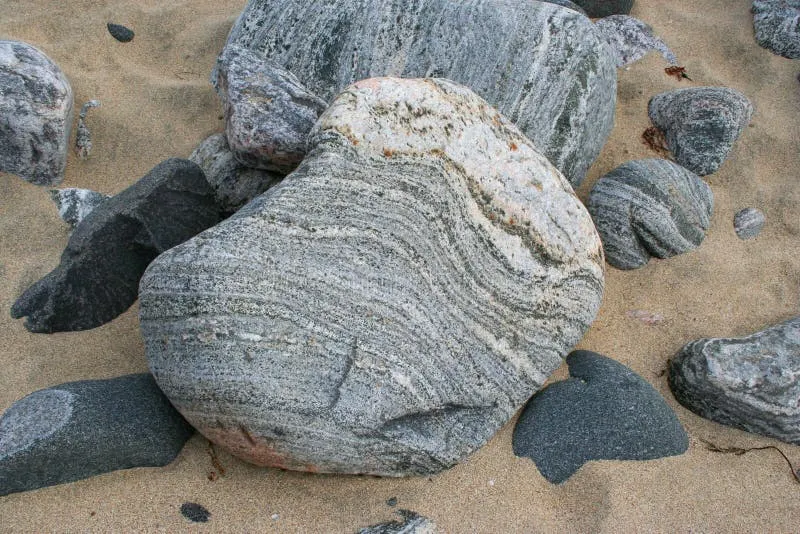
One of the most remarkable features of Lewisian gneiss is its visual texture. The rock is marked by alternating bands of different minerals:
-
Dark layers rich in mafic minerals such as pyroxene and amphibole.
-
Light layers made of quartz and feldspar, resembling granitic compositions.
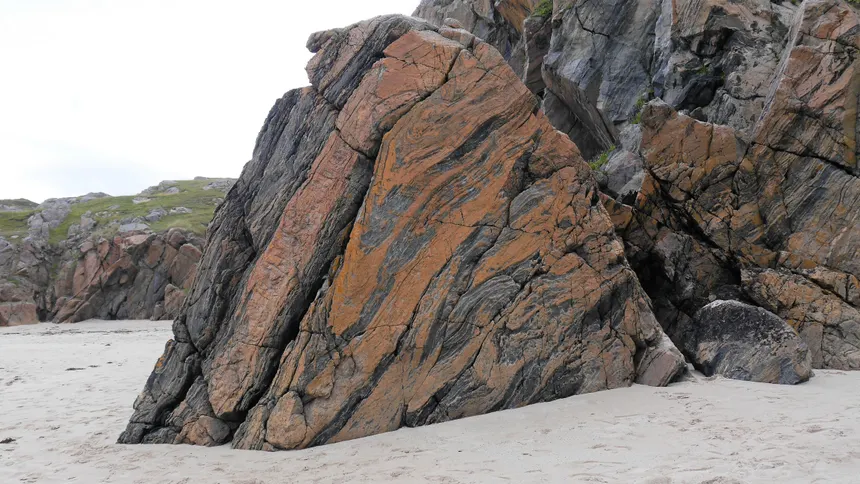
This striking pattern, often called gneissic banding, gives the rocks an almost hand-painted quality, as though nature itself were an artist.
When viewed in coastal outcrops or polished surfaces, the stone reveals a mesmerizing interplay of colors—grays, whites, blacks, and sometimes hints of pink or green.
Formation: A Journey Through Heat and Pressure
The Lewisian gneiss tells a story of extraordinary geological transformation. Its formation can be broken down into several key processes:
-
Original Rock Formation – The precursor rocks (igneous or sedimentary) crystallized deep in Earth’s crust nearly 3 billion years ago.
-
Metamorphism – Immense pressure and temperatures exceeding 700°C transformed the minerals, aligning them into bands and layers.
-
Tectonic Activity – Over billions of years, Earth’s crust shifted, folding and faulting the rocks.
-
Erosion and Exposure – Finally, ice, wind, and sea eroded the overlying material, exposing the gneiss on today’s coastal landscapes.
This journey makes Lewisian gneiss not just old rock but a chronicle of Earth’s tectonic and metamorphic history.
Where to See Lewisian Gneiss
The best-known exposures are in the Outer Hebrides, particularly on the Isle of Lewis and Harris. Visitors can see dramatic outcrops along:
-
Coastal cliffs shaped by waves and tides.
-
Inland hills and moorlands where erosion has revealed the ancient bedrock.
-
Beaches and rocky shorelines, where the gneiss meets the Atlantic Ocean.
These landscapes attract geologists, hikers, and photographers alike, each drawn by the sheer age and beauty of the rock formations.
Lewisian Gneiss and Human History
Though billions of years old, Lewisian gneiss has also played a role in human history:
-
Building material – Its durability made it useful in ancient structures, standing stones, and later, local architecture.
-
Cultural significance – For communities in the Outer Hebrides, the rocks are part of the landscape’s identity, linking natural history with cultural heritage.
-
Scientific study – Since the 19th century, geologists have studied Lewisian gneiss to better understand Earth’s crustal evolution.

The Concept of “Deep Time”
Standing on the Lewisian gneiss is an almost spiritual experience. These rocks embody the concept of deep time—the idea that Earth’s history stretches back billions of years, far beyond the human timescale.
-
Every crack and fracture whispers of tectonic collisions long before humanity.
-
Every band of mineral tells a story of Earth’s molten beginnings.
-
Every wave that washes over the gneiss connects the ancient past with the present moment.
To encounter these stones is to recognize our place in a much larger story, where human history is but a fleeting moment compared to the endurance of rock.
Scientific Insights from Lewisian Gneiss
Studying Lewisian gneiss has yielded key insights:
-
Plate tectonics – Evidence of early crustal movement and collisions.
-
Metamorphism – Understanding how minerals change under extreme conditions.
-
Early Earth conditions – Providing clues about the environment nearly 3 billion years ago.
Because the Lewisian gneiss has survived so long, it acts as a natural archive of Earth’s formative years, helping scientists reconstruct the planet’s evolution.
Modern Appreciation and Conservation
Today, the Lewisian gneiss is valued not only for its geological significance but also for its role in tourism and education. Sites like the Isle of Lewis draw visitors eager to experience these ancient stones firsthand.
Efforts are underway to preserve these landscapes, balancing tourism with conservation to ensure the rocks remain intact for future generations.
Why Lewisian Gneiss Captivates Us
The fascination with Lewisian gneiss lies in its combination of age, beauty, and meaning:
-
Age – Nearly 3 billion years old, connecting us to Earth’s earliest history.
-
Beauty – Striking banded patterns that rival works of art.
-
Meaning – A reminder of endurance, resilience, and the immensity of geological time.
For geologists, hikers, and dreamers alike, these rocks are more than stone—they are symbols of time itself.
Conclusion
The Lewisian gneiss of Scotland’s Outer Hebrides stands as one of the most remarkable geological treasures in Europe. Shaped by unimaginable forces over nearly 3 billion years, these rocks are living records of Earth’s deep history, etched into the landscapes of the Isle of Lewis and Harris.
To walk upon them is to encounter deep time, to glimpse the endurance of nature, and to remember that our own human stories are but a brief moment compared to the chronicles written in stone.
The Lewisian gneiss is not just rock—it is a window into the planet’s soul, a reminder of the Earth’s resilience, and an enduring symbol of time carved into Scotland’s rugged coastlines.
ALSO READ: Chullpa Towers: Ancient Funerary Monuments of the Andes