The Leaf Mantis: Nature’s Living Illusion
Among the countless marvels of evolution, few creatures inspire as much awe as the leaf mantis—a spectacular example of nature’s artistry in camouflage. With bodies sculpted to resemble withered leaves, complete with veins, textures, and even decay-like patterns, these insects have mastered the art of invisibility. To the untrained eye, they are mere fragments of the forest floor, blending seamlessly into their surroundings. Yet beneath this fragile disguise lies a patient and precise hunter, balancing beauty and brutality in perfect harmony.
The leaf mantis is more than just a triumph of adaptation; it is a philosophical emblem. Its existence reminds humanity of the delicate interplay between deception and survival, between the ephemeral and the eternal.
The Art of Camouflage: How Evolution Painted Perfection
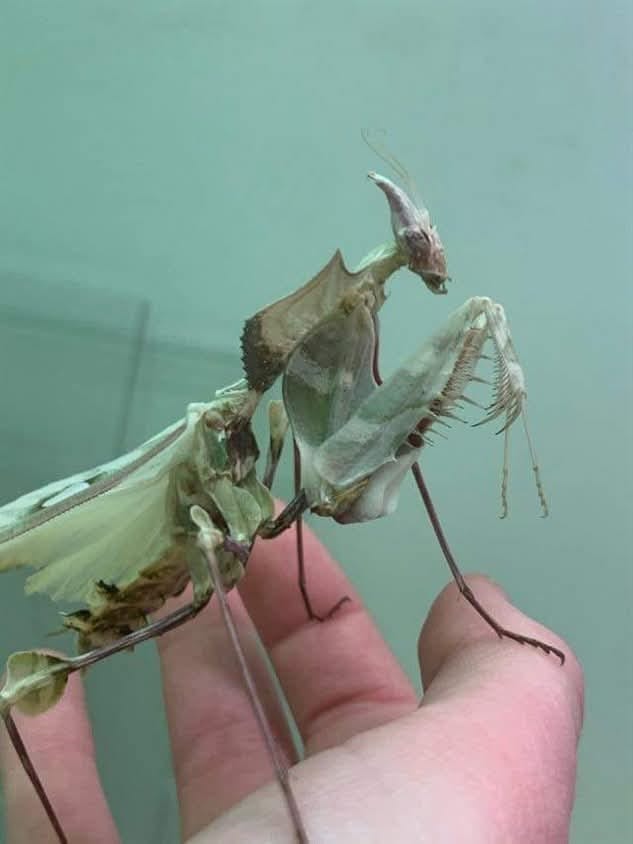
The leaf mantis (of genera such as Phyllocrania and Deroplatys) inhabits tropical forests across Africa, Southeast Asia, and South America. In these dense ecosystems, survival depends on the ability to remain unseen. Over millennia, natural selection sculpted the mantis’s body into a near-perfect imitation of dead leaves—a phenomenon known as biological mimicry.
Individual mantises blend differently depending on their habitat:
-
Brown-toned mantises mirror the hues of decayed leaves on dry forest floors.
-
Green-hued variants resemble fresh foliage found in moist environments.
-
Some species even develop irregular edges and vein-like markings that replicate leaf decay or tears.
This combination of color, texture, and structure forms a living illusion. When threatened, the leaf mantis freezes completely, aligning with surrounding leaves, making detection almost impossible even at close range. What appears to be delicate fragility is, in truth, a sophisticated defense mechanism honed through millions of years.
Sensory Mastery: The Hidden Tools of Survival
Beyond its visual disguise, the mantis possesses an array of highly tuned sensory adaptations that enhance its predatory efficiency. Its exoskeleton is lined with fine, hair-like extensions that register minute vibrations in the air and on nearby surfaces. These resonance sensors allow the mantis to detect both prey and predators through subtle changes in its environment.
Its compound eyes, large and multifaceted, provide an extraordinary range of vision. Capable of detecting motion in virtually any direction, the mantis sees the world through a spectrum of light invisible to human eyes. This visual perception complements its patience, enabling split-second precision when striking at unsuspecting prey.
Evolution crafted the leaf mantis not simply to survive, but to thrive within the narrow margins between seen and unseen reality.
A Predator Wrapped in Elegance
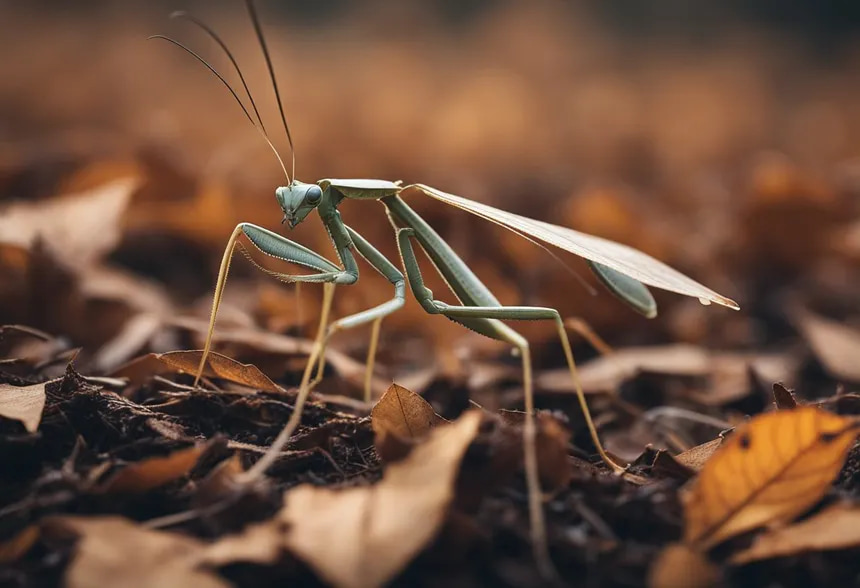
Though graceful in form, the leaf mantis is far from fragile in behavior. It is an ambush predator, relying on stillness and timing rather than pursuit. Perched motionless on a branch or among fallen leaves, it waits for smaller insects—flies, moths, beetles—to wander within reach. Then, in a motion almost too fast to perceive, its spined forelegs strike with surgical accuracy.
This duality defines the leaf mantis’s existence: a creature that personifies both beauty and lethality. Its features captivate naturalists and photographers alike, yet they conceal a ruthless efficiency that ensures its place in nature’s ever-evolving food web.
The Evolutionary Story: Adaptation and Continuity
The concept of mimicry in insects extends beyond simple deception. In evolutionary terms, mimicry reflects complex coadaptation—each generation refining traits that increase reproductive success. For the leaf mantis, this means evolving precise mimicry of its habitat to avoid predators such as birds and reptiles while enhancing its own hunting ability.
This adaptive intelligence demonstrates natural selection’s creativity. Over millions of years, similar evolutionary pathways have emerged in unrelated species—from stick insects to leaf-tailed geckos—proving that nature often arrives at the same solution through different routes. The leaf mantis thus stands as both specialist and survivor, shaped by necessity and refined by time.
Symbolism: The Mantis as a Metaphor for Balance
Beyond its biological wonder, the leaf mantis carries symbolic significance across cultures. In several Asian traditions, mantises are symbols of stillness and mindfulness, embodying patience and focus. Their ability to vanish into their surroundings mirrors philosophical concepts of harmony with nature.
From an ecological lens, the mantis represents balance—the interplay between predator and prey, life and death, decay and renewal. The leaf-like form is a reminder that even what appears lifeless in nature contributes to the ongoing rhythm of the living world. Each disguise, each movement, echoes the planet’s silent narrative of resilience.
Conservation and the Fragility of Habitat
While individual species of leaf mantises are not widely endangered, their survival is inseparable from the health of tropical forests. Deforestation, habitat fragmentation, and climate change threaten these delicate ecosystems. Beyond direct survival, such loss erodes entire microhabitats crucial for insect biodiversity.
Protecting the mantis’s home means preserving vast ecological networks, from soil microbes to canopy flora. Conservation efforts targeting forest ecology indirectly ensure the persistence of wondrous evolutionary designs such as the leaf mantis. Its camouflage depends not only on individual adaptation but also on the integrity of the environment it mimics.
Lessons from a Master of Disguise
Human observers often view the natural world through a lens of separation, but the leaf mantis invites a deeper perspective. Its survival strategy is not dominance but integration—an existence woven seamlessly into its environment. Within its evolutionary success lies a quiet lesson: survival favors harmony as much as strength.
Photographers and researchers who encounter the leaf mantis often speak of the disbelief that follows discovery. What was mistaken for a fragment of decay suddenly moves—alive, calculating, elegant. This moment of revelation encapsulates a universal truth: beauty and power often dwell within the unseen.
Ephemeral Beauty in a Transient World
The leaf mantis reminds us that transience defines all life. Its beauty is fleeting, its form fragile, yet its lineage stretches back eons. Every fallen leaf it imitates tells a story of cycles—growth, death, and rebirth—mirrored in the mantis itself. It stands as both participant and observer in the ceaseless transformation of its forest world.
In a time when human activity threatens the natural balance, the leaf mantis serves as both symbol and warning. Its perfection was not created overnight but crafted by slow, patient adaptation. To destroy that environment is to erase living evidence of evolution’s finest artistry.
Conclusion: The Living Testament of Nature’s Duality
In every rustle of leaves lies a ghostly presence—a hunter concealed within stillness. The leaf mantis embodies the paradox of nature: vulnerability cloaked in strength, deception serving survival, beauty masking predation. It illustrates that impermanence and harmony coexist, forming the silent architecture of existence.
Studying this insect means more than understanding camouflage. It is a meditation on adaptation itself—a reflection of how life, in infinite forms, persistently crafts balance from chaos.
ALSO READ: Mortuary Temple of Hatshepsut: Architectural Marvel of Ancient Egypt