The Lapedo Child: New Radiocarbon Dating Reveals a 28,000-Year-Old Human-Neanderthal Hybrid
A Hybrid Legacy of Two Human Worlds
In the quiet Lapedo Valley of Portugal, the discovery of a small child’s skeleton in 1998 changed the story of human evolution forever. Known as the Lapedo Child, this four-to-five-year-old was buried roughly 28,000 years ago — a period when both Neanderthals and early modern humans roamed Europe. The child’s remains displayed a striking combination of traits: the robust physique typical of Neanderthals and the delicate facial structure of Homo sapiens.
Now, a new study published in Science Advances has provided the most precise date yet for this enigmatic burial. Using a cutting-edge method known as compound-specific radiocarbon analysis (CSRA), researchers determined that the Lapedo Child lived between 27,780 and 28,850 years ago. This breakthrough not only refines the child’s age but also deepens our understanding of when and how the last interactions between Neanderthals and humans occurred.
The Discovery in Lapedo Valley: A Burial That Rewrote History
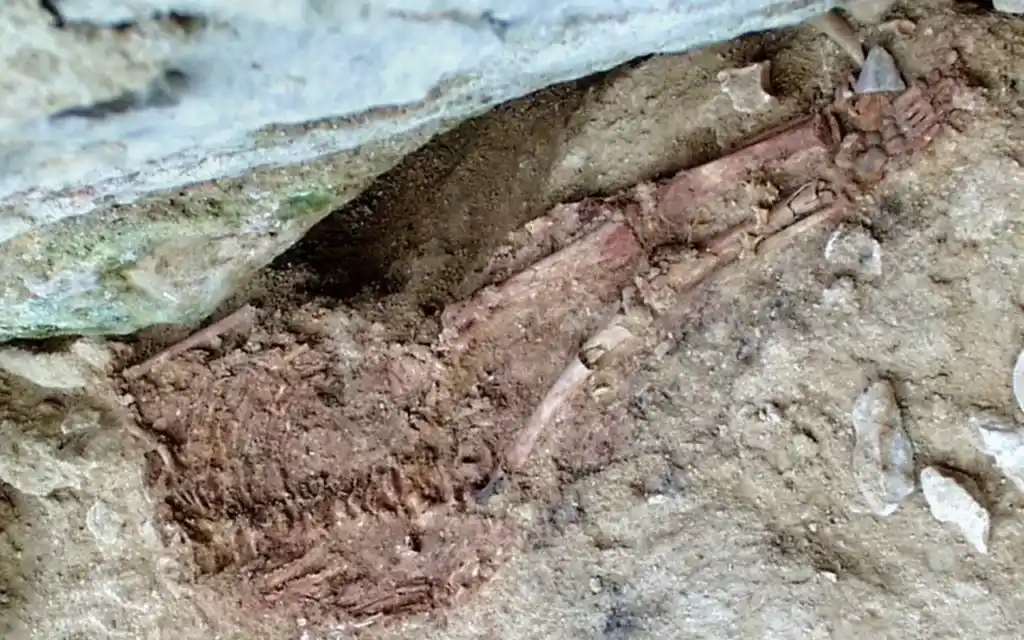
The story began in 1998, when archaeologists excavating the Lagar Velho rock shelter in central Portugal stumbled upon a partially preserved skeleton buried in ochre-stained sediment. Measuring roughly 1 meter long, the grave contained a child laid on its back, wrapped in what appeared to be a shroud dusted with red ochre, a pigment often used in prehistoric burial rituals.
At first glance, the burial site seemed typical of Upper Paleolithic modern humans. However, closer analysis of the skeleton revealed something extraordinary: the child’s limb proportions, pelvis, and jawline bore Neanderthal characteristics, while other features, such as the chin and cranial vault, were unmistakably human.
This unexpected blend led researchers to propose that the Lapedo Child was a hybrid, possibly the offspring of a Neanderthal and a modern human. The finding was met with controversy, as the concept of hybridization between the two species was still debated in the late 1990s — years before DNA evidence confirmed interbreeding events.
The Challenge of Dating Ancient Remains
Determining the exact age of the Lapedo Child has long been a scientific challenge. Early radiocarbon dating efforts produced inconsistent results, ranging from 20,000 to 26,000 years before present (BP). These wide margins were due to contamination and the poor preservation of the bone collagen — key material for carbon dating.
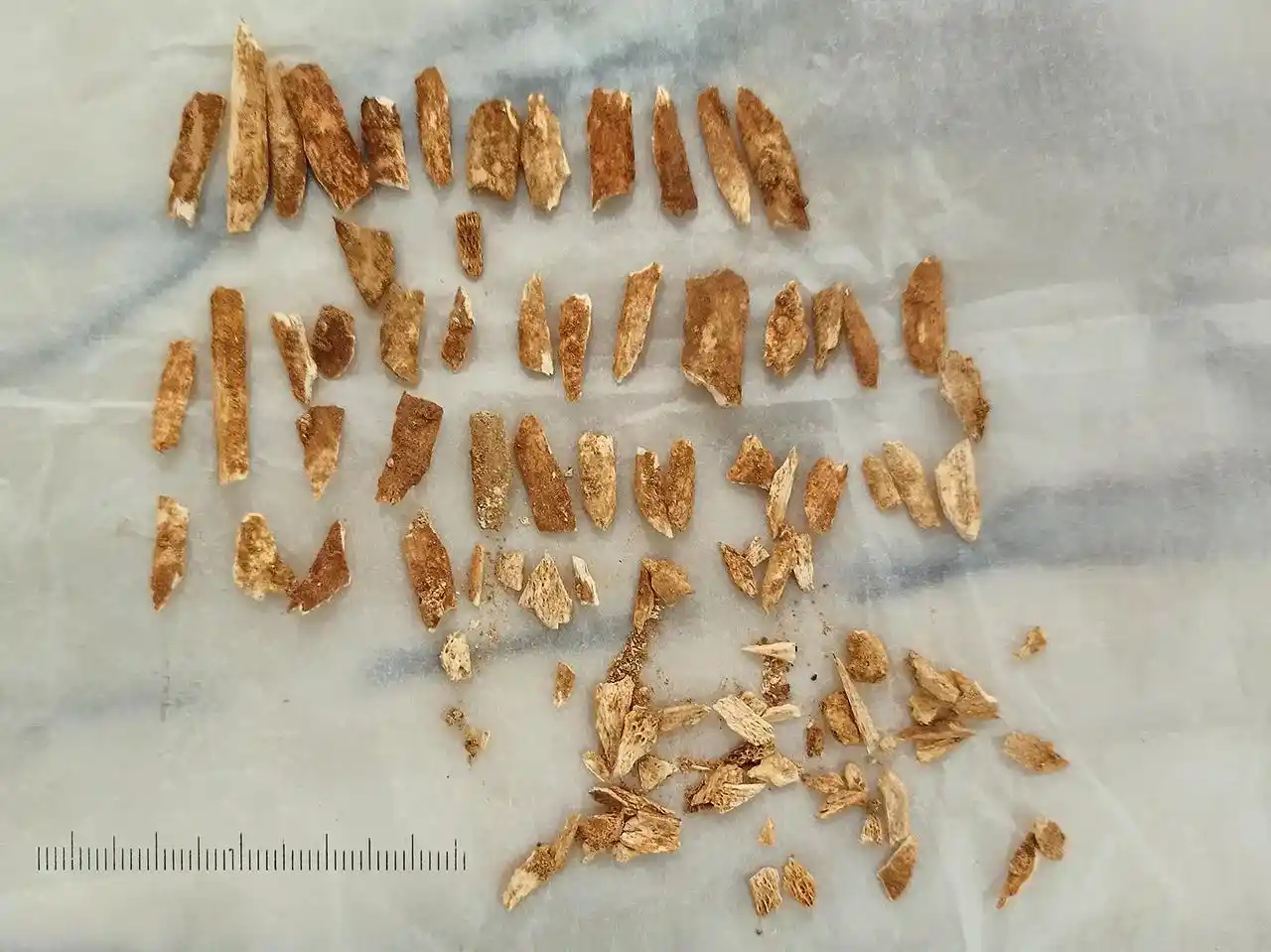
The new study, led by an international team of researchers, applied compound-specific radiocarbon analysis (CSRA), a method capable of isolating individual amino acids from bone collagen. By focusing on these purified compounds, scientists could eliminate modern contaminants, significantly improving the precision of the results.
The refined dating places the Lapedo Child’s burial between 27,780 and 28,850 years ago, providing a much narrower and more accurate timeframe than previously thought. This not only helps in understanding the child’s place in prehistory but also in assessing the timeline of Neanderthal extinction and human expansion across Europe.
Unraveling the Ritual: The Burial Context
Beyond the skeleton itself, the burial site contained several intriguing artifacts. Archaeologists discovered:
-
Bones of a young rabbit, placed atop the child’s body
-
Red deer bones near the shoulder area
-
Charcoal deposits beneath the legs, suggesting a possible ritual fire
Initially, these elements were thought to be part of a funerary offering — a practice associated with symbolic and spiritual behavior. However, the new study reveals a more nuanced picture.
Through radiocarbon dating of these associated materials, researchers found that while the rabbit bones were contemporaneous with the child, the red deer bones and charcoal were significantly older. This indicates that they were not deliberately placed during the burial but rather belonged to earlier occupations of the site.
The rabbit skeleton, however, appears to have been a symbolic offering. It was coated in the same red ochre pigment as the child’s shroud, suggesting a ritual act of farewell or rebirth — a symbolic gesture connecting life, death, and nature.
A Silent Site: Why Lapedo Was Abandoned
One of the study’s most compelling conclusions is that the Lagar Velho site was abandoned soon after the child’s burial. Archaeological evidence shows no human activity at the site for over 2,000 years following the interment.
Researchers propose that the child’s death may have transformed the area into a taboo or sacred space, leading prehistoric groups to avoid it. Such behavior implies a complex social and spiritual understanding of death, consistent with both Neanderthal and early human practices.
This abandonment offers a rare glimpse into how prehistoric communities assigned meaning to places of death — viewing them not just as burial sites, but as portals of transition between the living and the spirit world.
The Significance of the Lapedo Child: A Bridge Between Two Species
The implications of this new dating extend far beyond Portugal. The Lapedo Child stands at a pivotal point in human evolution, representing one of the latest possible examples of Neanderthal-modern human hybridization.
Genetic evidence now shows that Neanderthals and Homo sapiens interbred multiple times across Eurasia between 49,000 and 42,000 years ago. However, if the Lapedo Child lived around 28,000 years ago, this suggests that hybrid traits persisted much later than previously thought — possibly through successive generations of mixed ancestry.
This means that Neanderthal genetic influence in early European populations may have lasted well beyond the species’ extinction. Shaping the physical and genetic diversity of modern humans.
Advancing Science: The Role of New Dating Techniques
The success of compound-specific radiocarbon analysis (CSRA) in this study demonstrates how technological innovation continues to reshape archaeology and paleoanthropology. By isolating molecular components rather than bulk collagen, scientists can now date contaminated or fragile remains with unprecedented accuracy.
This breakthrough method holds promise for reevaluating other controversial finds where dating uncertainty has clouded interpretation. As one of the researchers noted, “With CSRA, we can refine our timeline of human evolution. Correcting decades of uncertainty and opening new windows into the past.”
Cultural Connections: Ritual, Symbolism, and Belief
The Lapedo burial is not just a biological or genetic puzzle. It is also a window into the spiritual world of early humans. The careful arrangement of the child’s body, the use of red ochre. And the inclusion of a rabbit offering all point to an emerging symbolic consciousness. Shared by Homo sapiens and Neanderthals alike.
Both species engaged in ritual burials, suggesting empathy, respect for the dead, and possibly belief in an afterlife. The Lapedo Child, therefore, represents a convergence of biology and belief. Where two human species met — and shared more than just DNA.
Conclusion: A Child Between Two Worlds
The new dating of the Lapedo Child to around 28,000 years ago. Offers one of the most precise glimpses yet into a time when modern humans and Neanderthals overlapped, interacted, and even blended. Through cutting-edge science, we are uncovering not just the timeline of a single child’s life. But the broader story of human evolution, connection, and coexistence.
The child from Lapedo remains a powerful symbol of humanity’s intertwined origins. A reminder that the boundaries between species were once more porous than we imagined. And that within our shared ancestry lies the legacy of both strength and survival.