The Jewelled Scarab Pectoral of Tutankhamun: Symbol of Eternal Life and Egyptian Mastery
A Jewel Beyond Beauty
Among the countless treasures uncovered in the tomb of Pharaoh Tutankhamun, few capture the fusion of art, religion, and royal symbolism as profoundly as the Jewelled Scarab Pectoral. Discovered in 1922 by Howard Carter in the Valley of the Kings, this stunning artifact is not merely a luxurious ornament — it is a theological statement in gold and gemstone, reflecting the ancient Egyptians’ deepest beliefs about life, death, and cosmic rebirth.
The pectoral, worn across the chest, served as both a protective amulet and a ritual emblem of resurrection. Its central figure — the scarab beetle — represents Khepri, the god of the morning sun, symbolizing creation, transformation, and the eternal cycle of renewal.
The Symbolism of the Scarab: Heart of Eternal Creation
In ancient Egyptian theology, the scarab beetle was one of the most potent and sacred symbols. The Egyptians observed the beetle (Scarabaeus sacer) rolling a ball of dung across the ground, associating this image with the movement of the sun across the sky. The scarab thus became the emblem of Khepri, the divine force responsible for the rebirth of the sun each morning.
In the Jewelled Scarab Pectoral of Tutankhamun, the beetle occupies the central and most sacred position. Often carved from lapis lazuli, green chalcedony, or carnelian, the scarab symbolizes renewal and resurrection — the sun god’s daily rebirth mirrored in the pharaoh’s journey through the afterlife.
For Tutankhamun, the scarab ensured his spirit would follow the same cosmic path: to die, be reborn, and ascend with the rising sun, securing his immortality.
Design and Composition: A Masterpiece in Gold and Stone
The pectoral is an exquisite example of 18th Dynasty craftsmanship, a period known for artistic refinement and technical innovation. The piece is meticulously constructed using gold cloisonné techniques — tiny gold partitions filled with inlays of semi-precious stones and colored glass, cut and fitted with microscopic precision.
The materials themselves held deep symbolic meaning:
-
Gold represented the flesh of the gods — eternal, incorruptible, and radiant like the sun.
-
Lapis lazuli symbolized the heavens and divine power.
-
Carnelian evoked the energy of the sun and blood, representing life and vitality.
-
Turquoise and faience reflected the color of renewal and fertility.
Together, these materials created not just a work of art but a cosmic diagram — a microcosm of the universe worn by a god-king.
The Sacred Composition: Theology in Design
Every element of the Jewelled Scarab Pectoral was theologically intentional. The design can be read almost like a sacred text in visual form.
At the center sits the scarab beetle, clutching a solar disc — the rising sun — between its front legs, representing Khepri lifting the sun into the heavens.
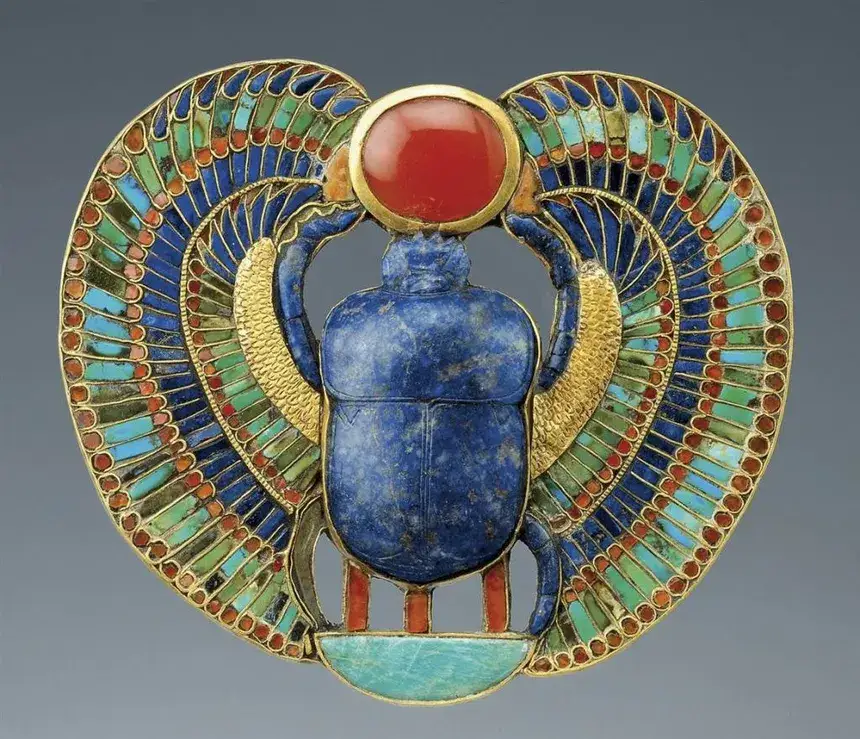
Flanking the scarab are two uraei — sacred cobras that symbolized divine authority and protection. Each wears the crown of Upper and Lower Egypt, uniting the Two Lands under the rule of the living Horus, the Pharaoh himself.
Beneath the scarab flows a motif of lotus blossoms and solar discs, evoking the cyclical rebirth of the sun from the waters of Nun — the primordial chaos. The lotus, which blooms with the morning light, was a central symbol of resurrection, mirroring Tutankhamun’s own hoped-for renewal in the afterlife.
Every color, symbol, and line thus participates in a visual hymn to the sun’s eternal journey and the Pharaoh’s divine destiny.
Tutankhamun and the Power of Sacred Jewelry
For the Egyptians, jewelry was far more than decoration. It was magical armor — a conduit of divine power designed to protect and transform the wearer.
The Jewelled Scarab Pectoral was among the most important amulets in Tutankhamun’s tomb, placed directly over the chest of his mummy. It served to protect the heart, which was believed to be the seat of intelligence and morality. In the Book of the Dead, the heart was weighed against the feather of Ma’at to determine the worthiness of the soul.
By placing the scarab over this vital organ, priests ensured that the Pharaoh’s heart would remain pure and his resurrection assured. The amulet was not simply symbolic — it was believed to contain the living power of the gods.
Craftsmanship of the 18th Dynasty: The Height of Egyptian Goldsmithing
The artisans of the 18th Dynasty — particularly during the reigns of Amenhotep III, Akhenaten, and Tutankhamun — achieved an unprecedented mastery over metal and gemstone. The creators of the Jewelled Scarab Pectoral were elite goldsmiths, possibly working in the royal workshops of Thebes or Memphis.
Their process required immense skill:
-
Designing the composition using papyrus sketches that aligned with religious texts.
-
Shaping gold sheets into the desired frame and adding thin partitions (cloisons).
-
Cutting gemstones and glass into precise shapes to fit within each cell.
-
Polishing and engraving the final surface to perfection.
The result is an object that balances artistic harmony with spiritual depth, demonstrating that Egyptian craftsmanship was not only technically sophisticated but also profoundly intellectual.
Theological Meaning: Life, Death, and Rebirth
The Jewelled Scarab Pectoral encapsulates the Egyptian belief in cosmic continuity — that the Pharaoh, like the sun, would die and rise again each day.
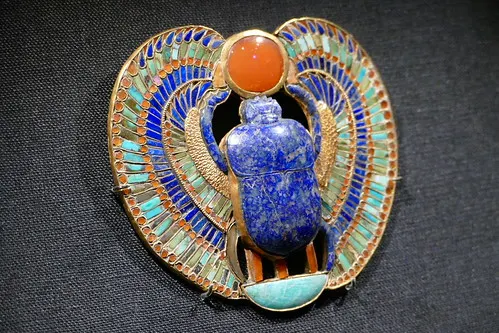
The scarab represents the moment of transformation, the daily rebirth of light from darkness. The solar disc signifies the eternal power of Ra, while the cobras and lotus symbolize protection and regeneration.
Together, these motifs affirm the pharaoh’s union with the sun god. A divine partnership ensuring not only his personal resurrection but also the ongoing stability of the universe.
This philosophy lay at the heart of Egyptian religion: to preserve order (Ma’at) through eternal cycles of creation and renewal.
Discovery and Legacy: A Treasure for the Ages
When Howard Carter and his patron Lord Carnarvon discovered Tutankhamun’s tomb in 1922. They unveiled one of the most complete royal burials ever found. Among the dazzling collection of over 5,000 objects. The Jewelled Scarab Pectoral stood out as a masterwork of symbolism and design.
Today, it resides in the Egyptian Museum in Cairo (Grand Egyptian Museum). Continuing to fascinate historians, archaeologists, and art lovers alike. It represents not only the splendor of Egypt’s New Kingdom. But also the philosophical sophistication of a culture that saw no boundary between art, religion, and science.
The Enduring Message of the Scarab
The Jewelled Scarab Pectoral of Tutankhamun remains one of the most eloquent expressions of humanity’s desire for immortality and renewal. Through gold and gemstone, it conveys a message that transcends time — that life, like the sun, is eternal and ever-renewing.
For modern audiences, this ancient masterpiece continues to shine as both an artistic triumph and a profound meditation on existence. In its luminous surface and sacred design, we glimpse the eternal spirit of Egypt. A civilization that turned death into rebirth, and matter into divinity.
ALSO READ: