The Jemdet Nasr Tablet: Early Mesopotamian Accounting and Hierarchical Society
When we think of spreadsheets, balance sheets, and accounting ledgers, the image that comes to mind is modern—numbers on a screen or a book of figures. Yet the roots of this practice reach back more than 5,000 years to the ancient civilizations of Mesopotamia, where people recorded the storage and distribution of goods, land, and labor on clay tablets.
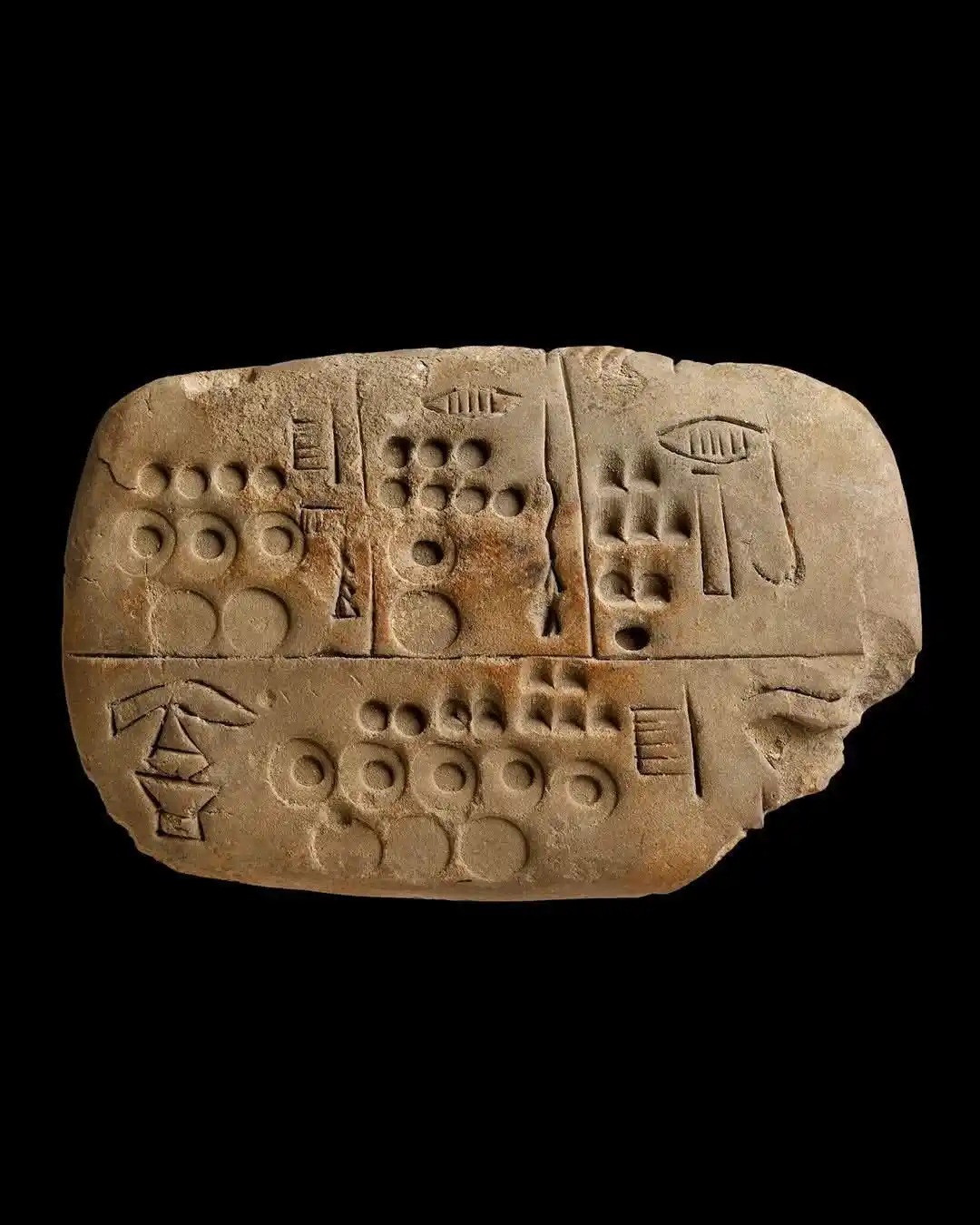
One of the most fascinating examples is a tablet from Jemdet Nasr, an ancient site in southern Mesopotamia (modern Iraq). Dating between 3200 BCE and 2900 BCE, this artifact reveals not only the earliest stages of the cuneiform script but also the ways in which society organized its economy and reinforced hierarchy. Known as the “field of the EN” tablet, it lists field areas, calculations, and the unequal division of resources—an unmistakable reflection of early power structures.
Discovery of Jemdet Nasr
The site of Jemdet Nasr lies near Babylon and has yielded some of the most important finds of the late Uruk and Jemdet Nasr periods. Excavations in the 1920s uncovered numerous clay tablets, each inscribed with early pictographic or proto-cuneiform signs.
These tablets represent the administrative heartbeat of Mesopotamian city life. They were not literary texts or myths, but practical tools used to track harvests, land allocations, and the movement of goods. The Jemdet Nasr tablet with the “field of the EN” is one of the best-preserved examples, now housed in the Ashmolean Museum (AN1926.583).
Description of the Tablet
The tablet is small, rectangular, and made of clay, inscribed with wedge-shaped impressions. Though simple in form, it is extraordinary in content.
Key Features:
-
Circles and half-circles represent numerals, part of the early counting system.
-
Proto-cuneiform script lists commodities and land measurements.
-
It records the areas of five fields with precise calculations.
-
The scribe added these figures together and divided the total.
The level of organization demonstrates the sophistication of early Mesopotamian bureaucratic systems—this was not just a note or sketch, but a carefully structured administrative record.
The Field of the EN: Calculations and Distribution
The tablet is known as the “field of the EN” because of how the final calculations were allocated.
-
Five Fields – The scribe listed and calculated the areas of five separate fields.
-
Grand Total – The areas were combined into a single total.
-
Division of Shares – The total was divided into thirds:
-
Two-thirds went to the EN (Sumerian for “lord”).
-
The remaining one-third was distributed unevenly among others, including the wife of the EN.
-
This process highlights the hierarchical distribution of resources. The EN, as the ruling figure, received the majority, while others received smaller, unequal portions. The system encoded social inequality into economic practice, ensuring the EN’s dominance.
The Role of the EN in Sumerian Society
The EN was a central figure in early Mesopotamian society, often translated as “lord” or “high priest.”
-
Political Power – The EN controlled land and its produce, securing wealth and authority.
-
Religious Authority – As a figure tied to temples, the EN acted as an intermediary between humans and gods.
-
Household Hierarchy – Even within the EN’s household, inequality persisted, with the EN’s wife receiving a smaller allocation.
The tablet reflects how economics and social order were inseparable in early Mesopotamia. Control over land meant control over power, and the EN stood at the center of both.
Early Accounting Systems in Mesopotamia
The Jemdet Nasr tablet is an early example of accounting and record-keeping—an innovation that shaped the future of human civilization.
Key Elements of Mesopotamian Accounting:
-
Numerical Notation – Using symbols like circles and half-circles to represent numbers.
-
Commodity Tracking – Recording grain, livestock, land, and labor.
-
Centralized Administration – Temples and rulers managed distribution, taxation, and storage.
-
Proto-Cuneiform Script – The earliest form of writing, developed for economic purposes before literature.
This shows that writing began not with stories, but with numbers and lists, serving practical rather than artistic needs.
Social Hierarchy in the Tablet
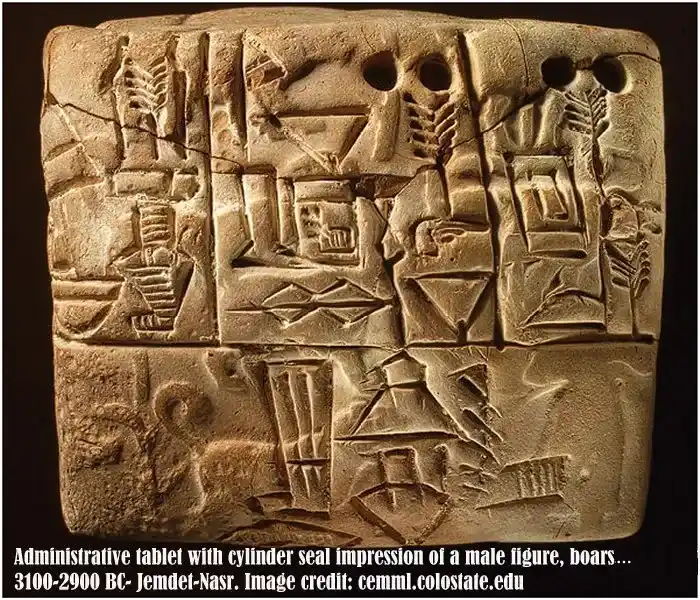
The allocation of land on the tablet tells a story of hierarchy and inequality.
-
EN as Lord – Received the majority, reflecting dominance.
-
Household Members – Received smaller portions, reinforcing status differences even within elite families.
-
Other Individuals – The distribution to unnamed others shows broader economic stratification.
This simple clay tablet encodes the political and social structure of its time, making it a valuable document of class relations in early Mesopotamia.
Comparison with Other Mesopotamian Tablets
The Jemdet Nasr tablet is not unique but part of a larger system of administrative texts.
-
Uruk Tablets – Similar records of grain and labor from the late 4th millennium BCE.
-
Shuruppak Tablets – Early administrative and lexical texts, highlighting the spread of record-keeping.
-
Later Cuneiform Tablets – Expanded into law codes, contracts, and literature, but always rooted in accounting traditions.
This continuity illustrates how economic needs drove the invention of writing, which only later evolved into a medium for myths and literature.
The Jemdet Nasr Tablet Today
The Ashmolean Museum in Oxford houses the Jemdet Nasr tablet (AN1926.583), making it accessible for both public viewing and scholarly study.
For visitors, it represents:
-
A 5,000-year-old spreadsheet, connecting modern administration to ancient roots.
-
A window into early social inequality, showing how resources were divided.
-
A testament to human innovation, as the beginnings of mathematics and writing emerged from necessity.
Why the Jemdet Nasr Tablet Matters
The significance of the Jemdet Nasr tablet can be summarized in three key points:
-
Origins of Writing – It represents one of the earliest uses of proto-cuneiform, showing writing’s roots in accounting and administration.
-
Social Hierarchy – The division of land reflects a structured and unequal society, with power concentrated in the hands of the EN.
-
Continuity of Human Practices – Like modern spreadsheets, it shows the enduring human need to record, calculate, and manage resources.
Conclusion
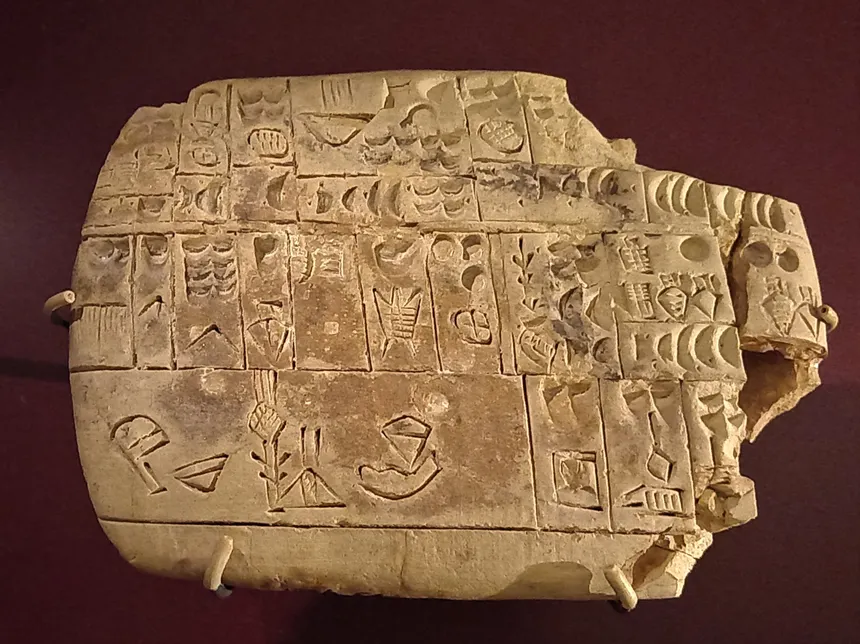
The Jemdet Nasr tablet from southern Mesopotamia is a small object with immense historical weight. Created between 3200–2900 BCE, it reveals how early societies calculated land, distributed wealth, and reinforced hierarchy through administrative records.
By documenting the field of the EN, the scribe preserved not only mathematical calculations but also the social structure of the time—where lords dominated, wives received unequal shares, and others got smaller portions. In doing so, the tablet bridges the gap between ancient accounting and modern administration, reminding us that the roots of bureaucracy stretch deep into human history.
Today, housed in the Ashmolean Museum, this tablet continues to captivate scholars and the public alike, offering a glimpse into the origins of writing, mathematics, and social order.
ALSO READ: The Roman Fluted Washing-Bowl from the Caubiac Treasure: A Masterpiece of Silverwork