Human Sacrificial Burial Found Beneath the Feathered Serpent Pyramid in Teotihuacan, Mexico
Unearthing the Secrets of a Lost Civilization
In the ancient city of Teotihuacan, located about 50 kilometers northeast of modern-day Mexico City, archaeologists have uncovered a human sacrificial burial beneath the Feathered Serpent Pyramid, also known as the Temple of Quetzalcoatl. This discovery provides new insights into the religious, political, and military rituals that shaped one of Mesoamerica’s most powerful civilizations.
Teotihuacan, often called the “City of the Gods,” was at its peak between the 1st and 7th centuries CE, long before the rise of the Aztecs. It was a city of monumental architecture, advanced urban planning, and mysterious origins. Yet, beneath its splendor lay a world of ritual sacrifice, cosmic symbolism, and divine kingship — themes vividly represented in this extraordinary find.
The Feathered Serpent Pyramid: A Sacred Monument of Power
The Feathered Serpent Pyramid, located at the southern end of Teotihuacan’s Avenue of the Dead, is one of the city’s most iconic structures. Built around 200 CE, it is the third-largest pyramid in the city, following the Pyramids of the Sun and Moon.
This monument was dedicated to the Feathered Serpent deity, Quetzalcoatl — a god associated with creation, wind, fertility, and renewal. Its façade is adorned with serpent heads, shells, and symbolic ornaments, reflecting both religious iconography and political authority.
Archaeological evidence suggests that the pyramid was not only a religious center but also a ritual stage for ceremonies involving human sacrifice — acts believed to sustain the gods and secure cosmic balance.
The Discovery: A Burial Beneath the Pyramid
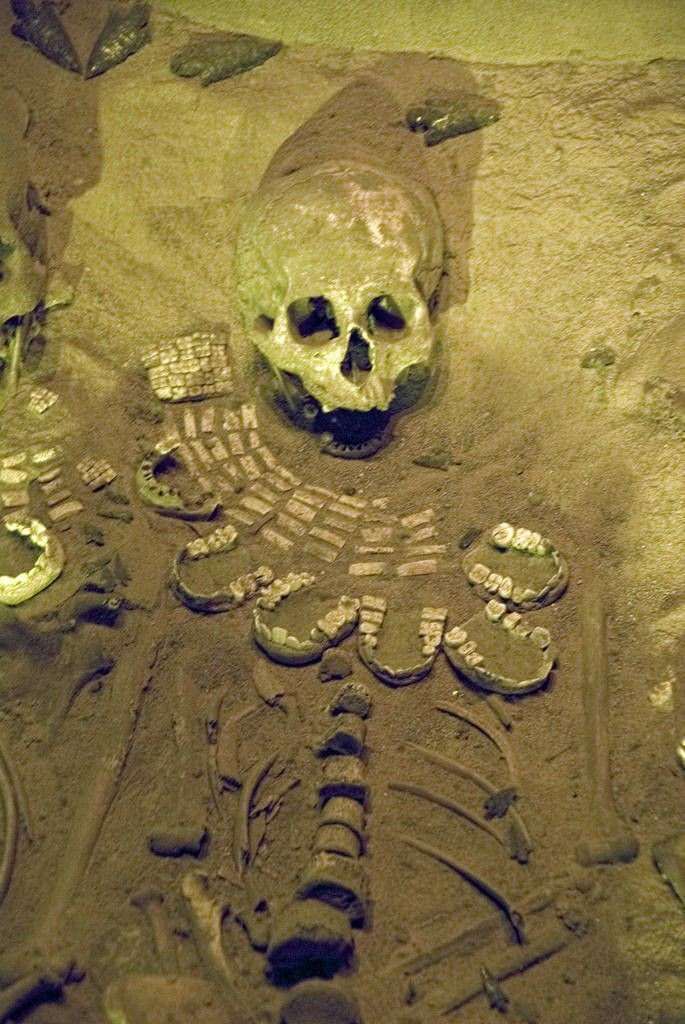
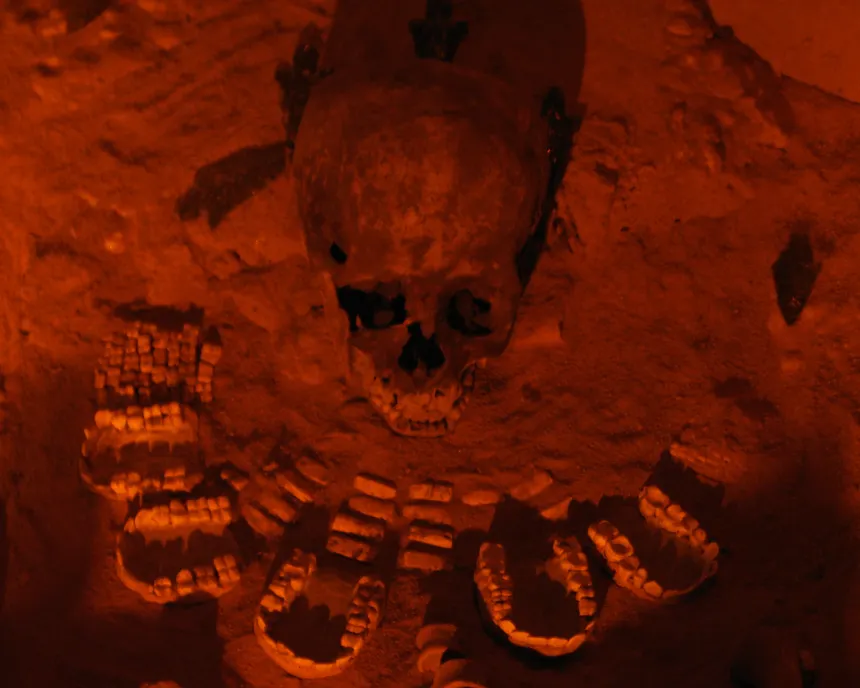
During extensive excavations by archaeologists from Mexico’s National Institute of Anthropology and History (INAH), a human sacrificial burial was discovered beneath the pyramid’s base. The remains were found alongside offerings of jade, obsidian blades, shells, and animal bones, all arranged in a deliberate ceremonial pattern.
The burial site included multiple skeletons, most believed to be young men, possibly warriors or captives. Their hands were often tied behind their backs, and they were buried in formal rows or circular groups, indicating ritual execution rather than random deaths.
Radiocarbon dating and stratigraphic analysis confirm that the burial corresponds to the construction phase of the pyramid, suggesting that the sacrifices were part of a dedicatory ritual marking the temple’s completion.
Symbolism of Human Sacrifice in Teotihuacan
1. A Ritual of Cosmic Renewal
In Mesoamerican belief, human sacrifice was not viewed as cruelty but as a sacred exchange between humans and gods. The victims’ blood was considered the essence of life, essential for maintaining cosmic order.
At Teotihuacan, these sacrifices may have symbolized the renewal of time, fertility of the earth, and legitimization of political power. By offering human lives, rulers affirmed their divine connection to the cosmos and their role as intermediaries between gods and men.
2. The Feathered Serpent and Duality
The Feathered Serpent deity embodies the union of opposites — earth and sky, mortality and divinity. The sacrificial burials beneath its pyramid may have represented this duality, symbolizing the cycle of death and rebirth, a central theme in Mesoamerican cosmology.
3. Warriors and Political Power
Some scholars argue that the victims were military elites or foreign captives, sacrificed to demonstrate the city’s dominance. The presence of military insignia and weaponry within some burials supports this interpretation, suggesting that Teotihuacan’s rulers used sacrifice to consolidate political control.
Artifacts Found with the Burials
Alongside the human remains, archaeologists unearthed an array of ritual objects and symbolic offerings, including:
-
Obsidian blades and spear points, possibly used in the sacrifices.
-
Greenstone and jade figurines, symbolizing fertility and divine favor.
-
Shells and marine materials, indicating long-distance trade with coastal regions.
-
Animal remains, including jaguars, eagles, and serpents — all symbolic of power and the gods.
-
Necklaces, bracelets, and earspools, suggesting the victims may have been honored participants in a divine rite.
These offerings reinforce the notion that the ritual was meticulously planned, aligning spiritual beliefs with cosmic cycles and architectural design.
Teotihuacan’s Religious and Political Order
1. A Theocratic Society
Teotihuacan was governed by a religious-political elite who controlled both spiritual and military affairs. The construction of monumental temples like the Feathered Serpent Pyramid required immense labor and resources, reflecting a centralized authority.
2. State-Controlled Sacrifice
Unlike later Aztec rituals, which were more public and large-scale, Teotihuacan’s priests conducted state ceremonies in hidden chambers or foundations to ensure the city’s spiritual stability and legitimize the elite.
3. The Pyramid’s Cosmological Role
The alignment of the pyramid corresponds with celestial events, particularly the movement of Venus, the planet associated with Quetzalcoatl. This finding reinforces the idea that priests timed sacrifices to astronomical cycles, linking human life to the rhythms of the heavens.
Archaeological Methods and Discoveries
Modern technology has played a crucial role in revealing Teotihuacan’s secrets. Using ground-penetrating radar, 3D scanning, and robotic exploration, researchers have mapped the pyramid’s subterranean tunnels and chambers, identifying new ritual deposits and burial sites.
Excavations led by Dr. Sergio Gómez discovered over 100,000 ritual artifacts within these tunnels, including liquid mercury pools, believed to symbolize rivers of the underworld. The combination of mercury and sacrificial burials suggests that people viewed the site as a gateway to the divine realm.
The Broader Meaning: Life, Death, and the Cosmos
The discovery of human sacrificial burials beneath the Feathered Serpent Pyramid highlights the profound interconnection between life, death, and cosmic order in ancient Mesoamerica.
For the people of Teotihuacan, death was not an end but a transformation — a journey toward becoming one with the gods. The sacrificed individuals were not merely victims but chosen intermediaries, whose deaths ensured the continued balance of the universe.
This worldview mirrors similar practices in other ancient cultures, such as Egyptian royal burials and Maya bloodletting rituals, emphasizing a shared human attempt to bridge the mortal and the divine.
Teotihuacan Today: A Living Legacy
Today, Teotihuacan stands as a UNESCO World Heritage Site, attracting millions of visitors each year. The Feathered Serpent Pyramid remains one of its most awe-inspiring monuments, offering a tangible connection to the city’s mysterious past.
Ongoing excavations continue to reveal new chambers, offerings, and skeletal remains. Each discovery adding to our understanding of how spirituality, astronomy, and political power converged in this ancient metropolis.
Visitors walking along the Avenue of the Dead, surrounded by the monumental pyramids of the Sun, Moon, and Feathered Serpent. Experience a powerful sense of the sacred geometry and cosmic order that once defined Teotihuacan.
Conclusion: The Eternal Echo of the Feathered Serpent
The human sacrificial burial beneath the Feathered Serpent Pyramid is more than an archaeological find. It is a window into the heart of Teotihuacan’s civilization. Where art, religion, and mortality were woven into a single cosmic vision.
Through this discovery, we glimpse a world where sacrifice ensured survival, death nurtured life, and architecture mirrored the heavens. The Pyramid of the Feathered Serpent thus remains not only a masterpiece of ancient engineering. But also a sacred testament to humanity’s eternal search for meaning in the universe.
ALSO READ: The Giant Hand in Chile: A Mysterious Monument of the Desert