The Tricycle of Shin: A Child’s Bicycle from Hiroshima’s Atomic Tragedy
An Artifact That Speaks Beyond Words
On August 6, 1945, the world entered a new era of destruction when the first atomic bomb was dropped on the Japanese city of Hiroshima. In a matter of seconds, tens of thousands of lives were extinguished, and the city was reduced to ruins. Among the countless victims was a three-year-old boy named Shin, who lived just 1,500 meters from the bomb’s hypocenter.
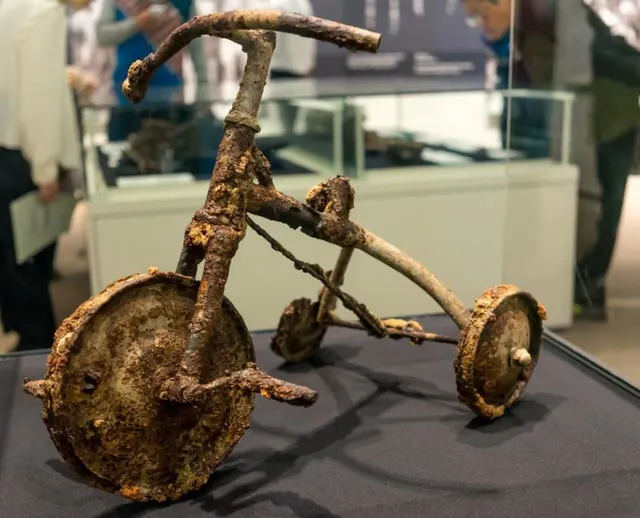
Shin’s small tricycle—charred and twisted by the blast—was later recovered and preserved. Today, this poignant artifact stands as one of the most powerful symbols of the human cost of nuclear war. Unlike statistics or abstract discussions, Shin’s tricycle tells the story of a child’s life cut short, offering a deeply personal reminder of the devastating consequences of the bombing.
Shin’s Story: A Life Interrupted
A Boy of Just Three Years
Shin was an ordinary child in extraordinary times. Like many children, he delighted in riding his small bicycle, unaware of the geopolitical tensions that would soon shape his fate.
The Day of the Bombing
-
On the morning of August 6, 1945, Shin was at home when the bomb detonated.
-
The explosion and heat wave devastated everything within kilometers.
-
Shin was fatally injured and died near his home, only 1,500 meters from ground zero.
Burial with His Bicycle
Shin’s father, devastated by the loss, chose not to separate his son from his beloved tricycle. He buried Shin together with the tricycle in a nearby grave. Decades later, when Shin’s remains were moved to a cemetery, the tricycle was unearthed, preserved, and eventually placed in the Hiroshima Peace Memorial Museum.
The Tricycle as a Symbol
Innocence Destroyed
A tricycle is universally associated with childhood—play, joy, and innocence. To see one burned, twisted, and blackened by atomic fire confronts us with the stark reality that war spares no one, not even children.
Personal Connection
Unlike large memorials or historical documents, Shin’s tricycle provides an intimate and immediate link between visitors and the tragedy of Hiroshima. It embodies not numbers but a single child’s life—a symbol of countless others.
Peace and Memory
Today, the tricycle serves as a peace artifact, urging reflection on the devastating consequences of war and the responsibility of future generations to prevent such tragedies from recurring.
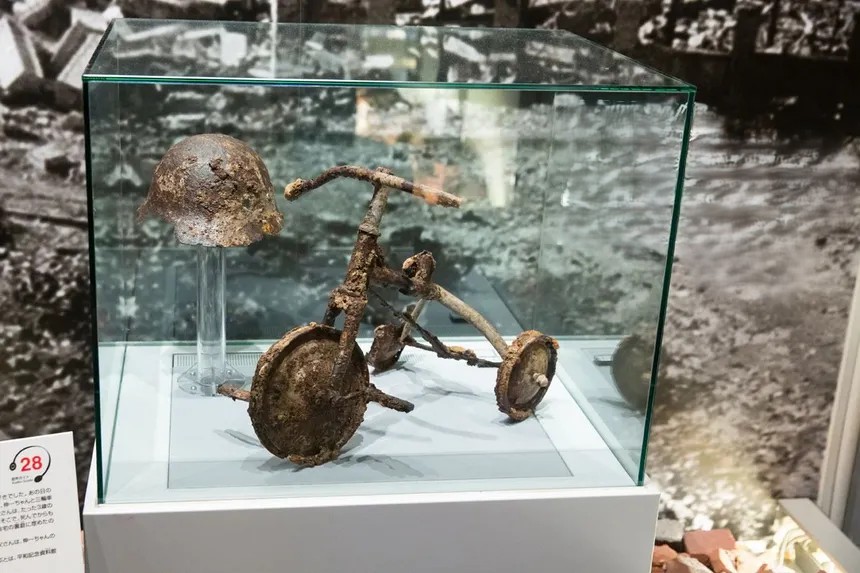
Hiroshima and the Atomic Bomb
To understand the significance of Shin’s tricycle, it is essential to recall the broader context of the Hiroshima bombing.
The Attack
-
Date: August 6, 1945
-
Bomb: “Little Boy,” the first atomic weapon ever used in warfare
-
Immediate Casualties: Around 70,000–80,000 people killed instantly
-
Total Death Toll (1945): Estimated at over 140,000, due to radiation sickness, burns, and injuries
Human Impact
The bombing not only destroyed infrastructure but also left survivors (hibakusha) suffering from long-term health effects and psychological trauma. Children, like Shin, were among the most vulnerable victims.
Preservation of the Tricycle
Unearthed After Decades
In the 1980s, Shin’s father decided to transfer his son’s remains to a formal cemetery. During the process, the tricycle was recovered and entrusted to the Hiroshima Peace Memorial Museum.
Museum Display
At the museum, Shin’s tricycle is displayed as a personal and emotional artifact, unlike more abstract relics such as steel beams or glass shards. Visitors often cite it as one of the most heartbreaking objects they encounter.
A Global Message
The tricycle has since become a symbol of peace and anti-nuclear advocacy, featured in exhibitions and educational materials worldwide. It embodies the museum’s mission: to ensure that the world never forgets Hiroshima’s lesson.
The Emotional Power of Everyday Objects
Why does Shin’s tricycle move people so profoundly?
-
Universality of Childhood: No matter culture or time, a child’s tricycle is familiar. Its destruction highlights the vulnerability of the innocent.
-
Contrast Between Life and Death: The joyful association of a toy contrasts brutally with the tragedy of atomic devastation.
-
Personalization of History: Statistics can numb us, but a single story humanizes the past. Shin’s tricycle ensures we remember not only the event but the individuals.
Lessons from the Tricycle of Shin
The Human Cost of War
The artifact reminds us that wars are not fought by abstract states but experienced by ordinary families and children.
The Dangers of Nuclear Weapons
The tricycle underscores the indiscriminate nature of atomic bombs: everyone within range, regardless of age or role, is a victim.
The Importance of Memory
Preserving such artifacts ensures that future generations learn from the past, fostering a culture of peace and remembrance.
Hiroshima Peace Memorial Museum
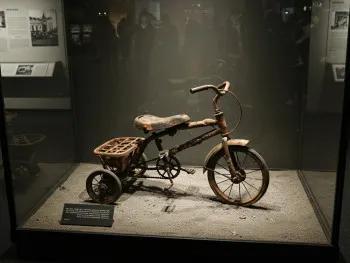
Located near the iconic Atomic Bomb Dome, the Hiroshima Peace Memorial Museum houses Shin’s tricycle as part of its collection.
-
Purpose: To educate visitors about the events of August 6, 1945, and advocate for nuclear disarmament.
-
Visitor Experience: Artifacts like clothing, lunch boxes, and Shin’s tricycle immerse visitors in the personal dimensions of the tragedy.
-
Global Impact: Millions of visitors from around the world encounter Shin’s story, making the tricycle a global symbol of remembrance.
Conclusion: A Small Bicycle, A Global Lesson
Shin’s tricycle is small in size but monumental in meaning. Preserved from the ashes of Hiroshima, it represents the life of a three-year-old boy lost to the world’s first nuclear attack.
As a historical artifact, it bridges time, allowing us to glimpse the human tragedy behind the headlines of war. As a symbol, it reminds us of the innocence destroyed by violence and calls on us to pursue peace with determination.
In a century where nuclear weapons still exist, Shin’s tricycle speaks louder than ever. It tells us that beyond politics and strategy, war always leaves its deepest scars on the most vulnerable. And it urges us: never again.
ALSO READ: Carbonised Bread from Pompeii: A 2,000-Year-Old Loaf Preserved in Ash