Hans Koch’s 16th-Century Gilt-Brass Clock-Watch: Timekeeping as Art and Science
A Renaissance Marvel in Miniature
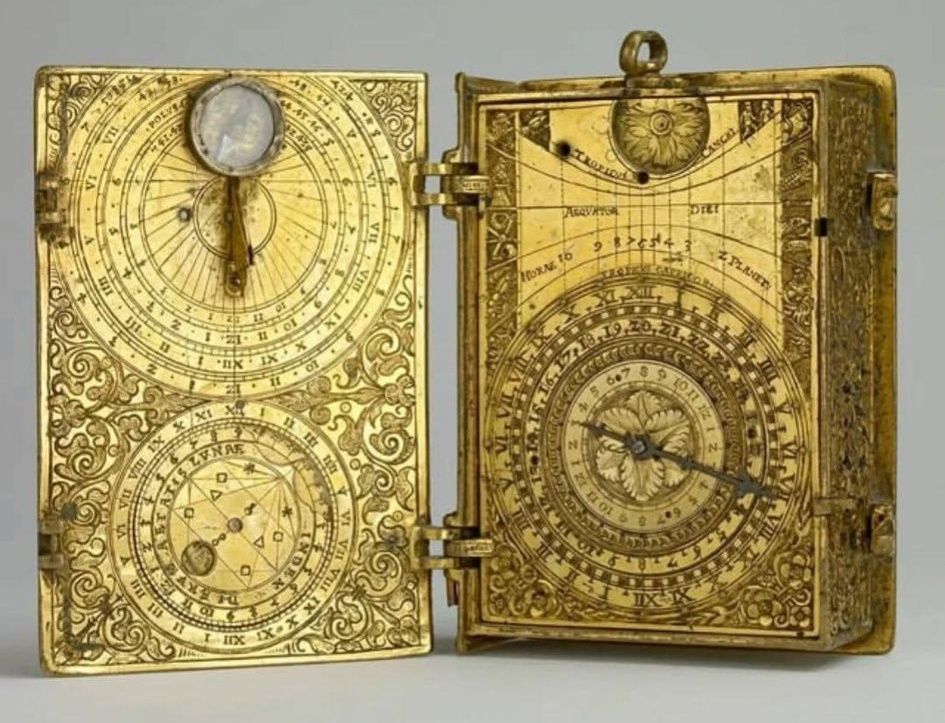
During the Renaissance, Europe’s fascination with science, craftsmanship, and art merged in extraordinary objects that transcended utility. Among these treasures stands the gilt-brass cased clock-watch created by Hans Koch around 1580, a masterpiece that fuses mechanical ingenuity with symbolic design. Shaped like a small book, this watch is more than a device for telling time—it is a statement of knowledge, prestige, and the era’s growing mastery of the cosmos.
Hans Koch: Master Craftsman of Augsburg
Hans Koch, an acclaimed German clockmaker active in Augsburg during the late 16th century, belonged to a community of artisans whose work helped transform horology. Augsburg was a hub of mechanical innovation and luxury craftsmanship, supplying Europe’s nobility with intricate scientific instruments.
Koch’s work reflects both technical precision and aesthetic refinement, qualities that made his creations prized possessions for elite collectors.
Description of the Clock-Watch
The watch is encased in gilt brass, giving it both durability and a radiant, golden appearance. Uniquely, Koch designed it in the form of a miniature book, reflecting Renaissance values that equated time, learning, and sacred knowledge.
Key Features:
-
Clock mechanism with alarm – Enabled precise timekeeping and personal reminders.
-
Sundials – Included as alternative time-indicators, emphasizing scientific versatility.
-
Lunar volvelle – A rotating disc to track lunar phases and cycles.
-
Book-shaped case – A symbolic nod to knowledge and humanist ideals.
Each feature combines utility with intellectual symbolism, positioning the watch as both a functional object and a conversation piece.
The Book as Symbol and Form
Why a book? In the Renaissance, the book symbolized wisdom, divine knowledge, and the pursuit of learning. By shaping a timepiece as a book, Koch imbued it with cultural and spiritual resonance.
-
Learning and Time: The book-watch linked literacy and scholarship to the orderly passage of time.
-
Religious Symbolism: Books often carried connotations of the Bible, aligning time with divine creation.
-
Kunstkammer Appeal: As a miniature “book,” it was ideal for display in a cabinet of curiosities—the private collections of the wealthy.
Sundials: Ancient Knowledge Within a Modern Device
The inclusion of sundials alongside mechanical elements underscores how Renaissance makers blended traditional and modern technologies.
-
Functionality: Sundials provided a backup when the clock mechanism failed or needed adjustment.
-
Symbolism: Sundials were reminders of humanity’s ancient methods of measuring time, connecting the present to classical antiquity.
-
Education: Owners could demonstrate their erudition by showing how sundials worked in different light conditions.
The Lunar Volvelle: Mapping the Skies
Perhaps the most striking scientific element of Koch’s clock-watch is the lunar volvelle.
What is a Volvelle?
A volvelle is a rotating disc, often used in medieval and Renaissance manuscripts to calculate celestial movements. In this watch, it tracked the moon’s phases, essential for calendars, religious festivals, and agricultural cycles.
Symbolism of the Moon
The moon held immense significance in Renaissance thought:
-
Religious: Linked to cycles of fasting and feasting.
-
Astrological: Believed to influence human behavior and health.
-
Natural: Guided agriculture, travel, and navigation.
By including a lunar volvelle, Koch gave his creation a cosmic dimension, connecting earthly time with celestial order.
Alarm Mechanism: Time as Personal Discipline
The inclusion of an alarm is remarkable for the late 16th century. Unlike public clocks that regulated cities, personal alarms reflected the growing importance of individual time discipline.
-
Practical Use: Allowed aristocrats, scholars, or officials to structure their day.
-
Cultural Shift: Signaled the Renaissance transition toward valuing punctuality and productivity.
-
Luxury Feature: Having a portable alarm clock reinforced the owner’s elite status.
Gilt Brass: Material and Aesthetic
The use of gilt brass (brass coated with a thin layer of gold) combined practicality with opulence.
-
Durability: Brass provided a solid base for delicate mechanisms.
-
Prestige: Gilding transformed a functional object into a luxury artifact.
-
Symbolism: The golden sheen reflected Renaissance ideals of harmony, brilliance, and divine order.
This duality of strength and beauty was central to the period’s artistic philosophy.
The Watch in Renaissance Society
Owning such a watch was not merely about telling time. It was about display, knowledge, and prestige.
-
Elite Ownership: Only the wealthy could afford such pieces, often nobility or wealthy merchants.
-
Conversation Piece: Watches served as tools to display erudition during intellectual gatherings.
-
Kunstkammer Objects: Collectors prized them as marvels of human ingenuity, worthy of display alongside scientific instruments, gems, and exotic curiosities.
Scientific Innovation and Humanist Ideals
Koch’s clock-watch embodies the Renaissance ethos where art, science, and philosophy converged.
-
Artistry: The gilded case and book form linked it to aesthetic traditions.
-
Science: Sundials and volvelle represented practical and theoretical astronomy.
-
Humanism: The object’s design tied human knowledge to the larger cosmos, reflecting the belief in man’s ability to understand creation.
Comparison with Other Renaissance Timepieces
In the late 16th century, portable watches were still rare and experimental. Koch’s watch is significant because it integrates:
-
Multiple functions (clock, alarm, sundial, lunar calendar).
-
Unique design (book form rather than a simple round case).
-
Symbolic weight, making it more than a practical device.
Compared to plainer watches of the era, this piece stands as a high point of horological artistry.
The Clock-Watch Today
Now preserved in museum collections, Koch’s gilt-brass watch continues to fascinate scholars and visitors alike. It is not only a window into Renaissance science but also a material link to an era when timekeeping, faith, and art were inseparable.
Exhibitions often highlight it as an example of how portable technology reshaped personal life in early modern Europe.
Why Hans Koch’s Watch Matters
This extraordinary artifact matters because it embodies:
-
Technological Innovation – Early mechanical watches with alarms were groundbreaking.
-
Symbolic Power – The book form and lunar volvelle reflect Renaissance cosmology.
-
Cultural Prestige – As an elite object, it tells us about the values of status, knowledge, and time discipline in the 16th century.
Conclusion: Time Bound in a Golden Book
Hans Koch’s gilt-brass cased clock-watch (c.1580) is more than a timepiece—it is a Renaissance worldview made tangible. Shaped like a book, it unites the mechanical with the celestial, the practical with the symbolic. Its sundials, alarm, and lunar volvelle reveal a society captivated by both precision and mystery, where measuring time also meant grappling with the rhythms of nature and the divine.
As it sits today in museum collections, Koch’s masterpiece reminds us that every tick of time carries with it centuries of craftsmanship, knowledge, and wonder.
ALSO READ: Old Babylonian Hematite Weights from Warka: Standardization in the Ancient World