Ripples of Time – Fossilized Waves from Earth’s First Seas
When the Earth Was Young
Long before forests shaded the continents or animals swam the seas, Earth’s surface was a vastly different world. The atmosphere lacked oxygen, the continents were still forming, and life existed only as simple microbes clinging to the edges of shallow lagoons.
From that alien landscape comes one of the planet’s oldest and most poetic relics — the fossilized ripple marks of the Tumbiana Formation in Western Australia. Formed 2.7 billion years ago, these delicate patterns in stone are the ancient imprints of waves that once rolled across the surface of Earth’s first oceans.
They are not just geological curiosities — they are time capsules, preserving the whispers of wind and water from an age when the world was still finding its rhythm.
The Tumbiana Formation: Cradle of Ancient Life
Located in the Pilbara Craton of Western Australia, the Tumbiana Formation is one of the world’s most important geological sites for studying early Earth environments.
Dating back to the Archean Eon (around 2.72 billion years ago), the region consists of alternating layers of sandstone, siltstone, and carbonate rock, representing ancient shallow marine and coastal lagoon environments.
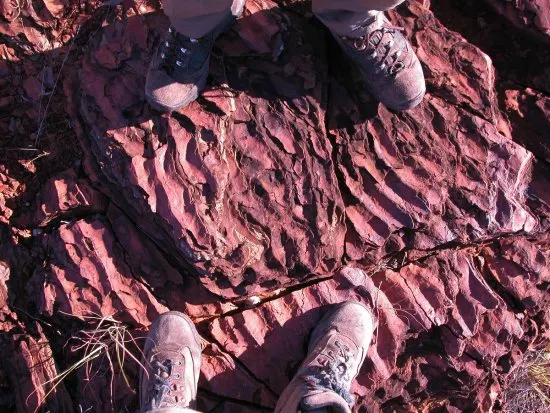
Within these layers, geologists have found beautifully preserved ripple marks — rhythmic, wave-like textures that once formed on the sandy bottoms of long-vanished tidal flats.
Unlike most modern ripples that vanish with the next tide, these were buried by subsequent sediment layers and slowly lithified — turned to stone over billions of years. Today, they stand as a tangible connection to a time when Earth’s atmosphere, oceans, and biosphere were just beginning to take shape.
How Fossil Ripples Are Formed
Ripple marks form wherever moving water or wind interacts with loose sediment such as sand or silt. As gentle currents flow across a surface, they create alternating crests and troughs — tiny dunes that reflect the movement of waves or tides.
There are two main types of ripples:
-
Symmetrical ripples – formed by back-and-forth motion of waves (common in shallow water).
-
Asymmetrical ripples – formed by unidirectional flow, such as a river or wind current.
The Tumbiana ripples are typically symmetrical, indicating that they formed in quiet, shallow waters, likely along the margins of lagoonal or coastal environments.
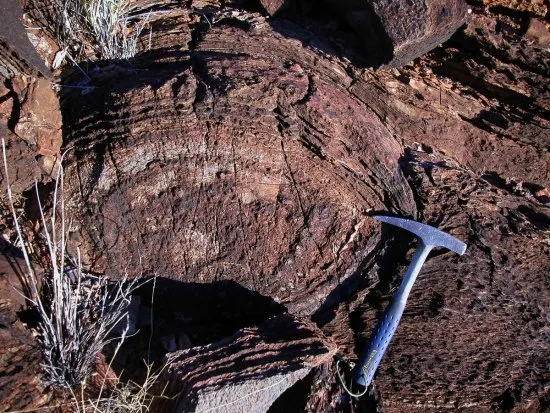
What makes them extraordinary is their age and preservation. Over time, these ripples were buried by additional sediment layers, compacted, and cemented into fine-grained sandstone and siltstone, preserving the minute details of their waveforms.
Each ridge and groove records a fleeting moment of motion — a snapshot of Earth’s earliest dynamic surface.
Ancient Microbial Life: Traces of the Earliest Ecosystems
The Tumbiana Formation is not just significant for its ripples — it is also one of the earliest known environments to preserve signs of microbial life.
Geobiologists studying thin sections of the rock have discovered stromatolitic structures, microbially induced sedimentary textures (MISTs), and subtle organic carbon signatures within and between ripple layers.
These findings suggest that microbial mats — colonies of cyanobacteria and other microorganisms — once thrived on these tidal flats.
These ancient microbes likely played a crucial role in shaping the ripples themselves. By secreting sticky biofilms, they helped bind sediments together, stabilizing ripple forms and allowing them to be preserved after burial.
More importantly, such microbes were among the first oxygen-producing organisms on Earth, gradually transforming the atmosphere during what scientists call the Great Oxidation Event.
Thus, each fossilized ripple may hold traces of the earliest photosynthetic life — the biological spark that eventually made complex life possible.
Reading the Ripples: Clues to Early Earth’s Climate
By analyzing the geometry, spacing, and orientation of ripple marks, geologists can infer ancient environmental conditions — including water depth, current velocity, and even wind direction.
In the case of the Tumbiana Formation, the fine scale and symmetrical shape of the ripples indicate calm, shallow waters, likely less than a few meters deep. The sediments suggest tidal lagoons or coastal mudflats, periodically flooded and exposed to air — ideal habitats for microbial life.
These environmental reconstructions help scientists understand not just local conditions but also the global climate of early Earth.
During the Archean, the planet’s sun was 20–30% dimmer, yet geological evidence suggests liquid water was abundant — a paradox known as the Faint Young Sun Problem.
Ripple fossils like those at Tumbiana provide tangible proof that stable, shallow seas existed despite the weaker sunlight, implying a greenhouse atmosphere rich in gases like methane and carbon dioxide that kept the planet warm enough for life.
A Geological Masterpiece: Stone as Memory
Standing before the ripple-marked stones of the Tumbiana Formation is like gazing at an ancient seafloor frozen in time. The ripples are typically just a few centimeters high, but their patterns are mesmerizing — graceful, rhythmic, and symmetrical, undisturbed for billions of years.
The rocks shimmer in shades of rust-red, ochre, and pale gray, their surfaces etched with the same patterns that once danced under Archean sunlight. Each undulating ridge is a line in Earth’s oldest diary, written not in ink, but in sediment and stone.
These rocks remind us that geology is the art of time itself — a record not just of catastrophic change but of subtle, everyday motion. The whisper of a wave, the slow drift of sand, the touch of a breeze — all immortalized in stone.
Scientific Significance and Ongoing Research
The Tumbiana Formation continues to attract scientists from around the world, eager to decode the environmental and biological signals locked within its ancient layers.
Through techniques like isotopic analysis, microscopy, and geochemical fingerprinting, researchers are tracing the composition of early seawater, the presence of organic compounds, and the metabolic processes of Archean microbes.
Recent studies suggest that the Tumbiana environment may have been one of the first oxygenated habitats on Earth. A transitional world where microbial photosynthesis began altering the planet’s chemistry forever.
By studying these ripples, scientists gain not only insight into Earth’s distant past. But also clues about how life might arise on other planets with similar early conditions.
From Stone to Story: The Poetry of Deep Time
There is something profoundly humbling about these fossilized waves. They remind us that long before human civilization, before even plants and animals. The Earth was already alive — its surface in motion, its chemistry evolving, its seas pulsing with the first whispers of life.
The Tumbiana ripple fossils are both scientific treasures and works of natural art — sculptures of time. Shaped by forces that predate imagination.
Their enduring beauty lies in their simplicity: repeating patterns of motion that speak across billions of years. Connecting us to the restless heart of our planet.
To touch one of these ripples is to touch the memory of moving water. To feel, quite literally, the heartbeat of a young and awakening Earth.
Conclusion: The Waves That Never Died
The fossilized waves of the Tumbiana Formation are among the oldest physical records of our planet’s dynamic surface. More than just ripples in stone. They are echoes of the first oceans, sculpted by wind, water, and the earliest stirrings of life.
Preserved through deep time, they remind us that the story of Earth is written not in words, but in motion. In the eternal rhythm of tides, erosion, and renewal.
Every wave that breaks today is a descendant of those first Archean ripples. A living continuation of the same natural poetry that began when the world was new.
ALSO READ: The Mysterious Maya Clay Figurine: A Glimpse into Ancient Rituals