Eryops megacephalus: The “Drawn-Out Face” of the Permian Swamps 🌊🐊
A Permian Powerhouse 🐊
Long before dinosaurs dominated Earth, the Permian Period (299–252 million years ago) was home to extraordinary creatures. Among them stood Eryops megacephalus, one of the most iconic and fearsome amphibians of its time.
Living between 295 and 285 million years ago, Eryops thrived in the rivers, swamps, and floodplains of what is now Texas and New Mexico. With a body measuring 1.5–2 meters (5–6.5 feet) long and weighing up to 90 kilograms (200 pounds), this predator combined the features of modern amphibians, crocodiles, and salamanders into a single, formidable package.
Its broad skull, powerful jaws, and sharp teeth made it a master ambusher in the murky Permian wetlands, while its sturdy limbs allowed it to haul itself onto land. As one of the best-known early tetrapods, Eryops megacephalus gives us a vivid glimpse into the world before dinosaurs.
Discovery of Eryops megacephalus 🔎🦴
Fossils in the Red Beds of Texas
The first fossils of Eryops were discovered in the Late 19th century in the Permian Red Beds of Texas, a region famous for yielding an abundance of early tetrapod fossils.
Described by Edward Drinker Cope
In 1887, American paleontologist Edward Drinker Cope officially described the species. Cope, a legendary figure in paleontology and a key player in the Bone Wars, named it Eryops megacephalus.
-
Eryops means “drawn-out face”, a reference to its elongated, wide skull.
-
Megacephalus translates as “large head”, emphasizing one of its most defining features.
Thanks to numerous fossil discoveries, including nearly complete skeletons, Eryops remains one of the best-studied temnospondyl amphibians of the Paleozoic.
Anatomy and Appearance 🦎
Size and Build
-
Length: 1.5–2 meters (5–6.5 feet).
-
Weight: Up to 90 kg (200 lbs).
-
Body: Stout, salamander-like frame.
-
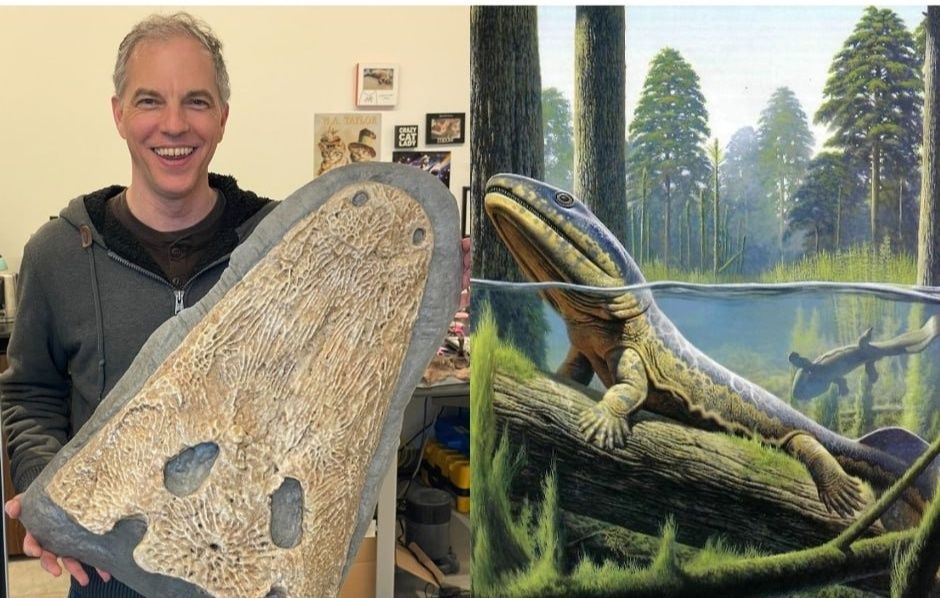
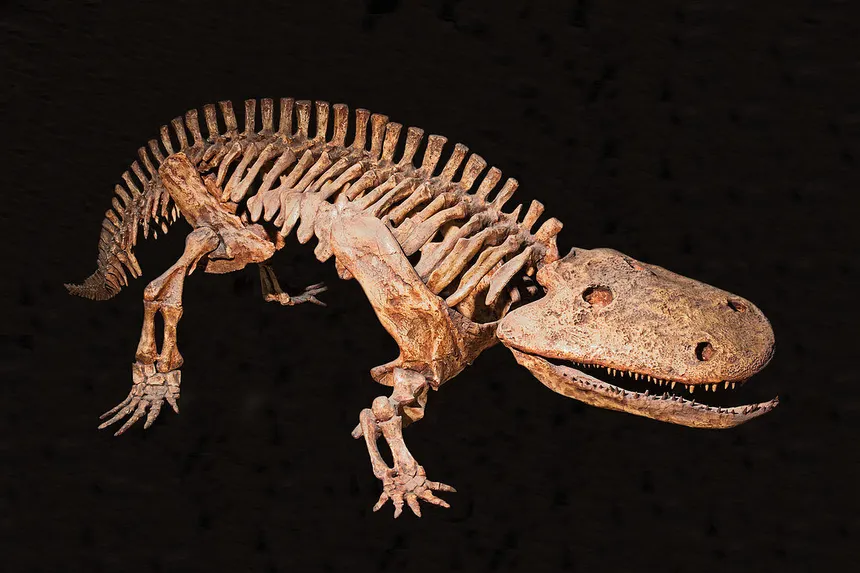
Skull: Broad, flat, and massive, measuring up to one-third the body length.
Teeth and Jaws
-
Lined with sharp, conical teeth, perfect for gripping slippery prey.
-
Secondary set of palatal teeth on the roof of the mouth prevented fish from escaping.
-
Strong bite force made it a dominant predator in its ecosystem.
Limbs and Locomotion
-
Strong, robust limbs adapted for moving both in water and on land.
-
While slow on land, Eryops could haul its heavy body between wetlands.
-
Likely relied on sprawling, salamander-like movements when on land.
Skin and Appearance
-
Like modern amphibians, Eryops probably had moist, glandular skin, aiding respiration.
-
Its tough, muscular build gave it a crocodile-like presence in shallow waters.
Habitat and Environment 🌿🌊
Where It Lived
Eryops inhabited the lowland swamps, rivers, and floodplains of Early Permian North America. The fossil-rich Red Beds of Texas reveal a lush environment teeming with life, including amphibians, reptiles, and early synapsids.
Climate
During the Permian, the supercontinent Pangaea was taking shape. Texas lay in an equatorial region, with warm, seasonal climates that supported wetland ecosystems.
Role in the Ecosystem
As a mid-to-top-level predator, Eryops helped regulate populations of fish, amphibians, and small reptiles. Its ambush-hunting style made it a fearsome presence in the Permian food chain.
Diet and Hunting Behavior 🐟🦎
A Piscivorous Predator
Eryops was primarily piscivorous, feeding on fish, but it also preyed on:
-
Smaller amphibians.
-
Early reptiles.
-
Invertebrates living in aquatic environments.
Hunting Strategy
-
Likely hid in shallow waters, waiting to ambush prey.
-
Used its broad jaws and tooth-studded mouth to grab and hold wriggling prey.
-
Swallowed food whole, relying on water pressure and gravity rather than chewing.
Its hunting style would have resembled that of modern crocodiles or large salamanders.
Evolutionary Significance 🧬
A Temnospondyl Giant
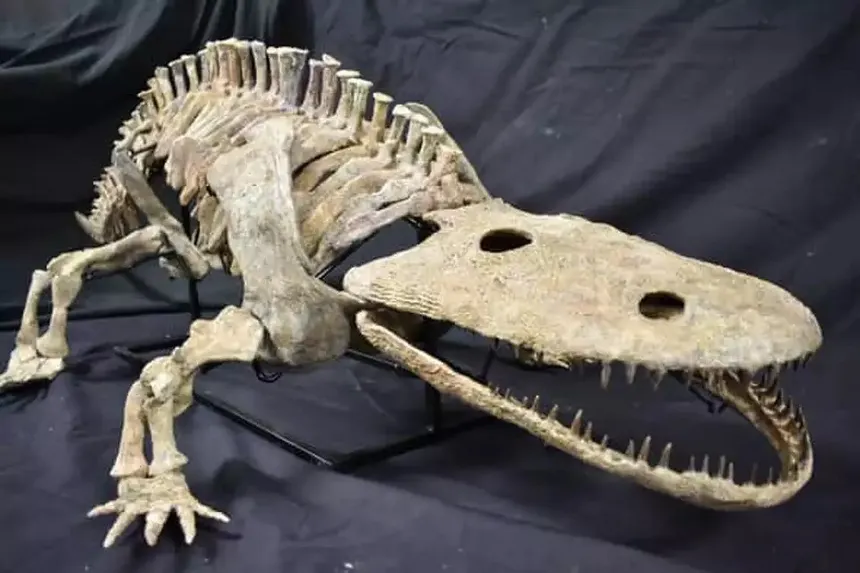
Eryops was a member of the Temnospondyli, a diverse group of early amphibians that thrived for over 200 million years. Temnospondyls represent an important stage in tetrapod evolution, bridging fish-like amphibians and more advanced land-dwellers.
A Step Toward Terrestrial Life
Unlike many earlier amphibians, Eryops had:
-
Stronger limbs for supporting its body on land.
-
Robust ribs to aid breathing outside of water.
-
Adaptations that made it one of the first large vertebrates to spend significant time on land.
This evolutionary leap paved the way for future amphibians, reptiles, and eventually mammals.
Coexistence with Early Reptiles 🐢🐉
The Permian swamps were shared by:
-
Early reptiles such as Captorhinus and Mesosaurus.
-
Synapsids (mammal-like reptiles) such as Dimetrodon.
-
Other large amphibians, including diverse temnospondyls.
While Dimetrodon may have ruled the drier uplands, Eryops dominated the aquatic ecosystems, making it a key predator of its time.
Extinction and Legacy ⚰️
By the mid-Permian, Eryops and many temnospondyls began to decline as reptiles diversified and climates grew drier. Amphibians, with their dependence on water for reproduction and survival, struggled in increasingly arid environments.
Although Eryops disappeared, its legacy lives on in:
-
The evolutionary bridge it represents between water and land vertebrates.
-
Its role in shaping our understanding of amphibian evolution.
-
Its fossils, which are among the best-preserved amphibian remains from the Paleozoic.
Fun Facts About Eryops megacephalus 🎉
-
Its skull could measure up to 60 cm (2 feet) long!
-
It had two sets of teeth—one along the jawline and another on the roof of its mouth.
-
It lived nearly 50 million years before the first dinosaurs.
-
It is one of the best-known temnospondyls, with multiple complete skeletons found.
-
If alive today, it would resemble a giant, prehistoric salamander mixed with a crocodile.
Why Eryops Still Fascinates Us Today 🌍
-
It was one of the first large vertebrates adapted to both water and land.
-
Its fossils provide vital insights into the Permian ecosystem.
-
Its discovery by Edward Drinker Cope ties it to one of paleontology’s most famous rivalries—the Bone Wars.
-
It embodies the transitional stage of evolution, showing how life diversified in the Paleozoic.
Conclusion: The Permian “Drawn-Out Face”
Eryops megacephalus was more than just an amphibian—it was a symbol of evolutionary experimentation in the Paleozoic. With its enormous head, ambush-hunting jaws, and ability to roam both land and water, it bridged the gap between early fish-like tetrapods and later land-dwellers.
Today, it stands as one of the most recognizable amphibians of prehistory, reminding us of a time when swamps teemed with giant predators long before dinosaurs appeared.
From its Red Bed fossils in Texas to its role in paleontology, Eryops continues to captivate scientists and enthusiasts alike—proof that even creatures from 300 million years ago can still inspire awe.
ALSO READ: Sivatherium giganteum: The Ice Age Giant That Blended Giraffe and Okapi 🦒❄️