The Dendera Zodiac – The Sky Map of Ancient Egypt
A Sky Carved in Stone
High above the temple floor in Dendera, Egypt, carved into the ceiling of the Temple of Hathor, lies a masterpiece that has fascinated historians, astronomers, and mystics for centuries — the Dendera Zodiac.
Created around 50 BCE, this circular bas-relief is far more than an artwork; it is a cosmic diagram, a map of the heavens immortalized in stone. Depicting constellations, zodiac signs, and celestial deities, it merges astronomy, religion, and art into a single vision of divine order.
In this ancient sky chart, the Egyptians captured their understanding of the universe — not as a void filled with stars, but as a living, breathing cosmos governed by gods and guided by harmony.
The Temple of Hathor: Sanctuary of Stars and Sound
The Temple of Hathor at Dendera, dedicated to the goddess of love, music, and motherhood, was also a center of celestial study. The priests of Dendera were both astronomers and theologians, keeping watch over the skies to mark festivals, agricultural seasons, and sacred rituals.
Hathor herself was associated with the Milky Way, believed to be the heavenly reflection of the Nile. The temple’s ceilings were decorated with astronomical scenes, but none more intricate than the Dendera Zodiac — a symbolic map of the heavens that mirrored the eternal cycles of life, death, and rebirth.
The Dendera complex stood as both a spiritual sanctuary and a scientific observatory — where religion met calculation, and faith met the stars.
The Dendera Zodiac: The Circular Sky
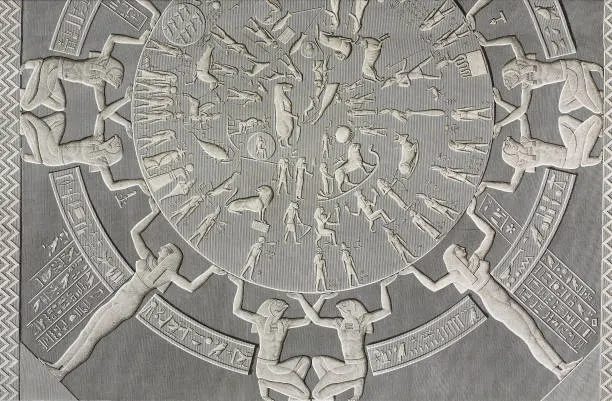
Unlike the rectangular celestial diagrams commonly found in other temples, the Dendera Zodiac is circular — a design rare in Egyptian art.
The circle represents the cyclical nature of time, eternal recurrence, and the unending rhythm of the cosmos. Within this perfect shape, Egyptian artists and astronomers arranged figures of gods, constellations, and zodiac signs that bridge Egyptian and Hellenistic traditions.
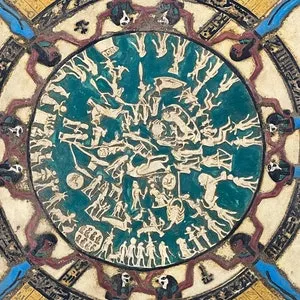
At the center lies a band of 12 zodiac constellations, including recognizable signs like Taurus, Leo, and Scorpio. Around them swirl figures representing planets and decans (ten-day divisions of the Egyptian calendar), along with sky deities, boats carrying stars, and symbols of the Milky Way.
The design is both scientific and sacred — an astronomical record and a theological statement carved into eternity.
Blending Egyptian and Greek Cosmology
The Dendera Zodiac was created during the Ptolemaic period, a time when Greek and Egyptian cultures deeply intertwined. This fusion is beautifully evident in the zodiac itself.
-
Egyptian deities such as Osiris, Isis, Thoth, and Hathor preside over the cosmic order.
-
Greek constellations — like Aries, Pisces, and Capricorn — are incorporated into Egyptian mythic frameworks.
-
The north pole of the sky, symbolized by a celestial god, anchors the chart like the axis of creation itself.
This combination reveals a civilization in dialogue — where Greek astronomy met Egyptian spirituality, producing a work that transcends cultural boundaries.
The Dendera Zodiac was, in essence, a universal map of the heavens, merging observation and reverence into a single cosmic vision.
The Zodiac’s Purpose: Sacred Calendar or Cosmic Prophecy?
Scholars continue to debate the original purpose of the Dendera Zodiac. Was it purely astronomical, or did it serve a deeper ritual function?
-
Astronomical Calendar:
Many experts believe it acted as a celestial calendar, tracking the movement of the Sun, Moon, and planets to determine sacred festivals and agricultural cycles. -
Astrological Symbolism:
Others interpret it as an astrological chart, representing not only cosmic time but also human destiny, connecting divine movements to earthly events. -
Religious Cosmogram:
For the priests of Dendera, the zodiac was a map of creation — a symbolic depiction of how the divine forces shaped both heaven and earth.
Whatever its exact purpose, the Dendera Zodiac reveals that ancient Egyptians were keen observers of the sky, with knowledge that bordered on the mathematical and metaphysical.
Carving the Cosmos: Artistic and Technical Mastery
The Dendera Zodiac’s craftsmanship is astonishing. Hewn from a single block of sandstone, it features detailed bas-relief carvings that maintain clarity even after two millennia.
Each constellation was carefully positioned according to astronomical principles. The layout likely represented the sky visible over Dendera at a particular historical moment — possibly the night of a significant celestial event or ritual alignment.
The level of accuracy suggests that Egyptian priests possessed advanced observational instruments and mathematical understanding.
Their carvings weren’t merely decorative — they were data encoded in myth, a timeless record of cosmic motion rendered in sacred art.
Discovery and Relocation: From Temple to Paris
The Dendera Zodiac gained international fame in the 19th century. When it was removed from the temple’s ceiling by French engineers under the orders of King Charles X.
In 1821, it was transported to France, where it remains on display in the Louvre Museum in Paris.
The removal sparked heated debates about cultural heritage and ownership, with Egypt later demanding its return. Yet, even in exile, the zodiac continues to fascinate. A piece of ancient Egypt’s soul etched into stone and displayed beneath modern skylights.
Meanwhile, the temple ceiling in Dendera was restored with a replica. Preserving the original context for visitors who come to see the heavens as the ancients once did.
Decoding the Celestial Language
For Egyptologists and astronomers, the Dendera Zodiac offers an invaluable window into ancient cosmology.
-
The constellations reflect Egypt’s blending of Greek star lore with local myths.
-
The planets, represented by gods sailing celestial boats, show Egypt’s early understanding of planetary motion.
-
The decans, or divisions of the sky into 36 star groups, formed the foundation of the Egyptian calendar and astrology.
Modern software used to reconstruct the night sky has shown that the positions of the stars match those of 51 BCE. Possibly marking the coronation of Cleopatra VII or another royal event.
Thus, the Dendera Zodiac may not only be an artistic wonder — it might be history written in stars.
Symbolism of the Cosmic Circle
At its heart, the Dendera Zodiac is a meditation on time and eternity. The circle itself represents the cyclical nature of existence. The rising and setting of the sun, the turning of seasons, and the rebirth of the soul.
For the Egyptians, the sky was not separate from life; it was a mirror of divine law. Every star had purpose, every orbit meaning.
To gaze upon the zodiac today is to step into that same rhythm. To feel the pulse of an ancient universe where gods moved among stars and humans sought their reflection in the heavens.
The Legacy of the Dendera Zodiac
The Dendera Zodiac continues to inspire not only scholars but artists, philosophers, and astronomers. It reminds us that the search for meaning in the sky is as old as humanity itself.
From ancient priests charting constellations to modern astronomers scanning distant galaxies. The impulse is the same — to understand our place in the cosmic order.
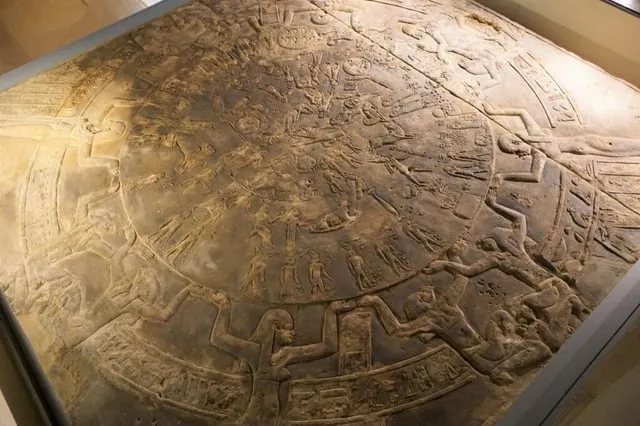
In its graceful carvings, the Dendera Zodiac whispers across 2,000 years:
We have always looked upward.
We have always sought our story in the stars.
Conclusion: The Eternal Sky of Egypt
The Dendera Zodiac is not just a relic — it is a conversation between earth and heaven. Carved by hands that believed in the eternal bond between the stars and the soul.
As we trace the lines of these ancient constellations. We connect with a civilization that looked at the same night sky and saw not cold space. But divine motion — a universe alive with meaning.
Through their art, the ancient Egyptians taught us that to study the stars is to seek eternity — and in that quest. We are still their descendants.
ALSO READ: A Leaf from a Lost World: The Fossil Fern That Fueled an Age