The Cup of the Ptolemies: Ancient Masterpiece Turned Medieval Chalice
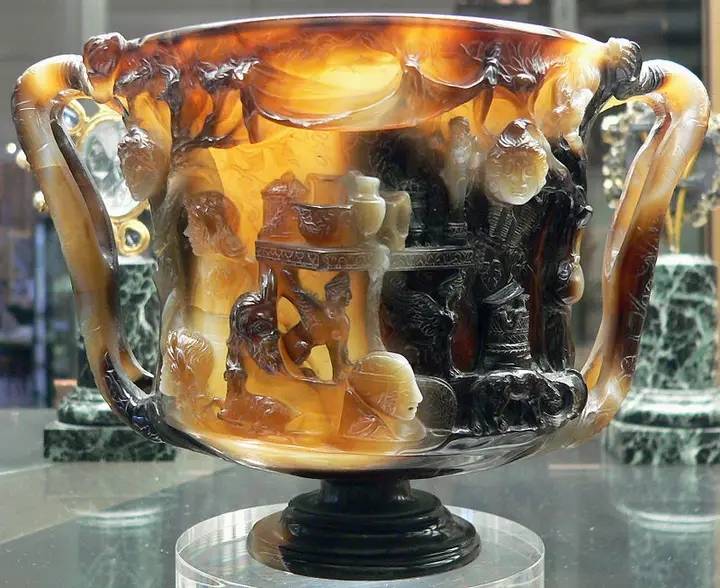
Among the most exquisite surviving artifacts from Classical Antiquity, the Cup of the Ptolemies—also known as the Cup of Saint Denis—occupies a unique place in both artistic and religious history. This onyx cameo two-handled cup (kantharos), adorned with intricate Dionysiac vignettes, was likely carved in Alexandria during the Hellenistic or early Roman period.
Measuring just 8.4 cm high and 12.5 cm in diameter, it is a small yet extraordinary object, blending Greek artistic tradition with later Christian reinterpretation. Over centuries, the cup’s role transformed: from a luxury vessel in antiquity to a consecrated chalice in the Middle Ages, before entering the collections of the Cabinet des Médailles at the Bibliothèque nationale de France in Paris.
This article explores the fascinating history, artistry, symbolism, and legacy of the Cup of the Ptolemies, tracing its journey across civilizations and belief systems.
Origins in Classical Antiquity
The Cup of the Ptolemies is believed to have been crafted during Classical Antiquity, probably in Alexandria, a cultural and artistic hub of the Hellenistic world.
Artistic Features
-
Material: Carved from banded onyx, prized for its layered colors and durability.
-
Form: A kantharos, a type of Greek drinking cup associated with Dionysus, the god of wine.
-
Decoration: Richly detailed cameo reliefs depicting Dionysiac scenes, including vines, masks, and mythological figures.
The craftsmanship reflects the skill of Alexandrian artisans, who specialized in luxury goods for royal courts and elite patrons.
Dionysiac Symbolism
The imagery on the cup connects it to the cult of Dionysus (Bacchus), a god associated with wine, ecstasy, and rebirth.
Common Motifs:
-
Vines and Grapes: Symbols of abundance and fertility.
-
Satyrs and Maenads: Followers of Dionysus, representing revelry and transformation.
-
Masks and Garlands: Evoking theatrical and ritual celebrations.
This Dionysiac symbolism makes sense in the context of a luxury drinking vessel, emphasizing both the pleasures of feasting and deeper religious connotations of life, death, and renewal.
Transition to the French Royal Treasury
The path of the Cup of the Ptolemies from Alexandria to France is not fully documented. However, by the Middle Ages, it was firmly established within the treasury of the French monarchy.
Its arrival in France may have occurred through:
-
Byzantine or Crusader channels, as luxury items often moved westward.
-
Royal collecting traditions, where ancient artifacts were valued for their beauty and rarity.
Eventually, it was donated to the abbey of Saint Denis, one of the most important religious centers in medieval France.
The Cup of Saint Denis: A Christian Transformation
Once placed in the Abbey of Saint Denis, the cup underwent a dramatic transformation.
Adaptation as a Chalice
-
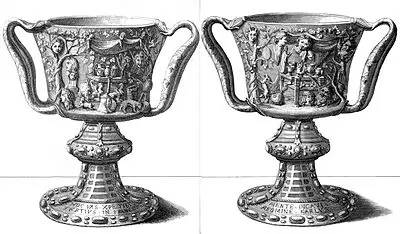
Lavish mounts were added in gold and precious stones.
-
Latin inscriptions were engraved, dedicating it to Christian worship.
-
Its new role was as a Eucharistic chalice, used in sacred rituals.
Symbolic Reinterpretation
Christians reinterpreted the Dionysiac imagery, once associated with wine and revelry, in a new context:
-
Wine → Blood of Christ in the Eucharist.
-
Rebirth themes → Christian resurrection.
-
Ecstatic imagery → spiritual transcendence.
This transformation highlights how medieval Christians adapted and repurposed pagan art to serve new religious meanings.
The Theft of 1804 and Loss of Mounts
In 1804, during a period of political upheaval in France, thieves stole the cup from its resting place.
-
The lavish medieval mounts were lost and never recovered.
-
Fortunately, the onyx cup itself was recovered and preserved.
This theft dramatically altered its appearance, stripping it of the Christian embellishments but restoring its ancient aesthetic purity.
Current Location: Bibliothèque nationale de France
Today, the Cup of the Ptolemies is part of the prestigious Cabinet des Médailles at the Bibliothèque nationale de France in Paris.
Significance of Its Display
-
Visitors can see the cup as close to its original ancient form as possible.
-
It serves as a testament to cross-cultural continuity, spanning Greek, Roman, Christian, and modern French heritage.
-
The cup is also a scholarly resource, allowing researchers to study ancient cameo techniques and religious transformations.
Artistic and Cultural Importance
As a Masterpiece of Antiquity
The Cup of the Ptolemies represents the pinnacle of Alexandrian luxury art, blending technical mastery with symbolic richness.
As a Christian Chalice
As a Survivor of Time
Despite theft, loss, and reinterpretation, the core artifact survives—offering modern audiences a tangible link to multiple historical eras.
Legacy and Scholarly Debates
Scholars continue to debate:
-
The exact date of the carving (Hellenistic vs. early Roman).
-
The original function: elite banquet cup or ritual vessel.
-
The symbolic layers: how much of its Dionysiac meaning carried into its Christian reinterpretation.
These debates enrich the cup’s legacy, ensuring its place as a subject of ongoing fascination in art history and archaeology.
Conclusion
The Cup of the Ptolemies is more than an artifact—it is a cultural bridge spanning 2,000 years of history. From its creation in Classical Antiquity as a Dionysiac kantharos, to its Christian reinterpretation as the Cup of Saint Denis, and its modern preservation in Paris, it embodies the adaptability and continuity of human creativity.
Its journey from Alexandria to France, from pagan ritual to Christian liturgy, and from medieval treasury to modern museum, illustrates how art transcends time, religion, and empire. Today, it remains a masterpiece of ancient craftsmanship and a symbol of cultural transformation, reminding us of the power of objects to connect civilizations across the ages.