The Crocodile Rain Spouts of Mali – Guardians of Mud and Spirit
Where Rain Meets Spirit in the Sahel
In the heart of Mali’s Sahelian landscape, where desert winds meet the fertile floodplains of the Niger River, lies the ancient town of Djenné. Known for its magnificent earthen buildings and its Great Mosque — the largest mud structure in the world — Djenné is a living museum of Sudano-Sahelian architecture, a style born from both necessity and artistry.
Among its most intriguing details are the crocodile-shaped rain spouts that jut from the walls of homes, mosques, and community buildings. These sculpted wooden figures serve a simple function — to channel rainwater away from fragile mud walls — yet they embody a far deeper symbolism rooted in spirituality, craftsmanship, and the eternal dialogue between humanity and nature.
The Crocodile Rain Spouts of Mali are more than architectural features; they are guardians of mud and spirit, embodiments of ancestral wisdom flowing through generations.
The Sudano-Sahelian Architectural Legacy
To understand the significance of these rain spouts, one must first appreciate the Sudano-Sahelian architectural tradition, which emerged across West Africa around the 13th century CE. This style, characterized by adobe (mudbrick) walls, wooden beams, and organic forms, evolved in response to the region’s harsh climate and seasonal rainfall.
The people of Djenné, along with those in Timbuktu and other Sahelian towns, developed sophisticated methods of building with earth, crafting structures that could breathe, cool, and regenerate. Each year, after the rains, the entire community participates in the annual re-plastering ceremony, where residents gather to repair and renew the mud surfaces of their buildings — a living ritual that unites art, labor, and faith.
Within this tradition, even functional elements like rain spouts are imbued with spiritual and aesthetic meaning. The result is an architecture that is not merely built, but cultivated — one that grows and breathes with the people who inhabit it.
The Function Behind the Form: Why Rain Spouts Matter
The Sahel experiences short but intense rainy seasons. For mud structures, water can be both a blessing and a threat. Without protection, rain can erode walls, wash away plaster, and weaken foundations.
To counter this, artisans designed wooden rain spouts — long, hollowed tubes inserted into the walls to divert rainwater away from the delicate adobe surfaces. But in Djenné, function never exists without artistry. The spouts are hand-carved into the shapes of sacred animals, most commonly crocodiles and lizards, and sometimes birds or serpents.
When the rains pour through their carved mouths, it appears as if these creatures themselves are exhaling the monsoon — releasing the ancient breath of life across the mud city.
The Crocodile: Symbol of Power and Protection
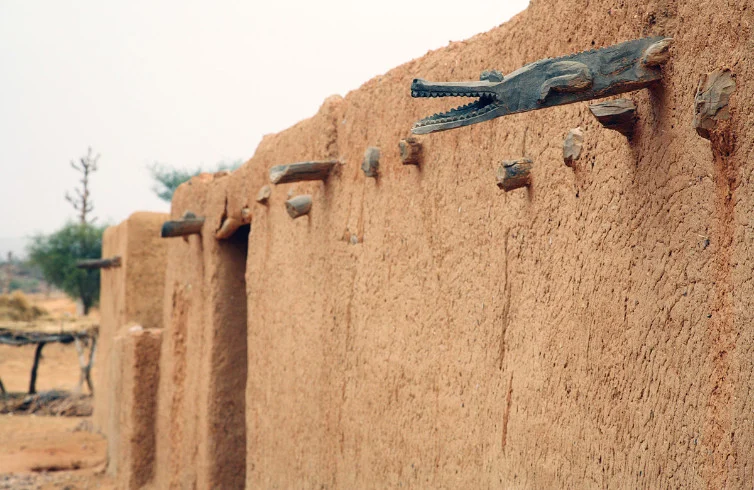
In the mythology and symbolism of West Africa, the crocodile holds a revered place. It is a creature of both water and earth, a bridge between realms. In Malian cosmology, crocodiles are guardians of rivers, protectors of fertility, and symbols of strength, adaptability, and spiritual resilience.
By carving crocodiles into the very architecture of their homes, the people of Djenné invite these protective spirits to dwell among them. The crocodile’s open jaws channel the life-giving rain, while its body stands as a sentinel against misfortune.
To this day, crocodiles are respected in many Malian communities as ancestors’ messengers. The fusion of their imagery with rainwater — the most precious gift in the Sahel — transforms the spout into a powerful symbol of life’s cyclical renewal.
Below the Spouts: Doors, Niches, and the Sacred Within
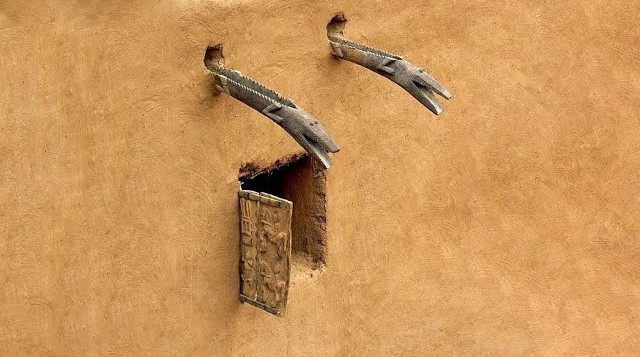
Beneath many of these rain spouts lie small carved doors or wooden panels, often protecting household shrines, storage spaces, or ancestral niches. These doors are intricately decorated with geometric motifs, human figures, and animal symbols, each narrating stories of creation, protection, and harmony.
The carvings are more than decoration — they serve as visual prayers, a dialogue between the visible and invisible worlds. Just as the rain spouts direct water outward, these sacred panels draw spiritual energy inward, creating a balance between protection and nourishment.
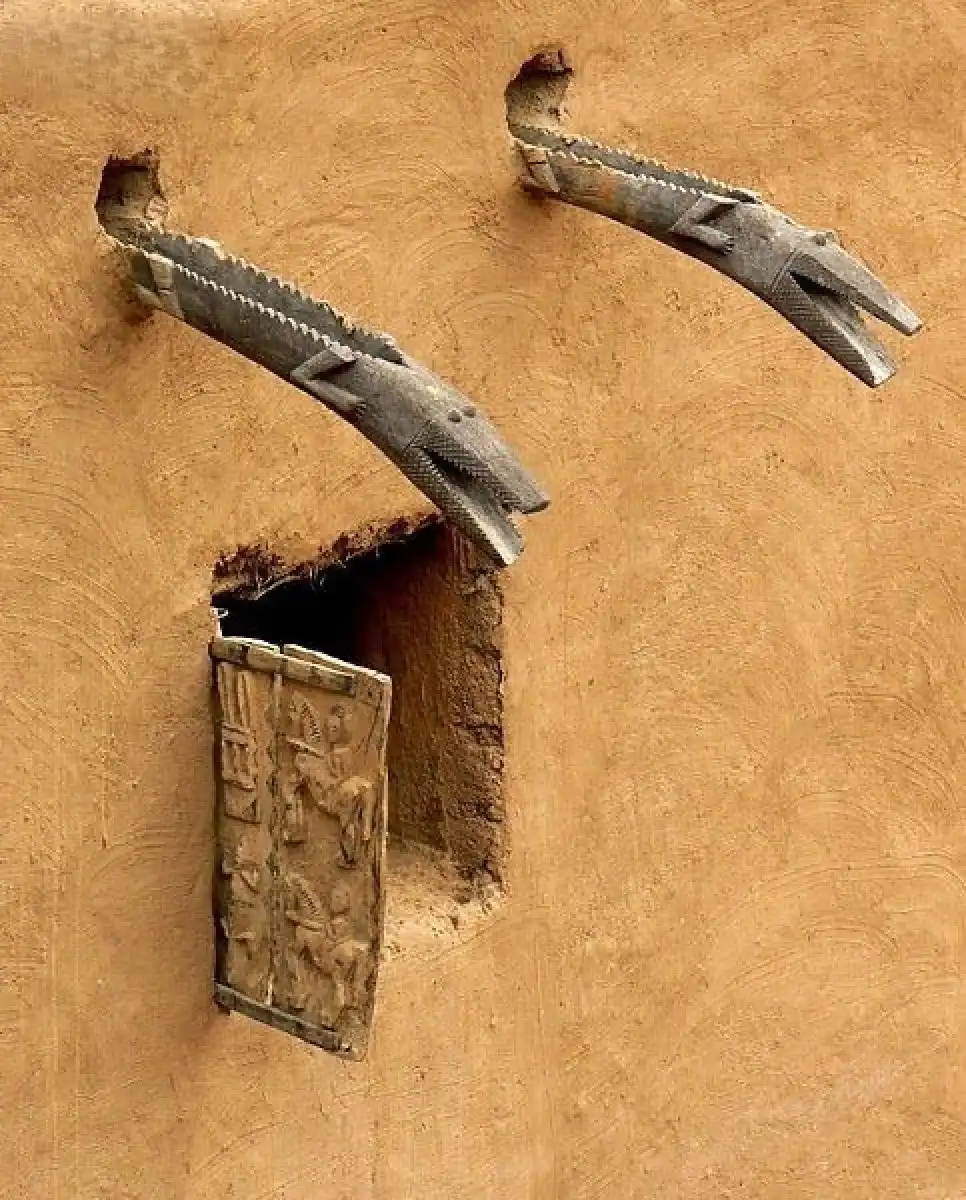
Together, they form a holistic design language that marries function, faith, and art into a single architectural gesture.
The Guild of Djenné’s Masons: Keepers of a Living Tradition
The continued existence of these rain spouts is a testament to Djenné’s masons’ guild. A centuries-old community of skilled artisans who pass down knowledge through apprenticeship and ritual. Each mason belongs to a lineage, and their craft is guided by spiritual codes, ancestral blessings, and community respect.
Their work is recognized by UNESCO as part of the Intangible Cultural Heritage of Humanity. Ensuring that this tradition — both tangible and spiritual — is preserved for future generations.
When they carve a crocodile or restore an ancient wall, these artisans are not merely maintaining buildings. They are reaffirming the sacred pact between humanity, earth, and water. A pact that has sustained the Sahel for nearly a millennium.
Art Meets Ecology: Sustainability in Earthen Design
Modern architects and conservationists have turned their attention to Djenné for lessons in sustainable design. The rain spouts exemplify eco-friendly innovation long before the term existed.
-
Material Sustainability: Crafted from locally sourced wood and mud, the spouts are biodegradable and renewable.
-
Climate Adaptation: Their form effectively diverts torrential water while maintaining the building’s natural cooling system.
-
Cultural Continuity: Each spout is unique, carrying personal, clan, or symbolic meaning — ensuring cultural identity thrives alongside functionality.
In a world increasingly disconnected from ecological balance. The rain spouts of Mali remind us that beauty and sustainability can coexist in harmony.
A Voice from the Past: When the Rain Flows Through
When heavy rain falls in Djenné, water rushes through the mouths of these carved creatures, splashing into the red earth below. The sound is rhythmic — ancient, almost musical. Locals say it is the earth speaking, a song of gratitude and renewal.
To watch the rain pour through a crocodile’s wooden jaw is to witness art in motion. A living connection to ancestors, nature, and divine balance. The sight evokes a profound realization: that what we build can be both shelter and spirit, both practical and poetic.
Conclusion: Guardians of Mud and Memory
The Crocodile Rain Spouts of Mali are not relics of a forgotten age. They are living witnesses to a culture that continues to thrive. They tell the story of a people who see no separation. Between function and faith, craft and cosmos, earth and eternity.
In their weathered wood and open mouths, they hold a timeless truth. That protection can be beautiful, that tradition can evolve, and that the very walls we build can breathe with the soul of the world.
As the rains return each year to Djenné, flowing once more through their carved guardians. The question lingers in the desert air:
Is it only water we hear — or the ancient breath of the earth speaking again?
ALSO READ: Ripples of Time – Fossilized Waves from Earth’s First Seas