The Atacama Giant: Chile’s Colossal Desert Sentinel
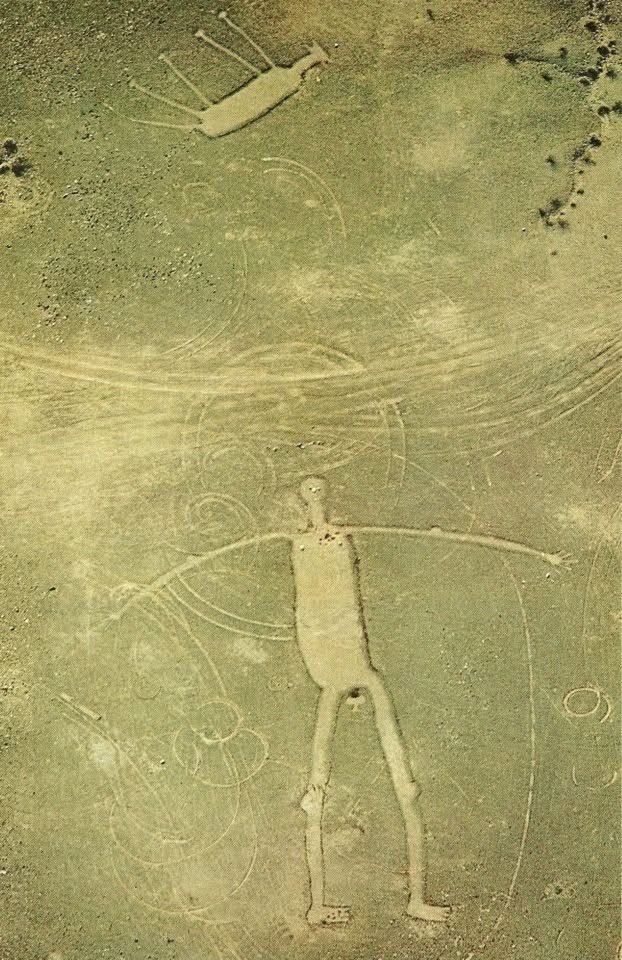
The Atacama Desert, one of the driest places on Earth, holds within its vast expanse a monumental mystery — the Atacama Giant. This ancient geoglyph, etched into the slope of Cerro Unita in northern Chile, stands as one of the largest anthropomorphic figures ever created by human hands. Dating between 1000 and 1400 AD, it reflects the complex cosmology, artistry, and social organization of pre‑Inca cultures that once flourished in the region.
Origins and Location of the Atacama Giant
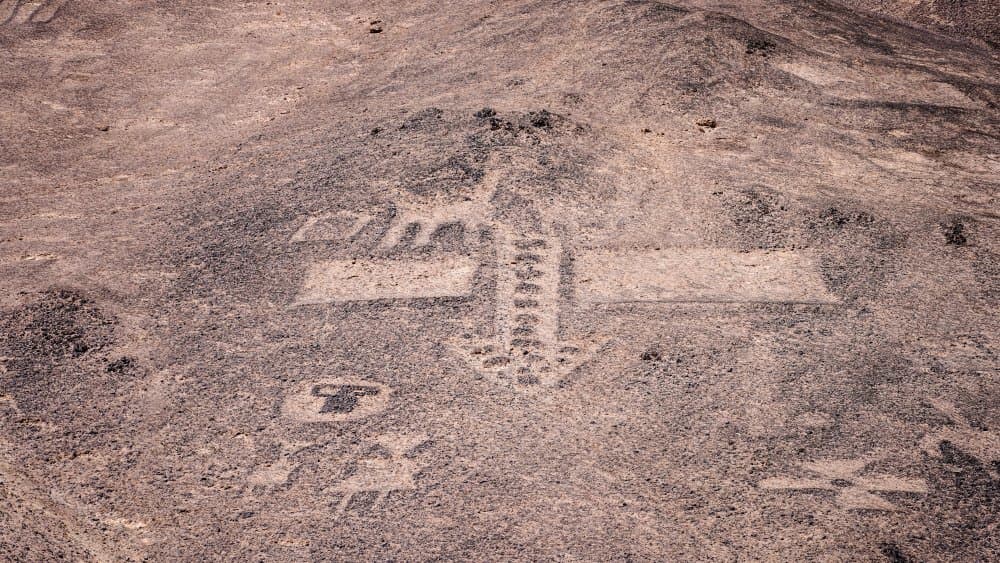
Situated in the Tarapacá region of Chile, near the town of Huara, the Atacama Giant rises about 119 meters (390 feet) high. It dominates Cerro Unita’s barren ridge, surrounded by scores of smaller geoglyphs—abstract lines, animal shapes, and circular motifs. These figures, created through the removal of darker desert stones to reveal the lighter substrate beneath, transform the landscape into a colossal canvas.
Researchers believe the Atacama Giant was produced by pre‑Columbian peoples who inhabited the Atacama Plateau, likely related to the Tiwanaku and later the Inca cultural spheres. The arid environment of the desert has been both a preserver and a sculptor, ensuring that the geoglyph has withstood centuries of wind, erosion, and time.
Constructing the Giant: An Art of Subtractive Design
Unlike petroglyphs carved into rock faces, the Atacama Giant is a negative geoglyph, meaning its contours were shaped by scraping away the darker oxidized top layer of the ground to expose the lighter sand beneath. This subtractive technique allowed the figure to emerge vividly under the desert sun, a process requiring remarkable precision and understanding of the region’s terrain and light conditions.
The geoglyph displays a stylized human form, likely adorned with headdresses and geometric elements symbolizing clothing or divine attributes. The alignment and scale suggest that its creators carefully planned its visibility from afar, possibly for ceremonial processions or astronomical observation.
Astronomical Purpose: The Celestial Calendar Theory
One of the most intriguing interpretations of the Atacama Giant lies in its possible role as a gigantic celestial calendar. Scholars have noted that certain alignments and markings correspond to lunar cycles and seasonal patterns. The figure’s antenna-like structures on its head may have served as reference points to track the movement of stars or constellations, helping local societies anticipate agricultural shifts during rare wet seasons.
Given the Atacama Desert’s clear skies and minimal atmospheric distortion, ancient inhabitants had ideal conditions for astronomical observation. Mapping celestial movements onto the landscape would have been both a spiritual and practical act, merging cosmic order with terrestrial life.
Symbolism and Cultural Meaning
Beyond astronomy, the Atacama Giant also communicates power and social identity. The figure’s imposing presence and size suggest that it represented a deity or a venerated ancestor connected to fertility, weather, or the heavens. Pre-Inca cultures often viewed mountains as sacred spaces—Apu or gods dwelling above—and Cerro Unita’s selection aligns with this worldview.
Archaeologists propose that the figure may symbolize a shamanic transformation or cosmic guardian. Its outstretched limbs and triangular patterns denote energy and spiritual ascension, mirroring rituals that sought harmony between humans and nature. In this way, the Atacama Giant served as more than an artwork; it was a sacred statement of existence within a vast, unforgiving desert.
Preservation in the Harsh Atacama Environment
The Atacama Desert’s hyper‑aridity, with rainfall measured in mere millimeters per year, has paradoxically safeguarded many ancient traces of human activity. The lack of vegetation and stable surface conditions have slowed erosion, allowing the geoglyph to survive for centuries. However, modern environmental challenges threaten its longevity.
Climate shifts, mining operations, and unauthorized vehicle access have all impacted nearby geoglyphs. Though the Atacama Giant remains visible, the surrounding cultural landscape requires strict conservation. UNESCO and Chilean heritage institutions continue to document, protect, and raise awareness of these fragile artworks through aerial photography and non‑invasive surveying.
Archaeological Context: A Landscape of Geoglyphs
The Atacama Giant does not stand alone. The surrounding region contains over 5,000 recorded geoglyphs, created by various cultures between 500 BCE and 1500 CE. Among these are animal figures, such as llamas and birds, as well as abstract geometrical forms. Many are believed to mark caravan routes along ancient trade networks that connected coastal societies with Andean highlands.
The repetition of themes—camels, serpents, sun symbols—indicates the exchange of not only goods but also cosmological ideas. The Atacama Giant thus integrates into a broader cultural phenomenon where ritual art, geography, and astronomy intertwined to form a symbolic map of human interaction with the desert.
Interpreting the Giant Today
For modern observers, the Atacama Giant invites awe and speculation. Some fringe theories have proposed extraterrestrial or lost-civilization origins, drawn by its monumental scale and abstract design. However, archaeological evidence firmly roots the geoglyph within the known traditions of Andean symbolism and local craftsmanship.
Advances in digital mapping have refined our understanding of the site’s orientation and purpose. Drone imaging and topographic studies reveal subtle ground modifications extending beyond the main figure—possibly ceremonial pathways or viewing platforms aligned with celestial events.
Tourism, while economically beneficial, presents a double-edged sword. Responsible travel initiatives now encourage observation from designated viewpoints rather than direct access, ensuring that the desert surface remains undisturbed for future generations.
The Enduring Legacy of the Atacama Giant
Standing against the stark emptiness of northern Chile, the Atacama Giant continues to embody humanity’s quest to connect earth and sky. It is at once a relic of ancient faith, a technical achievement of desert engineering, and a message carried through time by the landscape itself.
To archaeologists, it represents a convergence of art, science, and spirituality. To visitors, it symbolizes endurance—how ideas can transcend centuries when written upon the very ground they inhabit. The silent figure gazes toward the heavens, a reminder that long before telescopes or satellites, humankind sought meaning in the same vast sky.
Preserving the Atacama Giant is more than an act of conservation; it is an acknowledgment of a civilization’s dialogue with nature at its most profound. As the desert winds sweep over Cerro Unita, they whisper stories of the past—of artistry born in isolation, of cultures reading the stars, and of our unending desire to leave a mark upon the world.
ALSO READ: Sumerian Statues from Iraq, ca. 2700 BCE: A Glimpse into Ancient Devotion and Artistry