The Arch of Septimius Severus: Rome’s Triumph Carved in Stone
Monument of Power and Victory
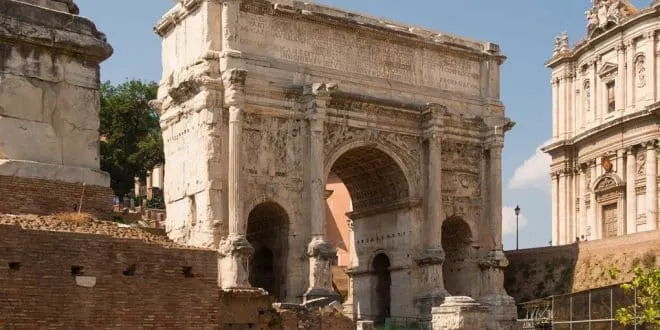
Standing tall at the northwest corner of the Roman Forum, the Arch of Septimius Severus remains one of the most striking symbols of ancient Rome’s imperial grandeur. Constructed in 203 CE, the arch commemorates Emperor Septimius Severus’s victories over the Parthians, Rome’s eastern rivals. Beyond celebrating military triumph, it served as a political statement—an enduring reminder of the emperor’s power, Rome’s dominance, and the unity of the Severan dynasty.
Even today, though weathered by centuries, the arch continues to inspire awe. Its intricate carvings, monumental scale, and historical resonance embody the fusion of art, politics, and religion that defined Roman monumental architecture.
Historical Context: Severus and the Parthian Wars
Septimius Severus, who reigned from 193 to 211 CE, was a formidable leader and founder of the Severan dynasty. His reign was marked by military campaigns that expanded Rome’s influence, particularly in the East.
Between 194 and 199 CE, Severus launched successful campaigns against the Parthians, capturing their capital city, Ctesiphon, and annexing new territories into the empire. These victories secured wealth, prestige, and a stronger frontier for Rome. To commemorate these achievements, the emperor’s sons, Caracalla and Geta, commissioned a grand triumphal arch in his honor—cementing both their father’s legacy and their own dynastic image.
Architecture and Design of the Arch
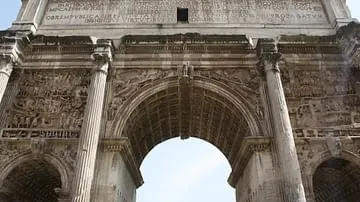
The Arch of Septimius Severus rises nearly 23 meters (75 feet) high and is built from Proconnesian marble, a material prized for its bright, reflective surface. Its structure follows the traditional form of Roman triumphal arches, with three passageways: a central, larger arch flanked by two smaller ones.
Key Features of Its Design:
-
Triple Arches: The central passage, designed for processions, dominates the structure, while the smaller side arches accommodate foot traffic.
-
Engaged Columns: Corinthian columns decorate the façade, enhancing its sense of grandeur and verticality.
-
Inscription: A large Latin inscription at the top originally praised both Severus and his sons for their victory over the Parthians. After Geta was murdered by Caracalla, his name was erased—a political act known as damnatio memoriae.
-
Gilded Bronze Chariot: Originally, the arch was crowned with a spectacular bronze sculpture of a six-horse chariot carrying Septimius Severus, though this has not survived.
Artistic Reliefs: Rome’s Triumph in Stone
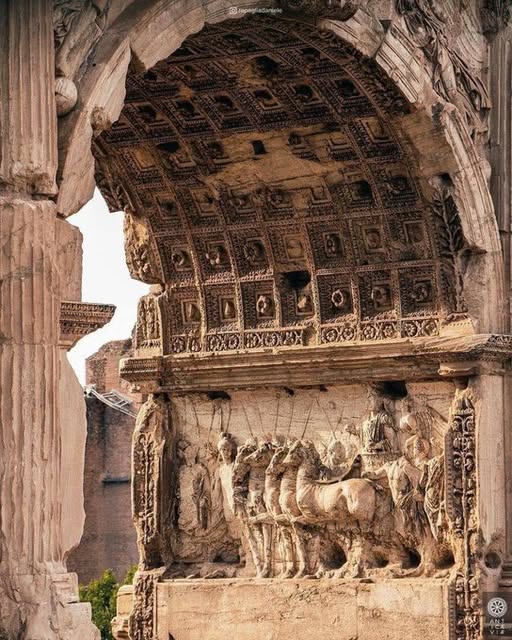
Perhaps the most captivating aspect of the arch is its marble reliefs, which vividly narrate the Parthian wars. These carvings transform the monument into a storytelling canvas, immortalizing Rome’s conquests.
Relief Highlights:
-
Military Campaigns: Panels depict Roman soldiers advancing into Parthian territory, capturing cities, and engaging in battle.
-
Triumphal Imagery: Victorious parades, the presentation of captives, and scenes of plundered riches emphasize the glory of Rome’s success.
-
Symbolism: The artistic style elevates these victories into the realm of divine favor, portraying the emperor as a chosen leader blessed by the gods.
Inside the central archway, the soffit ceiling is decorated with recessed coffers, once inlaid with gilded rosettes. This detail not only enhanced the monument’s beauty but also gave a celestial quality to those who passed beneath, as though stepping into a sacred space.
Political and Religious Symbolism
The Arch of Septimius Severus was more than a monument to military victory—it was a political tool. By inscribing Severus’s achievements in stone, the arch:
-
Legitimized the Severan dynasty: It reinforced the authority of Septimius Severus and his heirs in the eyes of the Roman people.
-
Linked military success with divine favor: The combination of triumphal imagery and celestial decoration conveyed that Rome’s victories were sanctioned by the gods.
-
Asserted Rome’s dominance over the East: By emphasizing the conquest of the Parthians, the arch underscored the empire’s strength at its frontiers.
Even the later removal of Geta’s name is symbolic—it reflects the arch’s evolving role as a political stage, subject to the shifting fortunes of power within the Severan dynasty.
The Arch Through the Ages
Over the centuries, the Arch of Septimius Severus endured the decline of the Roman Empire, natural wear, and partial burial beneath sediment. During the Middle Ages, it was incorporated into surrounding structures, even serving as a fortress.
Rediscovered and excavated during the Renaissance, the arch became a focal point of renewed interest in Roman antiquity. Modern preservation efforts have stabilized its structure, ensuring it remains a prominent feature of the Roman Forum for millions of visitors each year.
Experiencing the Arch Today
Walking through the Roman Forum today, visitors can still admire the monumental presence of the Arch of Septimius Severus. Sunlight plays across its weathered carvings, accentuating scenes of Roman soldiers, conquered foes, and the enduring might of an empire.
Although time has eroded some of the finer details, the monument retains its narrative power. It stands not only as a reminder of Rome’s military success but also as a testament to the city’s cultural ambition—a civilization that fused engineering, art, and ideology into stone.
Legacy of the Arch
The Arch of Septimius Severus remains a crucial example of Roman triumphal architecture. Its influence can be seen in later arches, including the Arch of Constantine, built over a century later.
More importantly, the arch serves as a bridge between history and memory. It preserves Rome’s political and cultural ideals, while also revealing the human drama of power, rivalry, and legacy. Whether in the victories it celebrates or in the erasure of Geta’s name.
Conclusion: A Timeless Testament to Rome
The Arch of Septimius Severus is more than a ruin—it is a living story carved in marble. It tells of Rome’s triumph over the Parthians, of imperial ambition, of artistry elevated to the service of power. Through its reliefs and inscriptions, it speaks across centuries. Reminding us of a time when empire, religion, and art converged in monumental form.
Today, as sunlight animates its aged stone, the arch continues to capture the imagination. It stands as both a symbol of military success and a poetic reminder of Rome’s cultural glory. A timeless expression of empire, endurance, and human creativity.
ALSO READ: Plimpton 322: The Babylonian Clay Tablet That Rewrote the History of Trigonometry