Strike It Lucky! Amateur Detectorist Unearths 10,000 Roman Coins on First Hunt
For most amateur metal detectorists, the first few outings are often characterized by unearthing rusty nails, bottle caps, or perhaps a few modern pennies. The real, valuable finds often take years of dedication, research, and countless hours in muddy fields. But for Nick Davies, a 30-year-old from Ford, Shropshire, this conventional wisdom was shattered in the most spectacular way possible.
On his inaugural treasure hunt, Davies unearthed a haul that has stunned historians and archaeologists: an incredible collection of 10,000 Roman silver and bronze coins.
The sheer scale and historical significance of the find, made in a farmer’s field near Shrewsbury, instantly catapulted Davies into the limelight and secured his name in the annals of British archaeological discoveries. He didn’t just find a coin; he found a piece of history that had been buried and untouched for nearly two millennia.
🏺 1,700 Years of History: What Was Found?
Archaeologists discovered the astonishing cache of coins—primarily silver and bronze nummi—crammed inside a heavily buried, 70-pound clay pot. Experts have meticulously dated the currency and established that the coins were in circulation — and likely deposited — between 240 AD and 320 AD. This places the treasure during a tumultuous but economically active period of Roman Britain, a time when the region was undergoing significant changes.

The preservation of the find is remarkable. These 10,000 nummi coins have spent an estimated 1,700 years underground, preserved by the earth until the sensitivity of a modern metal detector—and the luck of a novice—brought them back into the light.
“I never expected to find anything on my first treasure hunt – especially anything of any value,” Davies recounted, describing the moment of discovery as “fantastically exciting.”
The discovery is not just significant locally; experts have confirmed it as the biggest collection of Roman coins found in Britain this year, marking a major addition to the nation’s archaeological record.
🗺️ The Significance of the Shropshire Hoard
While Roman coin hoards are not entirely uncommon in Britain, the size and location of the Davies find make it particularly noteworthy. Experts have confirmed it as one of the largest collections of Roman coins ever discovered in Shropshire.
These hoards, often buried hastily, are crucial for historians because they act as time capsules. They offer a direct snapshot of the economy, the political atmosphere, and the wealth of the individuals who buried them.
Why bury 10,000 coins? The answer often points to times of insecurity. The person who interred this wealth likely did so during a time of imminent danger—perhaps a local uprising. A raid, or political instability—fully intending to return for it. They never did. This pottery jar full of nummi represents a hidden lifetime savings, a transaction that was suddenly and permanently interrupted.
The coins, once cleaned and cataloged, can help archaeologists understand trade routes. The mints that were active, and the extent of Roman influence in the area surrounding Shrewsbury and the Welsh Marches.
🏛️ A Future on Display: Shrewsbury’s Heritage Center
The journey of the Roman Hoard does not end in the field. Under the UK’s Treasure Act, all valuable finds of this nature must be reported. To the local Portable Antiquities Scheme (PAS) Finds Liaison Officer. The subsequent process involves an inquest to officially declare the find as ‘Treasure.’
Once this process is complete, a valuation committee assesses the hoard. Crucially, the finder (Nick Davies) and the landowner (the farmer) usually split the monetary reward.
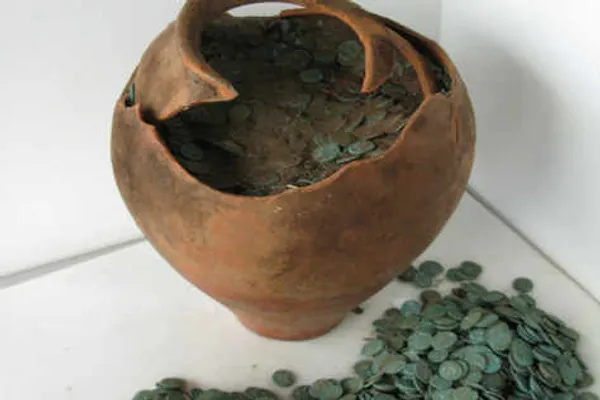
In a wonderful development for the local community. Officials could soon display this amazing haul for the public. There is great interest in making the 10,000 coins a centerpiece at Shrewsbury’s new, state-of-the-art £10 million heritage center. This move would ensure that the area keeps the coins where they were found. Allowing residents and visitors alike to connect directly with the region’s deep Roman past.
Nick Davies’s amazing stroke of luck serves as a powerful reminder of the hidden history. That lies just beneath our feet in the British landscape. For a novice detectorist, it was the ultimate reward. Proving that sometimes, beginner’s luck is truly the best luck of all.
ALSO READ: Los Guachimontones: The Largest Pre-Columbian Site in Jalisco, Mexico