Amarna Princess: The Mysterious Daughter of Nefertiti and Akhenaten
Few periods in Ancient Egyptian history captivate the imagination quite like the Amarna Period. Defined by the radical reforms of Pharaoh Akhenaten and his queen Nefertiti, this short-lived era broke away from millennia of tradition in both religion and art. Among the surviving treasures of this time is the enigmatic head of an Amarna Princess—a delicately sculpted artifact that embodies the elegance, innovation, and mystery of Akhenaten’s daughters.
Now preserved in the Egyptian Museum of Berlin, the piece continues to intrigue scholars and enthusiasts alike. Who was this princess? What role did she play in one of Egypt’s most controversial dynasties? And why does this artifact hold such symbolic power in our understanding of ancient art?
The Amarna Period: A Revolutionary Age
Akhenaten’s Religious and Cultural Upheaval
Akhenaten (originally Amenhotep IV) is remembered as the “heretic king” for his bold departure from traditional Egyptian polytheism. He elevated the Aten, the sun disk, to supreme deity, sidelining the priesthood of Amun.
This religious shift brought sweeping cultural changes:
-
The founding of Akhetaten (modern Amarna) as a new capital.
-
A new artistic style emphasizing naturalism, intimacy, and fluidity.
-
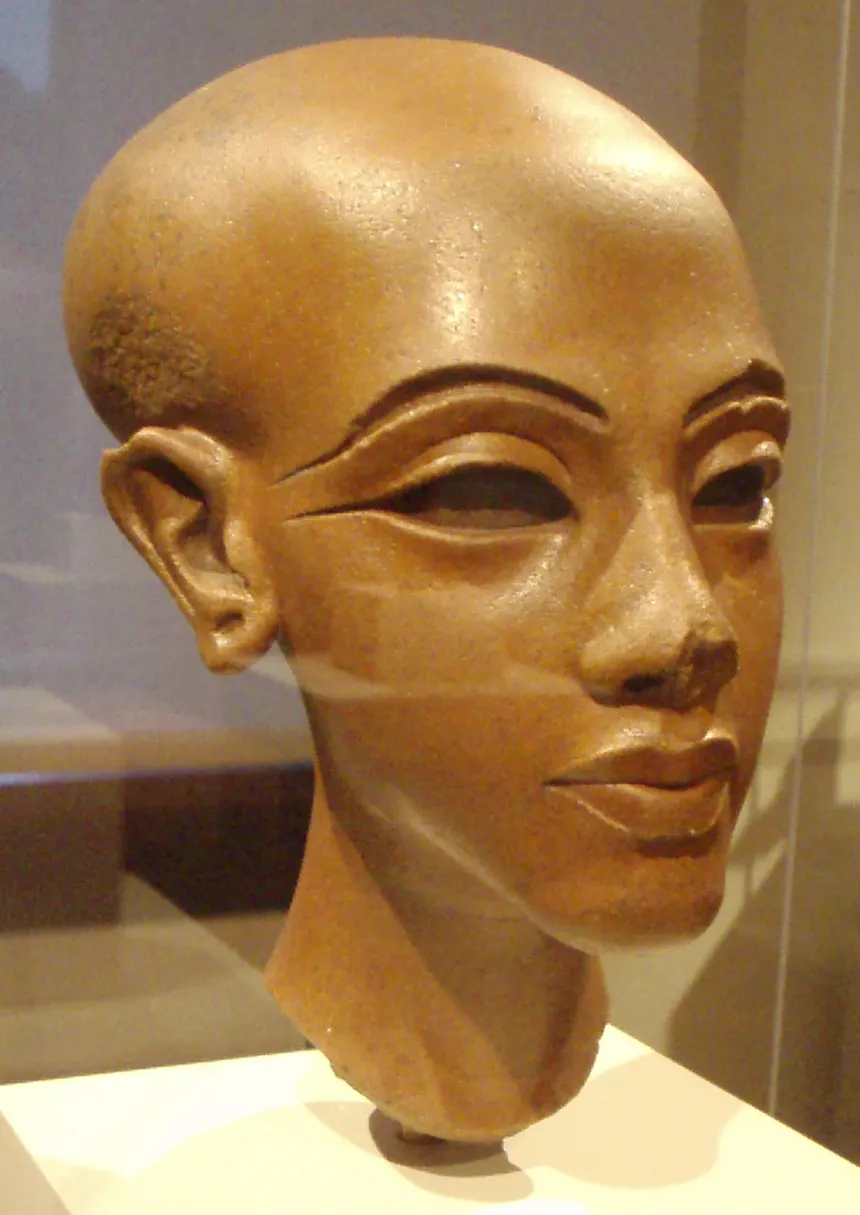
Revolutionary depictions of the royal family, including the queen and daughters, shown with elongated heads, soft features, and realistic expressions.
Nefertiti and the Royal Daughters
Queen Nefertiti played an unusually prominent role, appearing alongside Akhenaten in religious ceremonies. Their six daughters became prominent symbols of fertility and dynastic continuity, often portrayed in reliefs and sculptures. The Amarna Princess head belongs to this fascinating body of royal iconography.
The Sculpted Head of the Amarna Princess
Description of the Artifact
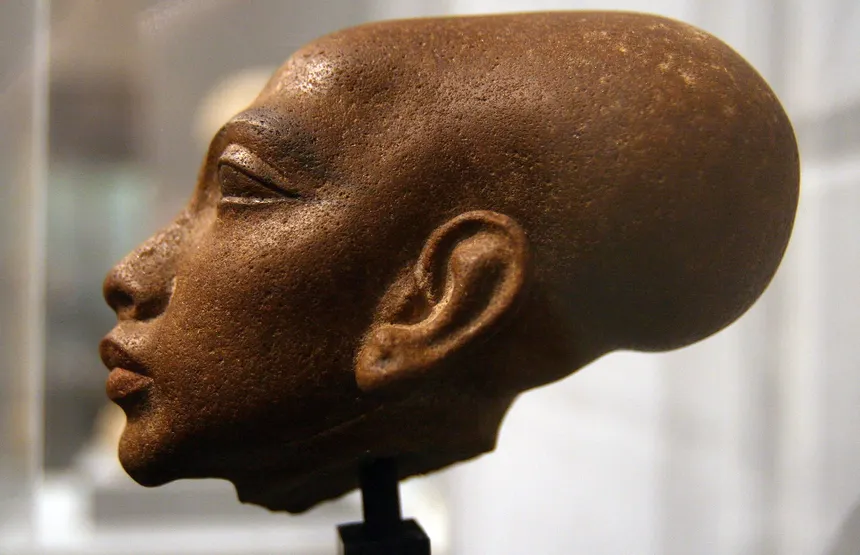
The Amarna Princess head is a finely crafted limestone sculpture, standing only a few inches tall. It depicts the youthful features of a young girl:
-
An elongated skull, a hallmark of Amarna art.
-
Soft cheeks and delicate lips, suggesting tender age.
-
Smooth, unfinished surfaces, possibly intended for later paint or detail.
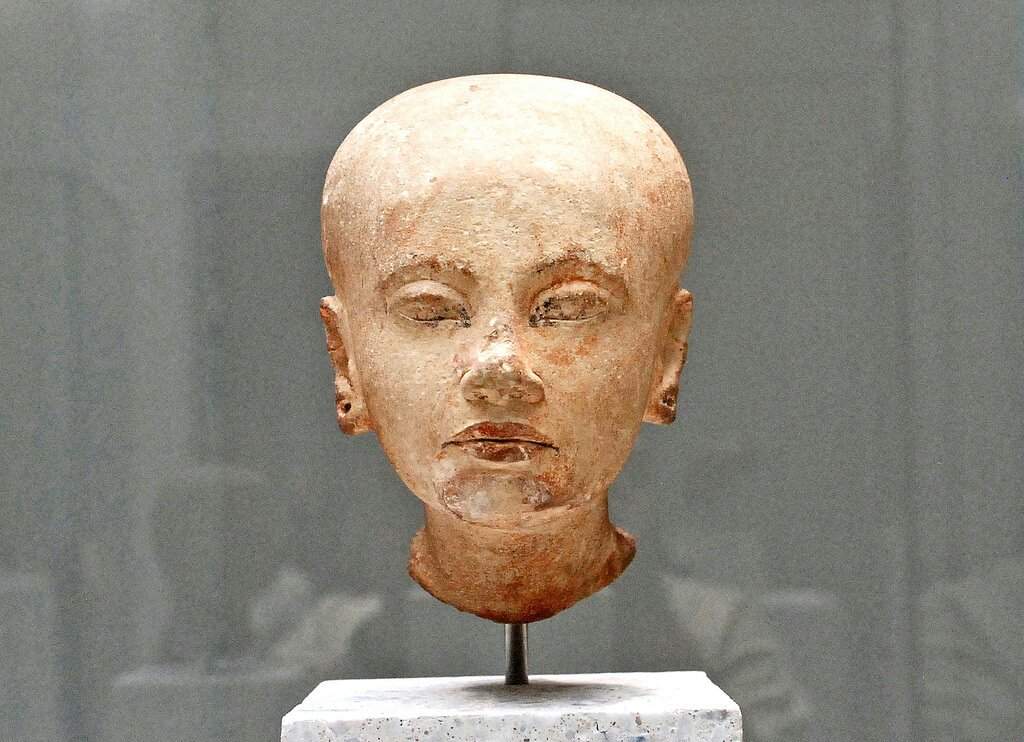
The head was likely part of a larger statue, perhaps representing one of the royal daughters in a temple or palace context.
Discovery in Amarna
The piece was unearthed in Tell el-Amarna, the ruins of Akhenaten’s short-lived capital. Archaeological excavations revealed palaces, temples, and workshops filled with sculptural fragments—evidence of a thriving artistic community under royal patronage.
Housing in Berlin
Today, the sculpture resides in the Egyptian Museum of Berlin, alongside the world-famous bust of Nefertiti. Together, they highlight the extraordinary craftsmanship and radical departure of Amarna art from earlier Egyptian traditions.
Symbolism of the Amarna Princess
Elongated Skulls and Artistic Innovation
The elongated skull of the princess has long puzzled scholars. While some argue it reflects an actual medical condition, most view it as artistic stylization, emphasizing the divine uniqueness of Akhenaten’s lineage. The exaggerated form may have symbolized spiritual enlightenment, closeness to the Aten, or a distinct royal identity.
Representation of Dynastic Continuity
The daughters of Akhenaten and Nefertiti were frequently depicted in intimate family scenes, reinforcing the dynasty’s divine legitimacy. The princess head may have symbolized:
-
Fertility and renewal, central to Aten worship.
-
Royal succession, ensuring the dynasty’s continuity.
-
The feminine principle, celebrated alongside Nefertiti’s prominent role.
A Window into Amarna Life
Unlike traditional Egyptian art, which often idealized figures, Amarna art captured moments of tenderness and realism—children at play, the royal family under the rays of Aten. The princess head embodies this shift toward naturalism, giving us a rare glimpse into the humanity of Egypt’s royals.
Identifying the Princess: Which Daughter Was She?
Akhenaten and Nefertiti had six known daughters:
-
Meritaten
-
Meketaten
-
Ankhesenpaaten (later Ankhesenamun, wife of Tutankhamun)
-
Neferneferuaten Tasherit
-
Neferneferure
-
Setepenre
Unfortunately, the Amarna Princess head cannot be definitively linked to any single daughter. Without inscriptions or distinctive features, scholars can only speculate. Some suggest it may represent Meritaten, the eldest daughter who later played a political role, while others argue for Ankhesenpaaten, who became queen beside Tutankhamun.
The Artistic Spirit of the Amarna Workshop
The Hands of the Sculptors
Amarna art flourished under the direction of master sculptors like Thutmose, whose workshop produced both royal portraits and devotional images. The unfinished surfaces of the princess head suggest it may have been a model piece, used by apprentices or left incomplete when the city was abandoned.
Departure from Tradition
Traditional Egyptian art followed rigid canons of proportion and symmetry. By contrast, the Amarna style:
-
Emphasized elongated forms and fluid lines.
-
Showed intimate family life, breaking with formal royal depictions.
-
Captured individuality rather than idealized uniformity.
The princess head reflects this radical experimentation, bridging art and ideology.
Decline of Amarna and Survival of the Princess Head
The Fall of Akhetaten
After Akhenaten’s death, his successors—including Tutankhamun—abandoned Amarna, restoring traditional religion and art. The city fell into ruin, and much of its art was destroyed or repurposed.
Survival of the Sculpture
That the princess head survived at all is remarkable. Its preservation allows modern audiences to witness the beauty and fragility of a vanished world, frozen in stone.
The Amarna Princess in Modern Scholarship
Interpretive Debates
Scholars continue to debate the meaning of Amarna art:
-
Was the elongated style purely symbolic?
-
Did it reflect real physical traits of the royal family?
-
How should we understand the prominence of women and children in this imagery?
The Amarna Princess head stands at the center of these discussions, offering tantalizing evidence but no definitive answers.
A Public Icon
Displayed beside Nefertiti’s bust, the Amarna Princess captivates museum visitors worldwide. For many, she represents the mystery and allure of Ancient Egypt, a lost world both intimate and alien.
Legacy of the Amarna Princess
The Amarna Princess remains more than just a fragment of stone; she is a symbol of innovation, identity, and the power of art. Her youthful face speaks across millennia, reminding us of a dynasty that dared to defy convention and a royal family that made themselves the focal point of religion, politics, and culture.
Though her name is lost to history, her image survives as testimony to the creativity of the Amarna artists and the bold vision of Akhenaten and Nefertiti.
Conclusion
The Amarna Princess is one of the most intriguing artifacts of the Amarna Period. Sculpted with elongated elegance and delicate youth, she embodies the revolutionary artistry of Akhenaten’s reign and the intimate role of the royal daughters in this extraordinary dynasty.
Discovered in the ruins of Amarna and now preserved in Berlin, the princess head bridges past and present, offering us a rare glimpse into an age of transformation. Her mystery endures, inviting us to imagine the lost stories of Egypt’s most enigmatic family.
ALSO READ: Ancient Cylinder Seals: The First Signatures of Civilization