The Nymphaeum of Sagalassos – The Eternal Fountain of Roman Grace in the Mountains of Turkey
The Mountain Jewel of Pisidia
High in the Taurus Mountains of southwestern Turkey lies the ancient city of Sagalassos, once one of the most prosperous settlements of Pisidia during the Roman Imperial period. Among its many grand structures, the Nymphaeum of Sagalassos stands as one of the most visually stunning and enduring symbols of Roman luxury and ingenuity. Built during the 2nd century AD under Emperor Hadrian or Antoninus Pius, the fountain was more than an architectural marvel—it was an expression of imperial power, divine beauty, and human artistry.
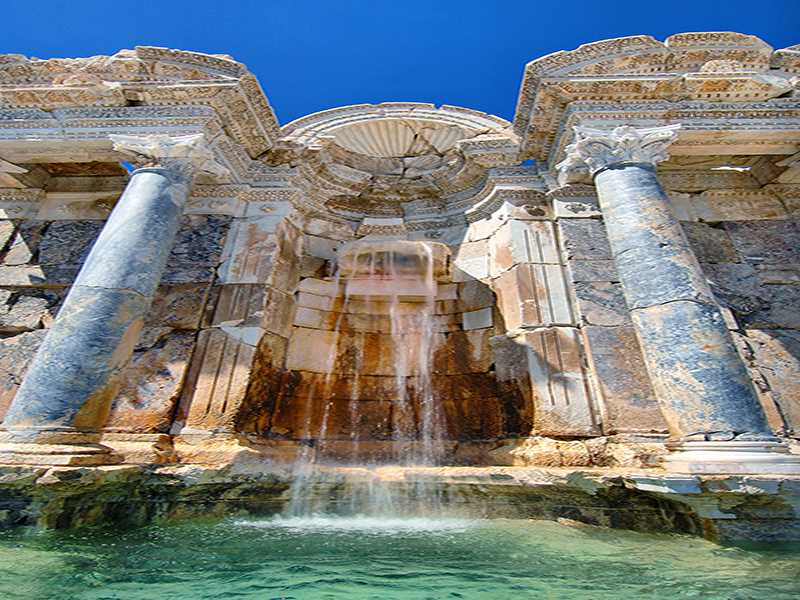
Visitors approaching the site today are greeted by a breathtaking sight: a monumental fountain framed by Corinthian columns, sculpted friezes, and flowing water cascading across centuries-old marble. It is a place where time, nature, and artistry merge into a living memory of the ancient world.
The Historical Context: Sagalassos in the Roman Empire
Sagalassos became part of the Roman Empire in 25 BCE after the annexation of the Kingdom of Galatia. Its strategic mountain location made it both defensible and resource-rich. By the 2nd century AD, Sagalassos had evolved into a thriving urban center boasting temples, baths, theaters, and monumental fountains. The Nymphaeum reflected not only the city’s prosperity but also the empire’s focus on urban beauty and public amenities.
In Roman culture, nymphaea were more than decorative fountains. They embodied the convergence of natural springs and divine reverence, often dedicated to the nymphs—spirits of nature and water. These monuments symbolized abundance, life, and harmony between civilization and the natural world.
Architectural Splendor: A Dance of Stone and Water
The Nymphaeum of Sagalassos is a masterpiece of Roman architectural engineering. The structure features a grand semicircular façade lined with columns and niches once filled with statues of gods, emperors, and mythological figures. Behind the ornate façade lies a complex hydraulic system that channeled water from nearby springs into a large basin, where it continuously flowed in rhythmic cascades.
Key architectural elements include:
-
Corinthian Columns – Tall, slender columns topped with acanthus leaf capitals that emphasize vertical elegance.
-
Reliefs and Friezes – Intricate carvings depicting mythological motifs, marine creatures, and decorative patterns.
-
Marble Basins – Large basins used to collect and distribute water, demonstrating Roman hydraulic mastery.
-
Symmetry and Proportion – The design reflects the Roman aesthetic ideal of harmony, balancing visual grandeur with functional precision.
As mineral-rich water streamed over the fountain’s surfaces for centuries, it left rust-red and ochre deposits that now color the stone—a natural patina painting history into its very fabric.
Engineering Brilliance: The Roman Water System
Behind the Nymphaeum’s beauty lies an ingenious system of aqueducts, channels, and gravity-based design typical of Roman engineering. Water was supplied from mountain springs via terracotta pipes and lead conduits that maintained steady flow rates regardless of elevation. The fountain not only provided water for daily use but also served as a symbol of civic pride and technological power.
This seamless integration of utility and ornamentation highlights a defining feature of Roman urban planning—creating spaces that were as functional as they were inspirational. The constant murmur of flowing water would have filled the forum, creating a tranquil ambiance that soothed both citizens and travelers.
Cultural and Religious Meaning
The Nymphaeum was not merely a public utility—it was a sacred space. In Roman society, water had deep spiritual significance, and fountains often honored nymphs and deities associated with sources of life. Locals may have offered flowers or coins to the nymphs, believing the continuously flowing water connected them to the earth’s divine essence.
The fountain also represented imperial favor. By commissioning such lavish projects, Roman emperors reinforced their power and benevolence. The Nymphaeum of Sagalassos served as a constant reminder of Rome’s ability to transform even the most remote mountain settlements into radiant reflections of the capital’s grandeur.
Rediscovery and Archaeological Excavation
For centuries, the ruins of Sagalassos lay silent beneath soil and vegetation until rediscovered in the late 19th century. Serious excavation efforts, however, began in the 1980s under the direction of archaeologist Marc Waelkens and the Sagalassos Archaeological Research Project (SARP). Their work unveiled the city’s exceptional preservation, from its baths and theater to the majestic Nymphaeum.
Meticulous restoration allowed archaeologists to reconstruct the fountain’s façade to near-original form, using original stones recovered from the site. Today, visitors can witness the Nymphaeum once again flowing with water—a revival of its ancient purpose and a triumph of modern archaeological restoration.
The Nymphaeum’s Role in Urban Life
In Roman cities like Sagalassos, monumental fountains were central to social life. Citizens gathered at these sites to collect water, converse, and admire the artwork. The Nymphaeum likely served as both a practical water source and a ceremonial landmark. Located near the upper city’s civic center, it connected the sacred and public spheres, where religion, politics, and leisure converged.
The sound of water, mixed with the mountain breeze, would have lent the Nymphaeum a distinctly serene presence—an oasis of calm amidst a bustling provincial town. It was a space where architecture, nature, and community forged harmony.
The Aesthetic of Time: Nature’s Touch on Stone
What makes the Nymphaeum today so visually compelling is not just its Roman craftsmanship but the transformation wrought by time. Spring waters laced with iron and minerals have, over millennia, etched vivid hues across the marble surfaces, turning white stone to copper, ochre, and gold. Moss and vegetation gently creep through crevices, blurring the boundary between the man-made and the organic.
This fusion of decay and persistence tells its own story—a reminder that nature always collaborates with civilization, sometimes as its destroyer, sometimes as its artist.
Visiting Sagalassos Today
Modern visitors to Sagalassos can explore the site as part of Burdur Province’s rich archaeological landscape. The site lies near the village of Ağlasun, around 7 kilometers away. The Nymphaeum has been carefully conserved and reconstructed, allowing visitors to experience it as both an ancient wonder and a living piece of heritage.
At sunrise and sunset, the golden light bathes its columns, making the water shimmer like liquid glass. An experience that captures the essence of time passing yet eternally present.
Conclusion: Harmony of Civilization and Nature
The Nymphaeum of Sagalassos stands as one of the most eloquent remnants of Roman ingenuity. More than a fountain, it embodies a philosophy. The reverence for beauty, the mastery of engineering, and the desire to unite life’s practical needs with a yearning for divine connection.
Even after two millennia, the cascading waters and silent stones continue to speak to our shared human pursuit of symmetry, grace, and continuity in a fragile world. The Nymphaeum reminds us that beauty endures not despite time, but because of it.
ALSO READ: The Hunting House at Castle of Cignolo Po: History, Architecture & Cultural Significance in Lombardy