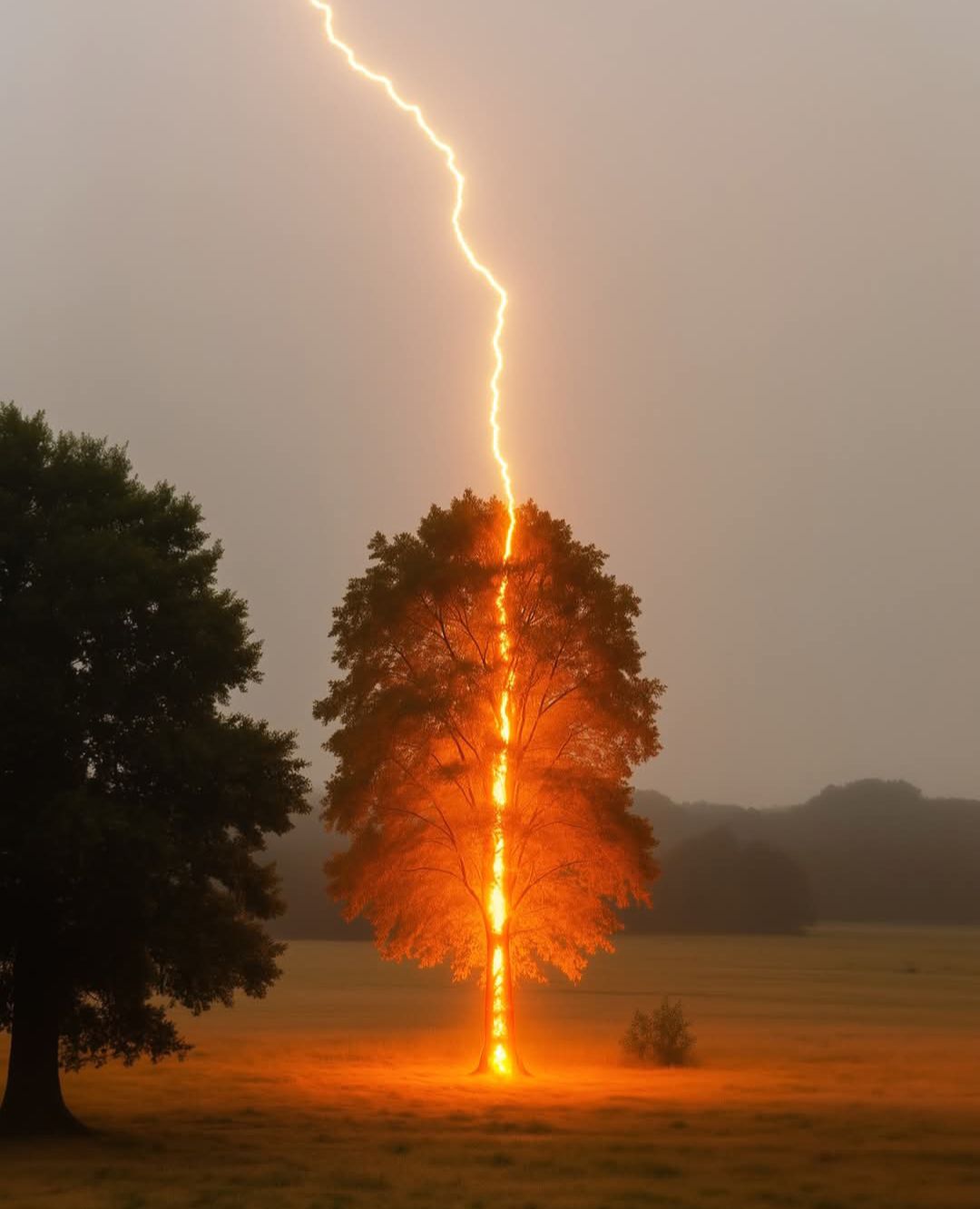
Lightning Photograph in West Virginia: Danny Danya’s Once-in-a-Lifetime Shot
In the green, rain-soaked hills of West Virginia, one woman captured something that blurred the line between chance and destiny. Danny Danya, an amateur photographer known locally for her landscape shots, happened to aim her phone during a passing thunderstorm. In that single heartbeat, lightning struck — not merely across the sky, but directly into a lone tree standing at the ridge of her field. The image that resulted wasn’t just a photograph. It was an encounter with the untamable.
The Perfect Millisecond
Lightning never waits. It flashes in less than half a second, releasing millions of volts through the atmosphere before vanishing into darkness again. The probability of capturing one by luck, without specialized equipment, is nearly impossible. Yet Danny’s photograph froze that fraction of eternity — an incandescent bolt splitting a tree while electric filaments spread through the air like shattered glass.
Her photo quickly spread through local communities in the Appalachian region. Within hours, it reached social media platforms where weather enthusiasts and photographers shared it as “the shot of the year.” Many called it more than luck — a convergence of instinct, timing, and courage.
The Landscape: Storm Country of Appalachia
West Virginia’s terrain is known for sudden changes in weather. With its rugged hills and dense forests, the state often experiences violent thunderstorms from late spring through mid-summer. Warm, humid air rising from the valleys mixes with cooler mountain currents to create highly charged storm conditions.
For photographers, it’s both a risk and a reward. The contrast between storm clouds and forested slopes creates hauntingly beautiful frames, but lightning remains an unpredictable danger. That volatility is part of what makes Danny’s shot so captivating — it transforms local landscape photography into something mythic.
The Science Behind the Flash
Understanding what Danny captured adds depth to the image’s impact. When lightning forms, a negatively charged region in a thundercloud reaches toward positively charged ground objects — trees, rock outcrops, or even people. The process generates what scientists call a “stepped leader,” a branching path of plasma searching for a connection.
When that connection completes, a massive electrical current surges instantly, creating a temperature hotter than the surface of the sun (up to 30,000 kelvin). The result is a bolt of pure, luminous energy — the exact moment Danny immortalized through her lens.
Photographs of direct ground strikes are extremely rare because they usually occur too fast for conventional shutter mechanisms to detect. High-speed cameras in meteorological research capture them using sensors trained on storm cells, not smartphones. This makes her still image of a full strike even more extraordinary.
The Human Element: Chance Meets Preparation
Some might call it a miracle; others might say it’s the eye of a photographer who’s spent years watching patterns in light and sky. Danny later explained that she’d taken dozens of storm pictures before but never caught anything beyond cloud illumination. During this storm, she decided to film a live segment but instinctively tapped her phone’s photo button instead of video. That impulsive movement, measured in milliseconds, preserved what no human eye could fully see.
This element of intuition — the idea of being present, patient, and aware of one’s surroundings — separates good photographers from lucky observers. Nature offers beauty constantly, but only those waiting for it can translate chaos into timeless composition.
The Emotional Power of Lightning Imagery
Lightning has fascinated humanity for thousands of years. Ancient cultures interpreted it as the weapon of gods: Zeus hurling fire from Olympus, or Indra wielding a thunderbolt over the Indian monsoon skies. Even in the modern scientific era, lightning retains a symbolic duality — creation and destruction, illumination and annihilation.
Danny’s photo evokes that same tension. The bolt that strikes the tree ignites part of its trunk, while surrounding rain quenches the flames — life and ruin in the same frame. Viewers feel both awe and fragility, reminded that Earth’s immense forces operate beyond human control.
Social Media Impact and Global Reach
After uploading her lightning photograph, Danny’s post quickly went viral. Within 24 hours, local media stations reached out to verify the authenticity of the shot. Meteorologists confirmed that simultaneous lightning strikes had been detected in her area based on radar data and ground sensors, validating her timing.
Online, the image spread to weather forums, photography groups, and nature pages, where it accumulated thousands of shares and comments. National Geographic’s digital editors even referenced it during a feature on accidental lightning photography — an acknowledgment that boosted West Virginia’s visibility as a site of raw, cinematic nature.
Technical Analysis: How the Photo Survived the Flash
Ordinarily, such a close strike would saturate a camera sensor, leaving only a white silhouette. Danny’s survival of both the strike and the image can be credited to environmental factors. The distance to the tree was roughly 90 meters, enough for voltage dissipation to prevent damage. The rain, acting as a natural conductor, distributed static energy around her rather than through her phone.
Her photographic settings were automatic — ISO moderate, exposure fractional — yet they harmonized perfectly with the lightning’s brightness. This improbable alignment preserved the shape of the bolt in stunning linear detail. Photographic analysts later noted faint secondary branches near the strike’s center, resembling what’s known in meteorology as a “return stroke,” where residual charges follow the first path back into the sky.
From Photo to Legacy: Art in the Age of the Instant
In a world saturated with digital images, true rarity still holds value. Danny Danya’s photograph became more than a viral post; it turned into a visual poem about timing and impermanence. Local art galleries in Charleston and Morgantown requested to exhibit prints of the image, emphasizing natural spectacle and Appalachian identity.
Environmental educators began using it to discuss lightning safety, while artists celebrated it for representing the fragile overlap between chance and art. The photo became an artifact — proof that one human reaction, paired with elemental violence, can crystallize an entire storm in visual memory.
Lessons from a Lightning Bolt
Danny’s experience offers several lessons for aspiring photographers and nature enthusiasts:
-
Always be ready. Natural events don’t wait for preparation; spontaneous awareness makes the difference.
-
Respect danger. Nature’s beauty comes with unpredictability — distance and safety should always come first.
-
Watch the light. Understanding atmospheric patterns and timing often leads to stronger compositions.
-
Value authenticity. Moments like these remind us that art isn’t just about control — it’s about responding to chaos.
Her photo now serves as both an artistic triumph and a quiet reminder: sometimes greatness arrives between frames, in the imperceptible interval where instinct meets nature.
Where Nature Meets Eternity
As storms continue rolling across West Virginia’s hill country, the story of Danny Danya and her lightning photograph lingers — a local legend in digital form. It represents that elusive moment when technology, humanity, and the earth itself intersect for a brief heartbeat.
Lightning is fleeting. Photographs, however, endure — carrying the echoes of each storm into the calm between the rains.
ALSO READ: The Terracotta Army of Qin Shi Huang: Ancient Innovation Beneath the Earth