The Crook and Flail of Tutankhamun: Unraveling the Symbols of Ancient Egyptian Kingship
Treasures from the Valley of the Kings
Among the dazzling artifacts unearthed in the untouched tomb of Tutankhamun, few stand as evocative as the golden crook and flail. Resting upon the mummified pharaoh within his gilded sarcophagus, these objects are not mere regalia—they are icons that encapsulate the heart of ancient Egyptian kingship, spirituality, and royal ideology. Discovered by Howard Carter in 1922, the crook and flail immediately drew attention for their exquisite craftsmanship and their profound symbolic significance.
The Origins and Evolution of the Crook and Flail
The crook (heka) and flail (nekhakha) date back even further than Tutankhamun’s 18th Dynasty reign, appearing in Egypt’s earliest dynasties. Originally, the crook was modeled after a shepherd’s staff, looping at the top and serving as a practical tool for herders over three millennia ago. The flail, in contrast, may have derived from threshing instruments or fly-whisks associated with agriculture.
Their evolution from practical tools to sacred emblems mirrors Egypt’s transformation from an agrarian society to a centralized theocratic kingdom. By Tutankhamun’s time, the pairing of crook and flail had become inseparable from royal iconography, often depicted across temple reliefs, statues, and funerary material.
Craftsmanship: Artistry Embodied in Gold and Glass
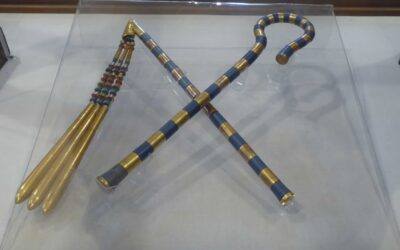
The crook and flail of Tutankhamun’s burial set are masterpieces of Late Bronze Age artistry. Measuring approximately 92 centimeters each, they were crafted from wood overlaid with gold sheet—a symbol of eternal flesh in Egyptian belief—and meticulously inlaid with bands of dazzling blue faience and colored glass.
Richly adorned, every detail communicates the wealth, piety, and technological skill of New Kingdom artisans. The alternating stripes of lapis-like blue and gleaming gold recall the uppermost echelons of luxury goods available in ancient Egypt, drawing connections to the divine world. The choice of faience also had spiritual connotations: its shimmering blue-green hue symbolized the renewal of life and the regenerative powers of the Nile.
Symbolism: The Power and Protection of Pharaoh
More than decorative insignia, the crook and flail carried deep symbolic weight. Held crossed over the chest of the mummified pharaoh, they fused two core functions of Egyptian monarchy:
-
The Crook (Heka): Protector and Leader
The crook’s curved form is a direct reference to the shepherd’s staff, embedding the idea that the king’s primary duty was to care for and protect his flock—the Egyptian people. This was a metaphor echoed in royal propaganda and religious texts, from the Old Kingdom pyramid texts to later hymns praising the pharaoh as both a shepherd and a god. -
The Flail (Nekhakha): Provider and Disciplinarian
The flail, often seen as a bundle of threshing rods, represents the authority to distribute grain—a source of life and economic stability in the Nile Valley. At the same time, it suggests the power to discipline and enforce order when necessary, reinforcing the king’s multifaceted role.
Together, these objects establish the pharaoh as the vital intermediary between gods and humans, tasked with provisioning his people, enforcing Ma’at (cosmic order), and guaranteeing prosperity through proper ritual.
Religious Significance: Bridging the Mortal and Divine
Egyptian rulers were not merely mortal kings but living gods on earth, specifically the incarnation of Horus. In funerary contexts, the crook and flail helped enact the king’s transformation from earthly monarch to Osiris—the lord of the afterlife. This connection is reinforced by temple reliefs where Osiris himself wields these symbols, defining him as the archetype of divine kingship.
Placing these emblems upon Tutankhamun at burial thus invoked his safe passage and rebirth into the afterlife, assuring his continued ability to care for Egypt from beyond the grave. For Egyptians of all classes, these images reaffirmed the endless cycle of death and renewal at the heart of their worldview.
Preservation: Testaments to Ancient Egyptian Craft and Belief
That Tutankhamun’s crook and flail survived more than three millennia is testament both to Egypt’s funerary technologies and to the profound reverence paid to royal burials. Their preservation rests on a blend of environmental serendipity—the arid Valley of the Kings—and the exceptional burial processes devised for Egypt’s divine kings.
The objects’ meticulous manufacture also played a part in their longevity. Gold’s resistance to corrosion ensured that, once sealed off from air and moisture, the crook and flail could remain as luminous and striking as they did on the day of interment.
Crook and Flail in Egyptian Art and Legacy
The visual language established by the crook and flail endures throughout Egyptian art. Statues, wall paintings, and reliefs consistently show pharaohs—both in life and after death—armed with these regalia, cementing their role as universal markers of true kingship.
Even centuries after Tutankhamun’s reign, later empires and foreign rulers appropriated the imagery, hoping to legitimize their own authority through Egyptian tradition. The motifs have persisted in modern Egyptological iconography, instantly recognizable worldwide as symbols of ancient Egypt itself.
The Crook and Flail Today: Meaning Beyond the Artifact
What makes these objects continually resonate is not only their aesthetic beauty, but their narrative power. To look upon the crook and flail is to glimpse an entire civilization’s faith in the written word, ceremony, and cosmic cycles—a civilization that believed its leaders could conquer death and guide the living and the dead alike.
Their story also speaks to the way material culture serves as a vessel for values, hopes, and identity. In museums or classrooms, images of Tutankhamun’s regalia provoke wonder and inspire questions that reach across time.

Conclusion: Eternal Symbols of Rule and Reverence
The crook and flail of Tutankhamun hold a unique place in history as both artifacts and as emblems—a king’s responsibilities cast in gold and glass, alive with meaning centuries after their creation. Preserved against the odds, they embody the dazzling craftsmanship, spiritual depth, and timeless legacy of ancient Egypt’s New Kingdom.
For students, historians, and armchair archaeologists alike, Tutankhamun’s crook and flail offer more than a glimpse of royal splendor; they grant access to the beliefs and values that shaped one of the world’s most enduring civilizations.
ALSO READ: The Heroon of Sagalassos: Eternal Monument of Roman Pisidia