2,100 Years Ago: The Forgotten Battle That Ended in a Terrible Massacre
Unearthing a Lost Chapter of Ancient Warfare
Around 2,100 years ago, a violent clash erupted somewhere in the heart of the ancient world. Thousands of warriors met on the battlefield, and by nightfall, what began as a campaign of power and conquest had turned into a bloody massacre. For centuries, the story of this catastrophic event lay buried beneath soil and silence—until modern archaeology began to uncover its grim remains.
Recent excavations across Europe and the Mediterranean have revealed chilling evidence of large-scale massacres dating between 150 and 50 BCE. These findings, combined with ancient texts, shed new light on the brutal realities of warfare during the late Iron Age and the expansion of the Roman Republic.
The Historical Context: Turmoil Across Continents
By 100 BCE, the world was in flux. The Mediterranean was dominated by Rome, whose political reach extended deep into Gaul, Hispania, and parts of the Near East. Beyond Rome’s borders lived powerful tribal confederations—the Cimbri, the Helvetii, and the Celtiberians—all struggling to maintain control of their homelands. Skirmishes between Roman legions and local forces often ended with overwhelming slaughter, as disciplined formations met tribal armies relying on courage and chaos.
The massacre uncovered near the modern-day site of Alken Enge in Denmark, for example, demonstrates that brutality was not confined to Rome’s campaigns. Across Northern Europe, Iron Age societies clashed in fierce conflicts for control of territory and resources, leaving behind fields of bones—the silent witnesses of annihilated armies.
The Archaeological Discovery: Bones Beneath the Marshes
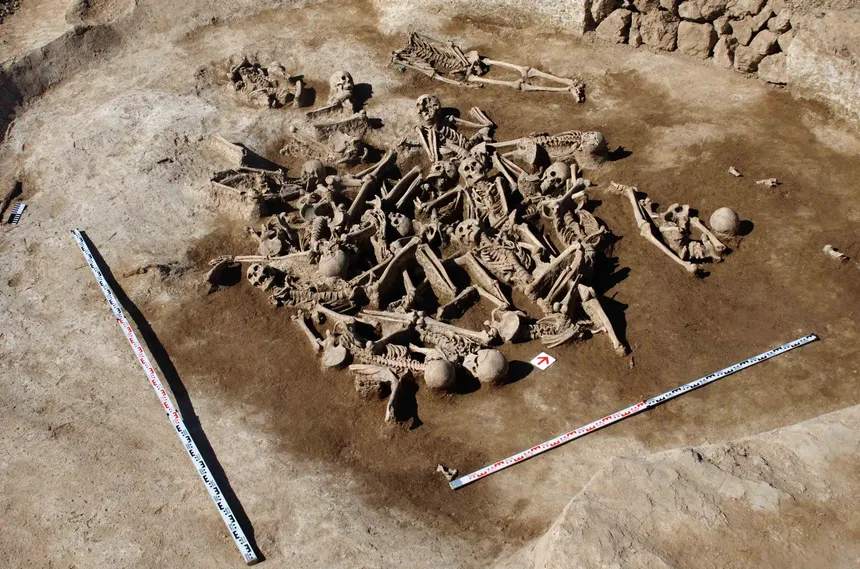
In recent decades, archaeologists working in wetlands, battlefields, and burial pits have unearthed extensive remains dating back roughly two millennia. One of the most striking examples is the site of Alken Enge, where over 2,000 human bones were found in a lakebed, representing hundreds of young men. Radiocarbon dating placed the event around the 1st century BCE—almost exactly 2,100 years ago.
Unlike formal burials, these bones were scattered, broken, and left exposed for months before being deliberately cast into the lake. Many showed signs of battle injuries—sword cuts, spear thrusts, and shattered skulls—indicating a violent end. The absence of offerings or grave goods suggests this was no ritual sacrifice but the aftermath of a devastating massacre.
Evidence of a Massacre: Violence Etched in Bone
Anthropological studies of the remains revealed extreme violence. Blows to the head and vertebrae showed efficient killing techniques consistent with battlefield executions. Some bones had cut marks suggesting decapitation, while others bore evidence of dragging or dismemberment—possibly as part of post-battle displays meant to intimidate rival tribes.
Weapons found nearby—iron swords, spearheads, and shields—hint at organized combat. Yet the chaotic scatter of bones suggests that after the defeat, survivors were hunted down rather than captured, turning the conflict into a deliberate extermination.
Such findings are not isolated. Sites in Spain and France record similar patterns of slaughter from the same period. Together, they paint a picture of a violent era when alliances crumbled, power shifted constantly, and victory was often measured in annihilation rather than territory gained.
The Broader Picture: Rome’s Wars and Tribal Catastrophes
The timing of the Alken Enge massacre coincides with the last centuries of the Roman Republic—a time of global transformation. As Rome expanded northward, neighboring societies faced immense pressure. Some battles ended in catastrophic losses, such as the defeat of the Cimbri and Teutones around 101 BCE. Others were local civil wars, with tribes fighting each other over resources or prestige.
Historians debate whether Alken Enge and similar sites reflect battles between tribes or early encounters with Roman forces. Regardless, these massacres represent societies caught in rapid social change. Warfare had become more organized, and weapons more lethal. Tribal rulers commanded armies that mirrored Rome’s structure, but without its discipline, they often suffered overwhelming defeats.
Insights from the Soil: How Archaeology Recreates the Tragedy
Modern battlefield archaeology combines advanced technology with careful excavation. Ground‑penetrating radar, LIDAR scanning, and 3D modeling allow archaeologists to reconstruct landscapes as they appeared 2,100 years ago. At Alken Enge, these tools revealed that the battlefield lay on a floodplain surrounded by marshes—an ideal place for an ambush or a failed retreat.
Micro‑analysis of soil samples uncovered traces of organic residues—blood, decayed fibers from clothing, and metal corrosion from weapons. This evidence helps clarify not only how the battle unfolded but also what happened afterward. The deliberate deposition of human remains into the lake suggests ritualized closure, perhaps symbolizing purification after a catastrophe.
Cultural and Psychological Impact: The Memory of Massacre
Although oral traditions are lost, the aftermath of such events must have left a deep mark on local memory. Whole generations could vanish in a single clash. Families lost their sons, social hierarchies collapsed, and surviving tribes may have turned to new religious or political structures in response to trauma.
Massacres of this magnitude shaped early European societies, influencing how later myths and legends conceived of war and sacrifice. Many Iron Age peoples viewed battle death as both tragedy and transcendence—warriors slain in combat would join the divine realm. However, archaeology shows a starker truth: most fell not as heroes but as victims of overwhelming violence.
Lessons from the Past: Understanding the Value of Peace
Examining such massacres does more than recount ancient brutality; it highlights the fragility of peace in any era. The archaeological traces of the 2,100‑year‑old massacre remind us that every lost life was part of a community and a culture. These findings humanize an age often reduced to myths of conquest and empire.
Today, the battlefields that once flowed with blood are quiet meadows and lakes. Yet beneath their calm surfaces lie reminders of the price of ambition and the enduring need for remembrance. Each excavation not only recovers evidence of warfare but also restores identities to those long forgotten.
Conclusion: The Legacy of a 2,100‑Year‑Old Tragedy
Two millennia after the massacre, archaeologists and historians continue to piece together what happened that terrible day. From fractured bones and rusted blades emerge stories of courage, fear, and human suffering. Whether fought between rival tribes or during Rome’s rise to power, this ancient clash was more than a battle—it was a turning point that reshaped regional history.
The findings serve as a timeless reminder: even in a world obsessed with progress, understanding the past’s darkest chapters is essential for appreciating the value of peace, memory, and humanity itself.
ALSO READ: The Paracas Elongated Skulls: Ancient Peruvian Cranial Deformation