The Minaret of Jam: A Tower of History in the Heart of Afghanistan
Lonely Wonder in Ghor Province
Rising from the remote Shahrak District of Ghor Province, the Minaret of Jam stands as one of the most extraordinary relics of medieval Islamic architecture. Built around 1190 during the reign of the Ghurid dynasty, this slender, fluted tower climbs approximately 65 meters into the Afghan sky, its baked-brick form appearing almost otherworldly amid the rugged mountains and winding Hari River.
Although centuries of isolation have kept it hidden from the modern world, the Minaret of Jam endures as a symbol of Afghanistan’s rich artistic and architectural heritage, and as a reminder of a once-mighty empire that rivaled its contemporaries from Delhi to Baghdad.
The Ghurid Dynasty: A Forgotten Empire of Builders
The story of the Minaret of Jam begins with the Ghurid dynasty, an Islamic empire that flourished in the 12th and early 13th centuries. Originating from the mountainous region of Ghor in central Afghanistan, the Ghurids rose to prominence under the leadership of Sultan Ghiyath al-Din Muhammad and his brother Muizz al-Din Muhammad, also known as Muhammad of Ghor—the conqueror who laid the foundation for Muslim rule in northern India.
The Minaret likely commemorates this golden era—a period marked by military prowess, cultural exchange, and architectural advancement. Some historians suggest it was built to celebrate a major victory over the Ghaznavids or as part of a mosque that once stood nearby, now lost to time. Others see it as a monument marking the Ghurid capital of Firuzkoh, a city long vanished from maps but thought to have been located near the minaret’s site.
Architectural Brilliance in Baked Brick
The Minaret of Jam captivates not only because of its scale but also because of the intricacy of its design. Constructed entirely from baked bricks set in lime mortar, its cylindrical body narrows gracefully as it ascends. The surface is richly decorated with geometric brickwork, Kufic and Naskhi calligraphy, and glazed turquoise tiles—a masterful combination that speaks of both engineering skill and artistic devotion.
Kufic inscriptions near the base include verses from the Qur’an, while the higher bands display floral motifs and arabesques typical of Islamic art from Central Asia. The visual rhythm of the tower—fluted sections alternating with calligraphic bands—draws the eye upward, creating an impression of movement and transcendence.
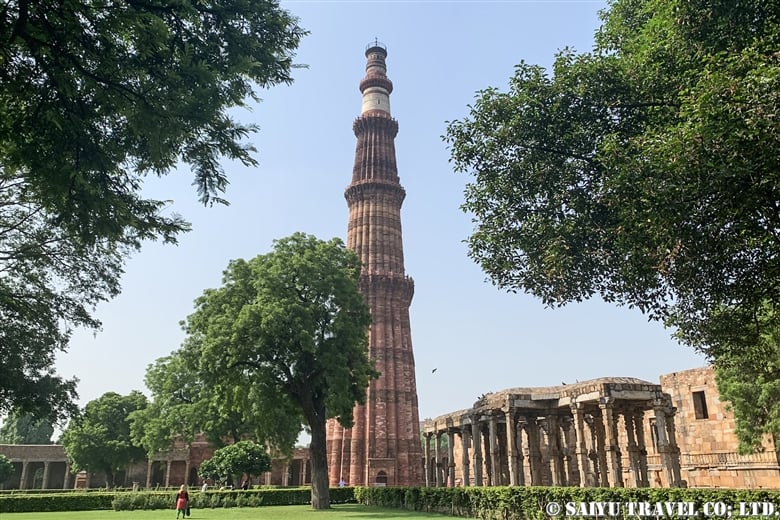
This fusion of structural elegance and symbolic ornamentation makes the Minaret of Jam one of the finest surviving examples of Islamic architecture of the late 12th century. Its style influenced later constructions across the Islamic world, including the Qutub Minar in Delhi, built only a few decades later by the successors of the Ghurids.

A Monument to Faith and Resilience
Standing alone in a narrow valley at the junction of the Hari and Jam rivers, the minaret almost seems out of place—an architectural marvel untouched by urban surroundings. Yet this isolation is what preserved it through centuries of invasions, earthquakes, and neglect.
Its towering form embodies both faith and fragility. The calligraphic verses from the Qur’an inscribed on its surface reflect the Ghurid devotion to Islam and the cultural revival that swept through the region during their rule. At the same time, the cracks and erosion that mar its bricks today tell a quieter story of endurance—of survival in a landscape often shaped by political upheaval and natural calamities.
Rediscovery in the Twentieth Century
Though local inhabitants had long known of the tower’s existence, the Minaret of Jam remained unknown to the wider world until 1957, when archaeologist André Maricq brought it to the attention of the global academic community. News of the discovery quickly spread among historians, who recognized its extraordinary significance as a relic of the lost city of Firuzkoh, the Ghurid capital once celebrated for its wealth and learning.
Excavations near the site revealed traces of ancient pottery, glazed tiles, and fragments of buildings—evidence of a once thriving urban settlement. Over time, however, natural disasters and invasions likely led to the city’s destruction, leaving the solitary tower as its only surviving witness.
A UNESCO World Heritage Site
In 2002, the Minaret of Jam was inscribed on the UNESCO World Heritage List for its exceptional architectural and historical value. UNESCO recognized it as a masterpiece of Islamic art, representing not only the peak of Ghurid creativity but also a significant chapter in the shared heritage of Central and South Asia.
At the same time, it was placed on the List of World Heritage in Danger due to ongoing threats. Erosion from floods, seismic activity, and looting in the area pose serious risks to the monument’s stability. International efforts have been made to monitor its condition and support conservation measures, though access to the remote site remains challenging.
Cultural and Symbolic Legacy
Beyond its physical beauty, the Minaret of Jam holds deep cultural meaning. It stands as a silent sentinel of Afghanistan’s medieval past—a reminder that this land, so often portrayed through the lens of conflict, once inspired innovation, scholarship, and artistic expression.
For archaeologists and historians, the minaret opens windows into the architectural evolution of Islamic Asia, linking Persian, Central Asian, and Indian artistic traditions. For local communities, it symbolizes endurance and pride—a tangible connection to an age when Afghanistan stood at the crossroads of civilizations.
Challenges of Preservation
Preserving a monument like the Minaret of Jam is no small task. The valley where it stands is prone to flash floods and earthquakes, and years of instability have hindered consistent conservation work. Climate change also poses new threats, with increased rainfall accelerating erosion around the base.
Afghanistan’s ongoing political and economic struggles have made protection efforts complicated, with limited resources available for sustained restoration. Nonetheless, local and international experts continue to advocate for its preservation, emphasizing that safeguarding such heritage is vital not only for Afghanistan but for global cultural memory.
The Enduring Spirit of the Minaret
The Minaret of Jam is more than a relic of the past—it is a message across time. Its fluted silhouette mirrors both the ambition of its builders and the spirituality of an age that sought beauty through divine inspiration. Standing alone against a vast Afghan landscape, it reminds us that the pursuit of creativity and faith can leave marks that even centuries cannot erase.
Every crack in its brickwork, every faded tile, is a word in the language of endurance. The Minaret of Jam continues to reach skyward, whispering stories of a forgotten empire to the winds that sweep through Ghor. Even in ruin, it remains magnificent—a monument not only to history but to humanity’s unending quest to leave something timeless behind.
ALSO READ: The Terracotta Siren of Taranto: A Masterpiece of Ancient Greek Myth and Art